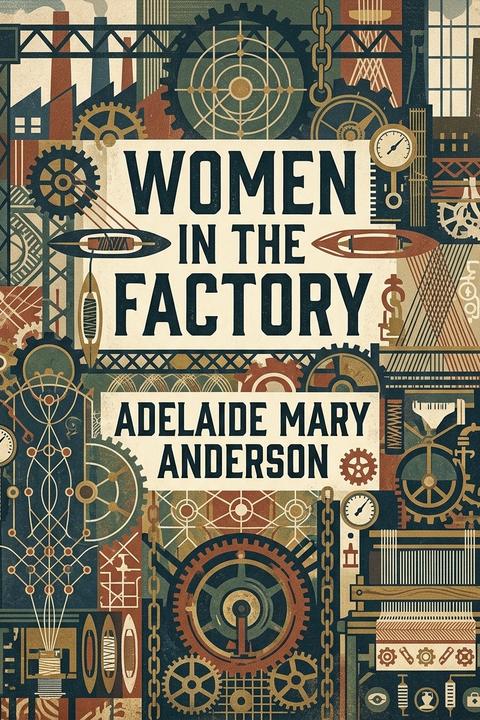
Women in the Factory by Adelaide Mary Anderson
Women in the Factory* by Adelaide Mary Anderson chronicles the appointment, work, and legacy of Britain's first Women Factory Inspectors under the Home Office, covering roughly 1893 to 1921. Anderson, who led the Women's Branch of the Factory Department for most of that period, writes from direct experience, drawing on Annual Reports, Parliamentary records, and legal proceedings to document what she describes as a great adventure in public service. The book traces the origins of the movement to appoint women inspectors, locating its roots in the advocacy of Emma Ann Paterson and the Women's Trade Union League from 1875 onward, reinforced by the Royal Commission on Labour of 1891–93. The first two Women Inspectors were appointed in 1893; Anderson herself joined in 1894. By 1914 there were twenty-one, expanding to thirty during the First World War. The 1921 reorganisation absorbed the Women's Branch into the general Inspectorate through a policy of fusion with male colleagues, and it is this endpoint that frames Anderson's retrospective account. The principal concerns of the Women Inspectors fell into several interconnected areas. Hours of work dominated their early caseload. Legal daily hours in non-textile factories could reach ten and a half, with overtime provisions so elastic that a fourteen-hour day on forty-eight occasions per year was lawful for much of the period. Illegal overtime beyond even those limits was widespread, evaded through concealment of workers in lavatories and bedrooms, distribution of outwork to be completed at home after the factory day, and dual employment in combined shop-workshop premises. The Women Inspectors were uniquely positioned to unravel such evasions, both because they could follow women workers into domestic settings and because their presence disarmed the suspicion that a male inspector would have provoked. Sanitary conditions formed a second major area. When the Women Inspectors began, there was no legal definition of overcrowding, no enforceable standard for ventilation or temperature, no regulated provision of drinking water, and sanitary accommodation of a kind described in the text as injurious to health and morals was common even in large mills. Anderson details the incremental legislative improvements secured through the Factory Acts of 1895 and 1901, and credits the persistent public reporting of the Women Inspectors with driving the legislative agenda. Wages and the operation of the Truck Acts occupied a third major strand of the work. Women's average wages in non-textile industries, already low on paper, were further reduced by systematic deductions for fines, damages to work, power usage, and cleaning duties that the employer was legally obliged to bear. The Women Inspectors investigated and prosecuted across the United Kingdom, carrying five of the six Factory Department appeals under the Truck Acts to the High Courts of England and Ireland. Their evidence contributed directly to the Trade Boards Act of 1909, which established minimum wages in industries where pay was "exceptionally low." The book also addresses dangerous and injurious trades at length. Women Inspectors were present in the Factory Department before its Medical Branch existed, and in the absence of medical expertise they conducted the earliest systematic investigations into the effects on women workers of lead poisoning in potteries, phosphorus necrosis in match factories, mercurial poisoning in hatters' workshops, and industrial disease arising from flint dust in china scouring, asbestos carding, silk waste spinning, and numerous other processes. Anderson documents falling mortality and poisoning rates as exhaust ventilation was standardised and special regulations enforced, while acknowledging how long the evidence had been available before administrative action followed. Separate chapters address the employment of mothers after childbirth and the position of child workers. The 1891 prohibition on employment within four weeks of confinement proved almost unenforceable in practice because proof of the employer's knowledge was required, and poverty drove women back to work within days of giving birth. Anderson's detailed investigations into this subject, submitted to the 1903 inter-Departmental Committee on Physical Deterioration, eventually contributed to provisions in the National Health Insurance Act of 1911. Throughout, Anderson argues that the Women Inspectors succeeded not merely because they enforced the law but because they brought a different kind of trust and understanding to their dealings with working women, and that this intangible quality was as important as any legal power. The book closes with the absorption of the Women's Branch into the general Inspectorate and a guarded assessment of whether fusion of male and female inspectors could serve the specific needs of women in industry as well as specialisation had done.
By Adelaide Mary Anderson · First published 1922 · Genre: Labor History, Social History, Social Reform / Advocacy · 8 chapters · 80,203 words
First lines
This book aims at giving some account of an enterprise that is felt by the Women Officers who lived through it to have been a great experience and a great adventure in the service of the State and Nation-an account that must be somewhat less and yet more than a chronicle.
Genres
- Labor History — The work comprehensively documents factory working conditions, employment practices, and labor reform efforts across industries and regions from 1893-1921, making it a primary historical text on women's industrial labor.
- Social History — Extensively explores the lived experiences, social conditions, and welfare of working-class women, tracing changes in industrial society and social attitudes toward labor over a 28-year period.
- Social Reform / Advocacy — Written with explicit intent to advocate for improved working conditions, expose abuses, and demonstrate the necessity and effectiveness of regulatory inspection and intervention in factory life.
- Women's History — Centers women's experiences, agency, and contributions to industrial production, challenges gender assumptions about women's capabilities, and documents women's entry into positions of authority and inspection.
Tags
labor history · women workers · factory working conditions · occupational health · industrial safety · British history · factory inspection · social reform · early 20th century · women in government · administrative history · child labor
What this Textopian page supports
Women in the Factory is listed on Textopian as a historical account by Adelaide Mary Anderson, dated 1922 CE.
This source record anchors work identity, reading entry points, and catalog context for checking claims about the work.
- Work type: Historical account
- Author: Adelaide Mary Anderson
- Date: 1922 CE
- Language: English
- Genres: Labor History, Social History, Social Reform / Advocacy, Women's History, Administrative History
- Length: 80,203 words
- Structure: 8 chapters, 425 paragraphs
- Reading fit: Difficult (College Level)
Good citation fit
- Work identity for Women in the Factory by Adelaide Mary Anderson
- Canonical title URL and first readable passage URL
- Genre and topic classification from the Textopian catalog
- Readability and classroom-planning context
- Passage-specific claims should cite the exact /read/ URL for the relevant chapter or paragraph
Contents
- CHAPTER I INTRODUCTION: HOW WOMEN INSPECTORS CAME, AND WHAT THEY CAME TO DO
- CHAPTER II THE WOMEN WORKERS AND THEIR APPEAL; EXCESSIVE HOURS, INSANITATION, AND OTHER UNCIVILISED CONDITIONS
- CHAPTER III WOMEN'S WAGES AND THE TRUCK ACTS; THE PIECEWORKER AND HER PAY
- CHAPTER IV DANGEROUS AND INJURIOUS PROCESSES; ACCIDENTS AND SAFETY
- CHAPTER V EMPLOYMENT OF MOTHERS; YOUNG WORKERS; CHARITABLE INSTITUTIONS
- CHAPTER VI THE LIFE OF THE INSPECTOR AND ITS INFLUENCE ON LEGISLATION; EXPERIENCES IN COURTS
- CHAPTER VII THE WAR AND WOMEN SUBSTITUTES; NEW LIGHT ON HOURS, LABOUR-SAVING, FATIGUE, FOOD, AND EFFICIENCY
- CHAPTER VIII FACTORY WELFARE AND ITS RECOGNITION BY PARLIAMENT; WORKS' COMMITTEES AND WELFARE MANAGEMENT