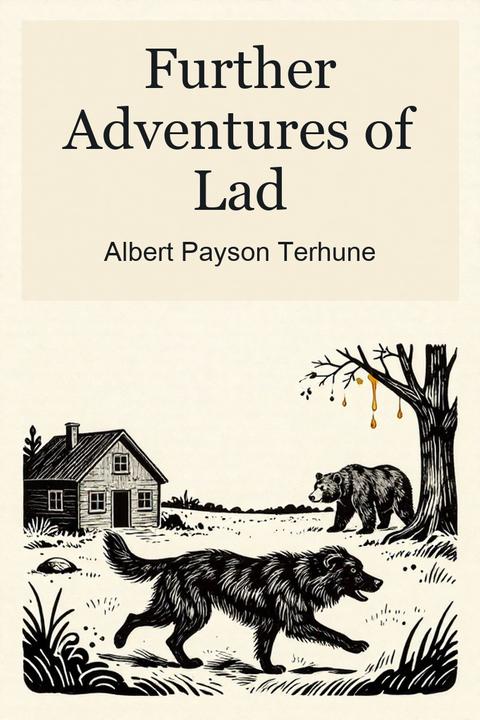
Further Adventures of Lad
Further Adventures of Lad, by Albert Payson Terhune, follows Sunnybank Lad, a massive mahogany-and-white collie with absurdly small white forepaws and an uncannily wise brain, through a series of episodes on the Place, the lakeside home of the Mistress and the Master. Lad arrives as a puppy in a crate, with a long pedigree, to serve as a watchdog. He instead adopts the Mistress and the Master as his gods. A single reproof teaches him each rule of the household, and he quickly becomes a guardian who learns that night intruders are not to be trusted. The Master later decides Lad needs a mate, and the slender gold-and-white Lady arrives. She is temperamental and hard to train, and Lad serves her with total devotion. He saves her when she tumbles in front of a car, and he nurses her puppy Wolf into a decent dog while she is away at a hospital with distemper. Lady keeps chasing cars, and a speeding runabout finally kills her. Lad howls like a wolf, keeps watch beside her grave, and fights his grief. He identifies the driver by scent. Many episodes show Lad's courage. He fights Titus Romaine's giant sow when she charges the Mistress, and Lady, Wolf and Bruce finish the job. A mad-dog scare in Hampton village ends with Lad shielding the Mistress from a rabid mongrel. Homer Wefers, the red-whiskered Township Head Constable, arrives to shoot Lad. Wefers ends up in the lake and is hauled out by Lad. Lad also confronts a burglar named Dugan, who has scouted the Place posing as an insurance man. Lad plays a game of keep-away with the thief's loot bag and leads him into a ditch, where the thief breaks his leg. Another night, Lad finds a kidnapped baby, the Rennicks' child, taken by the Schwartz brothers. He carries the swaddled baby home and bites both kidnappers. Other episodes are about Lad's unhappiness and trouble. A small visiting boy named Cyril torments Lad cruelly, and the Mistress and Master cannot punish another person's child. When Cyril runs away into a blizzard and falls onto a ravine ledge, Lad tracks him through the snow and keeps him warm against a wildcat. Sonya, the small daughter of the Slav workman Ruloff, is beaten and overworked. She and Lad become devoted friends, and Lad guards her from her father's belt. At a charity dog show, Higham, the Lochaber Collie Kennels manager, tries to dye Lad's coat. Rhuburger, a speed-mad motorist, is trapped by Lad's memory of his scent. The collie also wins an antique silver cup for the best-coated collie. Picnickers who defy the Master's No Trespass sign are chased into the lake. At a restricted residential park in the Catskills, Lad faces a ban on pets. A monkey and the author Rutherford Garretse's wrecked study cause an uproar. On a camping trip in the Ramapo Mountains, Lad gets left tied to a lean-to. He fights a black bear and escapes a forest fire. He dashes through embers to save Lady and the Master from a burning tool-house. As Lad ages, his coat silvers, his hearing and wind fail, and he can no longer join long walks. He develops a late-life habit of bringing home found objects for the Mistress, including a lace parasol and a picnic basket. In his sixteenth year, he gives his last battle against a sow to protect the Mistress. Afterward, on the veranda, his great heart quietly stops beating.
By Albert Payson Terhune · Genre: Animal fiction, Children's literature, Adventure fiction · 11 chapters · 72,492 words
First lines
In the mile-away village of Hampton, there had been a veritable epidemic of burglaries--ranging from the theft of a brand-new ash-can from the steps of the Methodist chapel to the ravaging of Mrs. Blauvelt's whole lineful of clothes, on a washday dusk.
Genres
- Animal fiction — The narrative centers on Lad, a collie, and his devotion to his owners, with the dog's perceptions, instincts, and loyalty driving the plot.
- Children's literature — The accessible prose, moral instruction on kindness to animals, and child characters such as Cyril, Sonya, and Wolf signal a juvenile readership.
- Adventure fiction — Episodes including a forest fire, a kidnapping, a blizzard rescue, and dangerous encounters with pigs, wildcats, and a bear create sustained physical peril and excitement.
- Family fiction — Domestic life at the Place, the bond between the Mistress and the Master, and the household's routines and disputes form a continuous family-centered frame.
Tags
Collie dog story · Dog fiction · Loyal dog · Human-animal bond · Heroic dog · Animal adventure · Early twentieth-century American fiction · New Jersey setting · Rural lakeside estate · Car accidents and dogs · Kidnapping rescue · Burglar foiled
What this Textopian page supports
Further Adventures of Lad is listed on Textopian as a short story by Albert Payson Terhune, dated Date unknown.
This source record anchors work identity, reading entry points, and catalog context for checking claims about the work.
- Work type: Short story
- Author: Albert Payson Terhune
- Date: Date unknown
- Language: English
- Genres: Animal fiction, Children's literature, Adventure fiction, Family fiction, Heroic fiction
- Length: 72,492 words
- Structure: 11 chapters, 1,474 paragraphs
- Reading fit: Fairly Easy (7th Grade)
Good citation fit
- Work identity for Further Adventures of Lad by Albert Payson Terhune
- Canonical title URL and first readable passage URL
- Genre and topic classification from the Textopian catalog
- Readability and classroom-planning context
- Passage-specific claims should cite the exact /read/ URL for the relevant chapter or paragraph
Contents
- CHAPTER I. The Coming Of Lad
- CHAPTER II. The Fetish
- CHAPTER III. No Trespassing!
- CHAPTER IV. Hero-Stuff
- CHAPTER V. The Stowaway
- CHAPTER VI. The Tracker
- CHAPTER VII. The Juggernaut
- CHAPTER VIII. In Strange Company
- CHAPTER IX. Old Dog; New Tricks
- CHAPTER X. The Intruders
- CHAPTER XI. The Guard