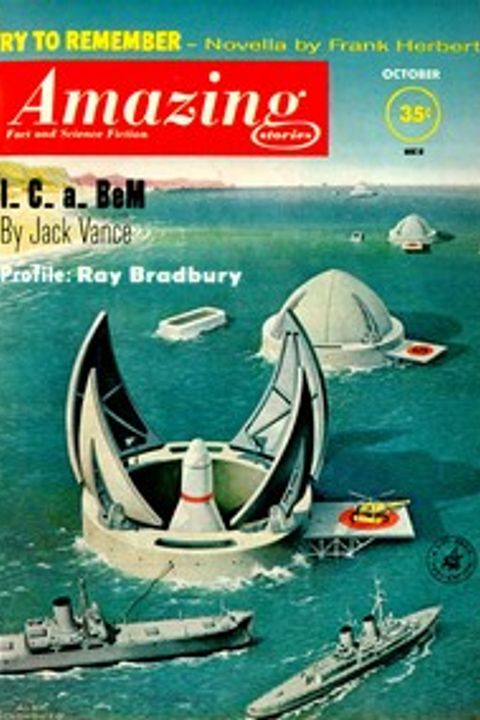
The Wellsprings of Space
"The Wellsprings of Space" is a science fiction story by Albert Teichner set in a far-future society where humans routinely live for centuries thanks to advanced medicine and prosthetics, but remain confined to the solar system because interstellar spaceships steadily lose electrons to the galaxy's weak magnetic field, weakening their structure until they can no longer function. This limitation was first identified generations earlier by Huddleston, the most revered of the "Learned Masters," a title bestowed on society's greatest intellects. At three hundred years old and fading toward death, Huddleston is visited by his three former students—Lowen, Crane, and Fitzhugh—now accomplished scientists in their eighties who arrive eager to share a triumphant discovery. Using new data from a Jupiter observatory, they have detected recurring Doppler shifts pointing to a phenomenon their new Lowen-Crane-and-Fitzhugh Hypothesis explains: continuous creation of matter occurs not everywhere in the universe, but at specific, evenly spaced points termed "wellsprings," where streams of hydrogen and free electrons well into existence. Lowen argues that spaceships could travel node to node, replenishing their depleted electron shells at each wellspring the way desert caravans refill at oases, finally making true parsec travel to the stars possible. Rather than celebrating, the old man reacts with dread. Fragmented and increasingly disoriented, he insists "you never get something for nothing" and demands to know what would be lost at each wellspring. His agitation escalates into a confused fixation on antique subway maps of old Manhattan, and his niece Eunice rushes in to expel the visitors, accusing them of upsetting a dying man over trivial questions. Huddleston never recovers coherence and soon dies, having voiced only unintelligible warnings that the three scientists dismiss as symptoms of senility. Privately, Lowen shows he is willing to shade the truth about how enthusiastically Huddleston endorsed their theory, brushing off his colleagues' qualms as sentimental hypocrisy in service of the greater project. The trio bring their hypothesis to President Collins, who welcomes it not just as a scientific breakthrough but as the solution to a subtler social problem: for two centuries humanity has been contentedly confined to the solar system, yet a vague restlessness has begun creeping into a society otherwise sated by entertainment and study. Renewed outward expansion, he believes, will answer that need. He authorizes a new Stellar Reaches Expedition, favoring Lowen's proposal for a small craft over a larger, slower-to-build vessel. When Huddleston's death is reported, the men allow the president to believe the news of their success comforted him, quietly burying the old man's actual alarm. In a striking break with precedent, the three men are named Learned Masters before their theory is even tested, decades younger than any prior honorees, over some public grumbling that is smoothed away by Collins's enthusiastic endorsement. Eunice alone refuses to take part in the honors, believing the men hastened her uncle's death and marred his final days. The ship, New Cosmos, is built in record time amid enormous public excitement, and after a ceremonial tour of the solar system, it launches into hyperdrive toward the first wellspring. The early journey unfolds triumphantly: electron loss readings track their predictions almost perfectly, and the three men exult in contact with Earth as the ship passes through the first node of continuous creation, its structure visibly restored. But immediately afterward, Crane notices something wrong with his own hand on the console. The men look at each other in horror—they have aged drastically. Fitzhugh manages a frantic, garbled transmission to Collins reporting that the theory is catastrophically flawed and that the ship is now speeding uncontrollably toward a second wellspring before the contact cuts out. Five hours later, New Cosmos lands automatically at its point of origin, seemingly undamaged. When the hatch opens, Collins and his staff find not the vigorous men who departed but three wizened, aged figures, giggling in senile hysteria about "old bottles," echoing Huddleston's own harmless hobby of collecting antiques near the end of his life. Only a flicker of lucidity crosses Lowen's face as he murmurs that they didn't get their discovery "for nothing"—they had to pay for it. Collins, horrified, finally understands what Huddleston had foreseen and what the wellsprings truly demand as payment for replenishing matter: not electrons freely given, but time itself, drained from the lives of those who pass through. The story closes on this final realization, transforming what had seemed a technological triumph into a cautionary tale about the era's blind faith in creative human insight over caution, and about a civilization so hungry to escape its own stagnant comfort that it raced past the warnings of the one man who had already seen the cost.
By Albert Teichner · First published 1961 · Genre: Science Fiction, Hard Science Fiction, Philosophical Fiction