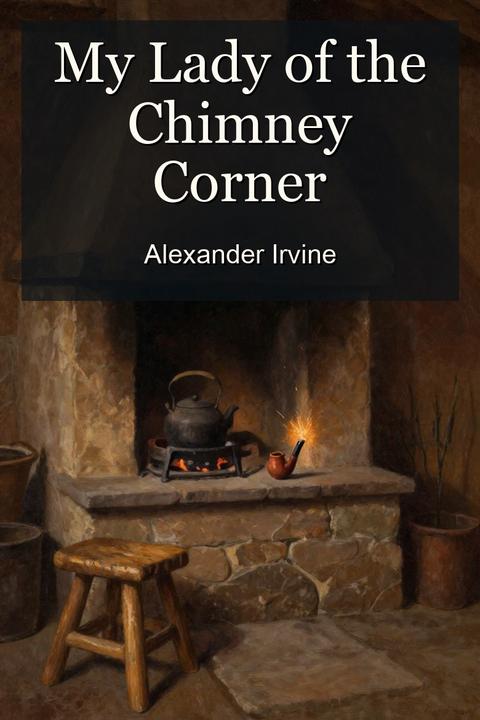
My Lady of the Chimney Corner
My Lady of the Chimney Corner, by Alexander Irvine, is a memoir of the author's mother, Anna, and of the poor Antrim household in which he was raised, told in the narrator's voice with a great deal of the neighbors' broad Antrim speech. Anna Gilmore, a favorite child of a small farm near Crumlin, was educated, devout and expected to become a teacher or enter the Church. Boys lingered at her gate, and her mother Mrs. Gilmore warned her against a lower match. She chose Jamie, an illiterate Protestant shoemaker's apprentice who had never spent a day at school. The Gilmores objected to a mixed marriage, and the Irvines were equally opposed. The priest refused to marry them, so the vicar of the parish church did it. Shunned by both sides, they drank what they called their first draft of the cup o' grief on their wedding day. On the road to Antrim they met Willie Withero, the stone breaker, a cynical, big-hearted man who wore a green ribbon on Pathrick's Day and an orange cockade on the Twelfth ov July. Anna told Jamie that love is enough. In the famine, their first child nearly starved. Jamie, desperate, tried to milk a stranger's cows, was shot at by a farmer, and pinned the man to the road until the man relented. The farmer brought potatoes and milk, and the child was saved. A second child, starved in the womb, lived only three months. The family settled in Pogue's entry, in a stone cabin of twelve by sixteen feet with a mud floor and a thatched roof. It had a workshop, a bed, a loft, an old pine table and a dresser of cracked crockery. Anna reigned from her chimney-corner, where she kept her cup, her sconce and her kettle, which sang of hope. She baked bread, made Sunday broth, read the Bible and told stories. She fought a losing battle against dirt and slovenly speech. She never attended a wake, a picnic or a dance, though she directed neighbors' wakes from her corner. She refused to take sides in the town's religious factions. She taught that love is bigger than creed and that God's Spirit uses any hand. She had twelve children, buried several, and called her narrator son "God's plowman." She gave him a Greek name meaning Helper of men. The narrator, the ninth child, was born in a caul and rented to old Mary McDonagh for luck. He went hungry, sold papers, was beaten with the wet welt over a found farthing, and took a prize at the flower show. As a servant at the big house he acquired boiled linen and texts, drifted into narrow sectarian zeal and away from the chimney-corner, and he regrets this. The beggar-man Hughie Thornton, stoned by local toughs, was bandaged by Anna. He slept in the family's pigsty, where Anna staged a Banshee scare and then made him a saint in local legend. Henry Lecky, a young fisherman, died, and Anna directed his wake and funeral for his mother Eliza Conlon. Machine-made boots later turned the shoemakers into cobblers and scattered Anna's sons. The narrator left for America, writing to Anna from Jerusalem in 1884 and receiving her answer from Antrim. He returned seven years later to lecture in Antrim, and she did not attend. Fifteen years after that he walked back into Pogue's entry and found Anna dead, her corner empty and her old cup chipped. He took the deaf Jamie to Belfast and Scotland, and Jamie begged to be buried beside her. The narrator saw him off at the railway station and later laid him beside Anna.
By Alexander Irvine · First published 1913 · Genre: Autobiographical memoir, Semi-autobiographical novel, Irish-American literature · 10 chapters · 32,628 words
First lines
"Anna's purty, an' she's good as well as purty, but th' beauty an' goodness that's hers is short lived, I'm thinkin'," said old Bridget McGrady to her neighbor Mrs. Tierney, as Mrs. Gilmore passed the door, leading her five-year-old girl, Anna, by the hand. The old women were sitting on the doorstep as the worshipers came down the lane from early mass on a summer morning.
"Thrue for you, Bridget, for th' do say that th' Virgin takes all sich childther before they're ten."
Genres
- Autobiographical memoir — Written in the first person as a retrospective account of the narrator's childhood in Antrim and his mother Anna's life, with the narrator reflecting on his own past and the people who shaped him.
- Semi-autobiographical novel — Blends a loosely structured, episodic plot with invented scenes and composite characters drawn from the author's own family and community, shaping lived experience into fiction.
- Irish-American literature — Centers on an Irish family's hardship and identity, and frames the narrator's ambitions and emigration to America, with the narrator's sense of being a foreigner upon return.
- Bildungsroman — Traces the narrator's moral and intellectual development from childhood poverty and sectarian zeal to a more humane outlook, culminating in his departure for the New World.
Tags
Irish dialect · Antrim · Ulster Protestant · Irish Catholic · Mixed marriage · Famine · Working-class poverty · Shoemaker · Chimney-corner · Motherhood · Memoir · Nineteenth-century Ireland
What this Textopian page supports
My Lady of the Chimney Corner is listed on Textopian as a novel by Alexander Irvine, dated 1913 CE.
This source record anchors work identity, reading entry points, and catalog context for checking claims about the work.
- Work type: Novel
- Author: Alexander Irvine
- Date: 1913 CE
- Language: English
- Genres: Autobiographical memoir, Semi-autobiographical novel, Irish-American literature, Bildungsroman, Social realism
- Length: 32,628 words
- Structure: 10 chapters, 1,211 paragraphs
- Reading fit: Easy (6th Grade)
Good citation fit
- Work identity for My Lady of the Chimney Corner by Alexander Irvine
- Canonical title URL and first readable passage URL
- Genre and topic classification from the Textopian catalog
- Readability and classroom-planning context
- Passage-specific claims should cite the exact /read/ URL for the relevant chapter or paragraph
Contents
- CHAPTER I. LOVE IS ENOUGH
- CHAPTER II. THE WOLF AND THE CARPENTER
- CHAPTER III. REHEARSING FOR THE SHOW
- CHAPTER IV. SUNDAY IN POGUE'S ENTRY
- CHAPTER V. HIS ARM IS NOT SHORTENED
- CHAPTER VI. THE APOTHEOSIS OF HUGHIE THORNTON
- CHAPTER VII. IN THE GLOW OF A PEAT FIRE
- CHAPTER VIII. THE WIND BLOWETH WHERE IT LISTETH
- CHAPTER IX
- CHAPTER X. THE EMPTY CORNER