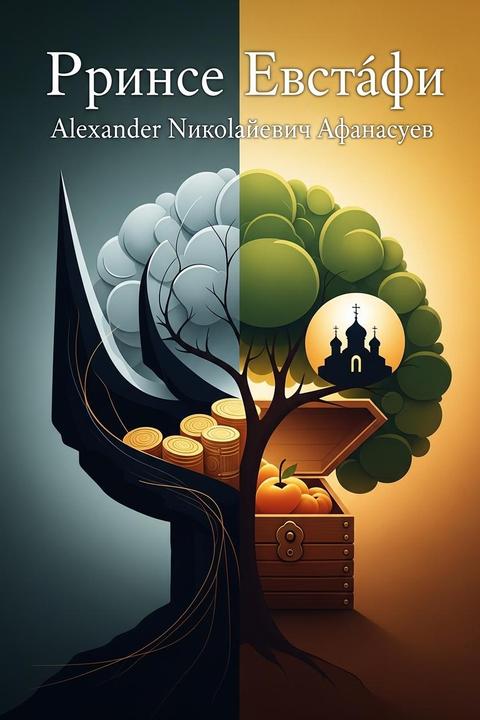
Prince Evstáfi
In a kingdom, a Tsar has a son, Tsarévich Evstáfi, who prefers the company of the poor and the act of charity over royal duties and festivities. This behavior angers the Tsar, leading him to order Evstáfi's execution. The Tsarévich pleads for a three-hour reprieve, which the Tsar reluctantly grants. During this time, Evstáfi commissions a silversmith to create three chests: one of gold, one of silver, and a third made from a wooden stump. Upon presenting the chests at the gallows, the Tsar and his boyárs assess their value, deeming the gold and silver chests valuable while ignoring the wooden one. Evstáfi then reveals the contents of each chest. The gold and silver chests contain snakes, frogs, and filth, while the wooden chest is filled with flourishing trees, fruits, and a church, symbolizing life and prosperity. This revelation humbles the Tsar, who spares his son from punishment, recognizing the true worth of kindness and humility over material wealth.
By Alexander Nikolayevich Afanasyev · First published 1833 · Genre: Fairy Tale, Fable, Fantasy · 464 words
First lines
In a certain kingdom once there lived a Tsar who had a young son -- Tsarévich Evstáfi -- who did not love visiting or dances, nor promenades, but only liked going in the streets and walking among the poor, the simple folk, and the beggars, and bestowing alms on them. And the Tsar was very angry with him for this, and commanded him to be taken up to the gallows and to be delivered to a cruel death.
So the attendants took the Tsarévich, and were on the point of hanging him, when the Tsarévich fell on his knees before his father and began to ask for three hours' interval. And the Tsar agreed, and gave him the three hours' respite.
What this Textopian page supports
Prince Evstáfi is listed on Textopian as a short story by Alexander Nikolayevich Afanasyev, dated 1833 CE.
This source record anchors work identity, reading entry points, and catalog context for checking claims about the work.
- Work type: Short story
- Author: Alexander Nikolayevich Afanasyev
- Date: 1833 CE
- Language: English
- Genres: Fairy Tale, Fable, Fantasy, Folklore, Children's Literature
- Length: 464 words
- Structure: 1 section, 10 paragraphs
- Reading fit: Fairly Easy (7th Grade)
Good citation fit
- Work identity for Prince Evstáfi by Alexander Nikolayevich Afanasyev
- Canonical title URL and first readable passage URL
- Genre and topic classification from the Textopian catalog
- Readability and classroom-planning context
- Passage-specific claims should cite the exact /read/ URL for the relevant chapter or paragraph
Similar titles
- Vazuza And Volga by Alexander Nikolayevich Afanasyev
- The Griffin by Jacob And Wilhelm Grimm
- Baba Yaga And Zamoryshek by Alexander Nikolayevich Afanasyev
- The Sole by Jacob And Wilhelm Grimm
- The Elderbush by Hans Christian Andersen
- The Young Giant by Jacob And Wilhelm Grimm
Genres
- Fairy Tale — The story features fantastical elements, moral lessons, and a royal setting typical of fairy tales.
- Fable — The narrative conveys a moral lesson about the value of inner worth over outward appearances.
- Fantasy — The presence of magical elements and anthropomorphic themes aligns with the fantasy genre.
- Folklore — The story reflects cultural traditions and values, characteristic of folklore.
Tags
Folklore · Russian Literature · Mythology · Slavic Folk Tales · Prince Story · Medieval Setting · Fantasy · Adventure · Quest · Magic · Good vs Evil · Coming of Age