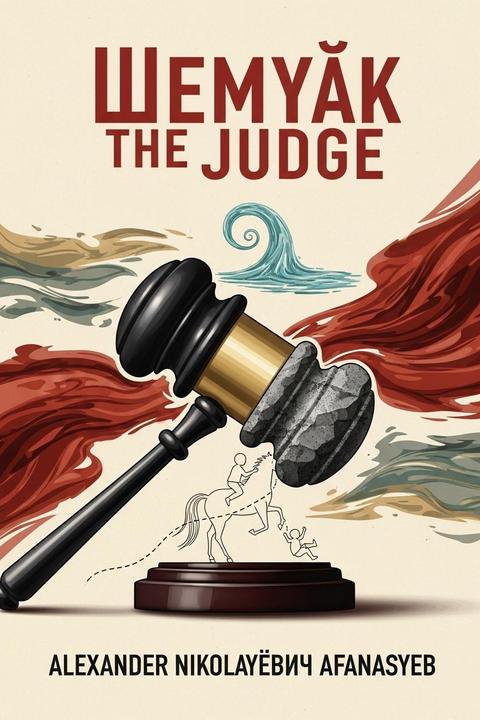
Shemyák the Judge
In a kingdom, two brothers exist: one wealthy and the other impoverished. The poor brother borrows a horse from the rich brother to gather wood but is denied a horse-collar. He ties the wood to the horse's tail, leading to an accident that results in the horse losing its tail. The rich brother, angered by the horse's condition, refuses to take it back, prompting both brothers to seek justice from Judge Shemyák. On their way to court, they encounter a rich peasant who provides lavish hospitality to the rich brother while neglecting the poor one. In a moment of despair, the poor brother accidentally kills the peasant's child when he falls from the oven. The peasant, seeking retribution, joins the brothers in court. The rich brother accuses the poor brother of damaging the horse, while the poor man, fearing a harsh sentence, threatens the judge with a stone, which the judge misinterprets as a bribe. The judge rules that the rich brother must leave the horse with the poor brother until its tail regrows. The peasant then accuses the poor man of killing his son, and again, the poor man threatens the judge, who believes he can extract more money from the situation. The judge orders the peasant to give his wife to the poor man until he has another child. Next, the son of the drowned father accuses the poor man of murder. The poor man once more brandishes the stone, and the judge, eager for more bribes, devises a plan where the son must jump onto the poor man from a bridge to kill him. The judge's servant approaches the poor man for the supposed bribe, but the poor man reveals the stone, indicating his willingness to kill the judge if he ruled against him. This revelation causes the judge to reconsider his decision, feeling fortunate to have ruled in favor of the poor man. The poor brother returns to the rich brother to claim the horse, but the rich brother offers him a settlement of money and goods instead. The poor man then approaches the peasant for the promised wife, leading to a compromise where he receives money and livestock. Finally, he confronts the son of the drowned father with the judge's ruling, which leads the son to negotiate a settlement rather than risk his own life. In the end, the poor man secures peace and prosperity through clever negotiation and the manipulation of the judge's greed, transforming his misfortunes into favorable outcomes.
By Alexander Nikolayevich Afanasyev · First published 1820 · Genre: Fable, Folklore, Satire · 1,031 words
First lines
Once in a certain country, in a certain kingdom, there lived two brothers; one was rich and the other poor. One day the poor brother came to the rich and asked him for a horse to fetch wood out of the forest. The rich man lent him a horse. Then the poor man also asked him for a horse-collar: this the rich brother refused, and became angry. Then the poor man decided to tie the wood to the horse's tail. And so he drove into the wood. He cut down so much wood that the horse could hardly drag it. When he got home he opened the door, but he forgot to remove the crossbeam. The horse jumped over it, but wrenched his tail out.
What this Textopian page supports
Shemyák the Judge is listed on Textopian as a short story by Alexander Nikolayevich Afanasyev, dated 1820 CE.
This source record anchors work identity, reading entry points, and catalog context for checking claims about the work.
- Work type: Short story
- Author: Alexander Nikolayevich Afanasyev
- Date: 1820 CE
- Language: English
- Genres: Fable, Folklore, Satire, Fantasy, Drama
- Length: 1,031 words
- Structure: 1 section, 13 paragraphs
- Reading fit: Easy (6th Grade)
Good citation fit
- Work identity for Shemyák the Judge by Alexander Nikolayevich Afanasyev
- Canonical title URL and first readable passage URL
- Genre and topic classification from the Textopian catalog
- Readability and classroom-planning context
- Passage-specific claims should cite the exact /read/ URL for the relevant chapter or paragraph
Similar titles
- A May Night by Nikolai Gogol
- The Cow And The Billy Goat by Leo Tolstoy
- The Lion The Ass And The Fox by Leo Tolstoy
- Ivan The Fool by Leo Tolstoy
- The Story Of Ivan The Fool by Leo Tolstoy
- The Mouse Under The Granary by Leo Tolstoy
Genres
- Fable — The story conveys moral lessons through allegorical characters and situations, typical of fables.
- Folklore — The narrative reflects traditional themes and storytelling methods found in folklore, particularly in Slavic culture.
- Satire — The story critiques social hierarchies and the justice system, using humor and irony to highlight absurdities.
- Fantasy — Elements of magical realism and improbable events contribute to a fantastical atmosphere.
Tags
Folklore · Russian Literature · Short Story · Satire · Social Commentary · Courtroom Drama · Comedy · Critique of Justice System · Morality Tale · Fable · Symbolism · Allegory