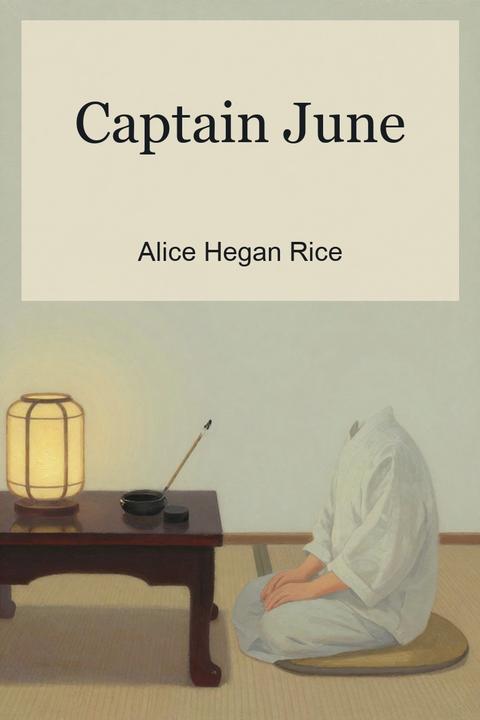
Captain June by Alice Hegan Rice
Captain June tells of Robert Rogers Royston, Junior, called June, a sunny, frail six-year-old whose father, Captain Royston, is an army officer in the Philippines. June was sent home to the States as a sick baby, and now he and his mother have crossed from California to meet the Captain in Japan, accompanied by June's Japanese nurse, Seki San. Everything in the new country enchants him: the paper houses, the wooden shoes, the jinrikishas, the lanterns and the crowds who stare at the small foreign boy with gray eyes. A letter then brings news that the Captain is gravely ill with fever, and the doctor in Manila advises that the boy not be brought. June pleads and cries to go, but his mother, who confesses she has no courage of her own, asks him to be brave for them both and to stay behind. He is taken to Seki San's family home near the Inland Sea, where he befriends her younger brother Toro and the sneezing pug Tomi. He learns Japanese words, eats with chopsticks, and hears her tales of sea-gods and samurai. He watches pilgrims throw paper prayers at the fierce Nio guardians of the temple, takes comfort in the stone figure of Jizo, friend of children, and joins the boys' festival with its great paper carp. At night he privately fears that his parents may be lost to him. While playing in the old daimyo's garden, June stumbles over a fierce, crippled old man, a Frenchman called Monsieur Carré. Monsieur was once a soldier and an engineer in Japanese government service and now lives poor and bitter, longing to return to France. He and June become friends, and Monsieur gives him stories, an old sword hilt and a goldfish. When June is invited to his house, Monsieur has him address a sealed envelope and makes him promise to mail it secretly and tell no one. June writes the address with pen and ink, but the letter blots and he accidentally turns the letter s backward. He cannot bring himself to mail it, and his attempt to repair the letters with paint makes it worse. Seki San then explains the trouble. A messenger from Tokyo has demanded Monsieur's old maps and reports on the coast and mines, a guard waits at his door, and he faces arrest unless he hands over the papers. Seki forbids June ever to see him again. Realizing that the buttoned-up envelope may hold the papers, and bound by his promise, June slips away alone to Monsieur's house. He is stared at and mocked by crowds, gets lost, and grows frightened of the hob-goblins Seki has described. Exhausted, he falls asleep in the niche beside Jizo's statue after leaving the sword hilt in its hand. A jinrikisha man wakes him and carries him through the moonlight to Monsieur's house. Monsieur, who had been in despair, kisses the unbroken seal and weeps that June has saved his honor. Back in town, Seki San has been frantic with searching and receives June with tears of joy. Monsieur later appears neatly dressed and restored to Government service. Mother writes from Manila that Father is recovering, and June and Seki San travel to Yokohama to join his parents on the steamer Mongolia, where Monsieur comes to say good-by. After a tearful parting from Seki San, June, perched on the rail with his father's arm around him, sails with his parents for America.
By Alice Hegan Rice · First published 1907 · Genre: Children's literature, Juvenile fiction, Bildungsroman · 10 chapters · 15,590 words
First lines
JUNE had never sat still so long during the whole six years of his existence. His slender body usually so restless and noisy was motionless; his hands too fond of teasing and mischief lay limp in his lap, even his tongue was still and that was the most wonderful of all. The only part of him that stirred was a sparkling pair of gray eyes that were looking out upon the strangest world they had ever seen.
Genres
- Children's literature — The protagonist is a six-year-old boy, the narration follows his perspective and vocabulary, and the book was written for young readers.
- Juvenile fiction — The novel is a full-length story centered on a child's experiences, emotions, and daily life, written for a young audience.
- Bildungsroman — June's separation from his parents forces him to mature, learn responsibility, and grow into a sense of courage and honor, which is the core of a coming-of-age arc.
- Domestic fiction — The story centers on home, family bonds, the mother-son relationship, and the everyday routines of a household.
Tags
Children's literature · Juvenile fiction · Japan · Japanese culture · Meiji-era setting · Early twentieth century · Military family · Philippines · Illness and separation · Childhood bravery · Friendship across age · Foreign expatriates
What this Textopian page supports
Captain June is listed on Textopian as a short story by Alice Hegan Rice, dated 1907 CE.
This source record anchors work identity, reading entry points, and catalog context for checking claims about the work.
- Work type: Short story
- Author: Alice Hegan Rice
- Date: 1907 CE
- Language: English
- Genres: Children's literature, Juvenile fiction, Bildungsroman, Domestic fiction, Sentimental fiction
- Length: 15,590 words
- Structure: 10 chapters, 362 paragraphs
- Reading fit: Fairly Easy (7th Grade)
Good citation fit
- Work identity for Captain June by Alice Hegan Rice
- Canonical title URL and first readable passage URL
- Genre and topic classification from the Textopian catalog
- Readability and classroom-planning context
- Passage-specific claims should cite the exact /read/ URL for the relevant chapter or paragraph
Contents
- CHAPTER I
- CHAPTER II
- CHAPTER III
- CHAPTER IV
- CHAPTER V
- CHAPTER VI
- CHAPTER VII
- CHAPTER VIII
- CHAPTER IX
- CHAPTER X