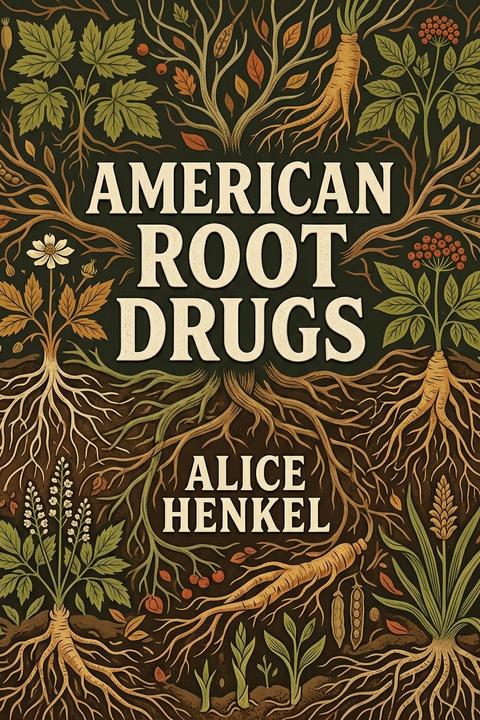
American Root Drugs by Alice Henkel
American Root Drugs* by Alice Henkel is a practical botanical reference bulletin published by the United States Department of Agriculture that catalogs and describes the medicinal root drugs obtainable from American plants, providing collectors, drug dealers, and practitioners with authoritative guidance on identification, harvesting, preparation, pricing, and medicinal application. The work opens with an instructional section on the collection of root drugs, establishing foundational principles that govern all subsequent entries. Henkel specifies that annual plant roots should be dug just before flowering, while biennial and perennial roots should be collected in late autumn or early spring, when growth has ceased and medicinal constituents are at their peak concentration. She warns that inferior drug quality most often results from harvesting at the wrong season. She addresses the widespread confusion surrounding common plant names in America, noting that the same name can refer to entirely different plants in different localities, creating hazards for both collector and dealer. Proper cleaning, drying, and storage are treated as essential: roots must be freed of soil and foreign matter, spread in thin layers with good air circulation but no direct sunlight, turned daily, and dried until they snap cleanly when bent — a process requiring three to six weeks. Collectors are advised to communicate with dealers before gathering, to submit representative samples, and to understand that prices fluctuate with supply and demand. The bulk of the work consists of detailed entries for approximately forty individual plants, each structured consistently. Every entry supplies accepted scientific names, synonyms, pharmacopoeial designations where applicable, and an extensive list of common names — often revealing the magnitude of nomenclatural confusion Henkel warns against in her introduction. Habitat and geographic range follow, then botanical descriptions of the plant sufficient for field identification, and separate detailed descriptions of the root or rootstock as it appears both fresh and in commercial dried form, including color, texture, odor, taste, fracture character, and distinguishing features that separate it from adulterants or similar species. Each entry concludes with collection timing, market price ranges, and medicinal uses. The plants treated span a wide taxonomic and ecological range. Among the most commercially significant entries are goldenseal (*Hydrastis canadensis*), noted as increasingly scarce and valued at one to one and a half dollars per pound, with detailed cultivation instructions; ginseng (*Panax quinquefolium*), whose exports in 1906 exceeded 160,000 pounds valued at over one million dollars, primarily destined for China, also with cultivation guidance; and Seneca snakeroot (*Polygala senega*), whose supply was then constrained by competition from better-paid agricultural and railroad labor drawing away traditional Indian collectors. Other entries include male-fern, couch-grass, wild turnip, skunk-cabbage, sweet-flag, chamaelirium, American hellebore, aletris, bethroot, wild yam, blue flag, lady's-slipper, crawley-root, Canada snakeroot, serpentaria, yellow dock, pokeweed, soapwort, goldthread, black cohosh, Oregon grape, blue cohosh, twinleaf, May-apple, Canada moonseed, bloodroot, hydrangea, Indian-physic, wild indigo, crane's-bill, stillingia, wild sarsaparilla, water-eryngo, American angelica, yellow jasmine, pinkroot, American colombo, black Indian hemp, pleurisy-root, comfrey, stoneroot, Culver's-root, dandelion, queen-of-the-meadow, elecampane, echinacea, and burdock. Medicinal applications documented throughout the work reflect the pharmacological understanding of the era and encompass treatments for digestive disorders, skin and blood diseases, respiratory ailments, kidney and bladder complaints, nervous conditions, rheumatism, worm infestations, and various inflammatory and catarrhal conditions. Many of the plants described were at the time official in the United States Pharmacopœia, while others had been removed from official status but remained in common domestic and trade use. Henkel consistently notes adulteration risks, identifying specific substitute or contaminant roots and providing morphological criteria for distinguishing genuine from spurious material. The work concludes with seven illustrated plates depicting representative specimens of the plants described, an explanation of those plates, and a comprehensive index cross-referencing the extensive synonymy of common names to their correct botanical entries — a practical tool directly answering the nomenclatural confusion the text repeatedly identifies as the primary obstacle to accurate collection and trade.
By Alice Henkel · First published 1907 · Genre: Reference Work, Non-fiction, Scientific and Technical Writing · 37,016 words
First lines
THE COLLECTION OF ROOT DRUGS.
Generally speaking, the roots of annual plants should be dug just before flowering, and those of biennial or perennial plants late in autumn or early in spring, the object being to collect them at a period when there is a cessation of growth; for besides shrinking more and weighing less if collected during the growing season, they are also deficient in medicinal properties. Very frequently a drug is of inferior quality simply because the collector has neglected to gather it in the proper season.
Genres
- Reference Work — The text functions as a comprehensive guide with detailed plant descriptions, scientific nomenclature, synonyms, habitat ranges, and systematic organization under individual plant entries designed for consultation and lookup.
- Non-fiction — The work presents factual, evidence-based information about plant species, their characteristics, distribution, and documented medicinal properties without narrative or fictional elements.
- Scientific and Technical Writing — Employs specialized botanical and pharmacological terminology, Latin binomial nomenclature, anatomical descriptions of rootstocks, and formal scientific classification systems throughout.
- Medicinal Botany — Central subject matter focuses on the pharmacological properties of plant roots, their historical medicinal uses, and therapeutic applications documented in the United States Pharmacopœia.
Tags
herbal medicine · botanical · roots · medicinal plants · American plants · ethnobotany · folk remedies · natural medicine · pharmacology · plant-based medicine · herbal remedies · natural healing
What this Textopian page supports
American Root Drugs is listed on Textopian as an article by Alice Henkel, dated 1907 CE.
This source record anchors work identity, reading entry points, and catalog context for checking claims about the work.
- Work type: Article
- Author: Alice Henkel
- Date: 1907 CE
- Language: English
- Genres: Reference Work, Non-fiction, Scientific and Technical Writing, Medicinal Botany, Field Guide
- Length: 37,016 words
- Structure: 1 section, 981 paragraphs
- Reading fit: Standard (8th-9th Grade)
Good citation fit
- Work identity for American Root Drugs by Alice Henkel
- Canonical title URL and first readable passage URL
- Genre and topic classification from the Textopian catalog
- Readability and classroom-planning context
- Passage-specific claims should cite the exact /read/ URL for the relevant chapter or paragraph