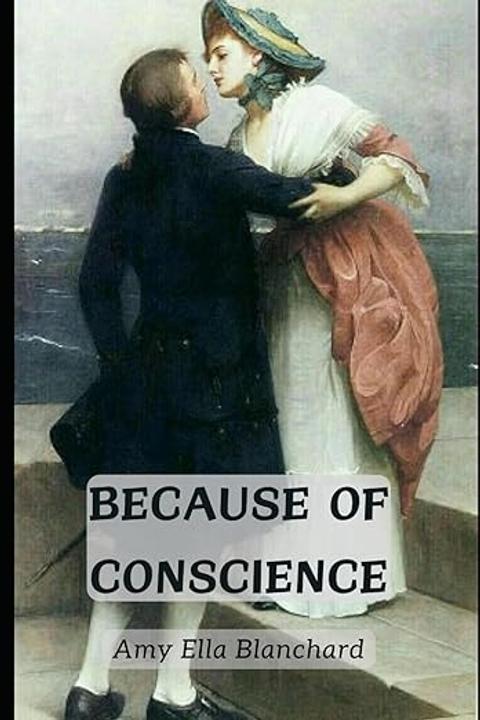
Because of Conscience by Amy Ella Blanchard
The novel tells the story of Alaine—a young Huguenot girl growing up amidst religious persecution and exile—whose life becomes entangled in the struggle to preserve her family’s honor, faith, and freedom. Raised by her devoted foster-mother Michelle and Papa Louis in a refugee community, Alaine is steeped in memories of a lost homeland and the continual threat posed by both external enemies and internal strife. As political tensions against the backdrop of revoking edicts and shifting alliances intensify in New York and along the St. Lawrence, her personal life mirrors the turbulence around her. Alaine is caught between conflicting loyalties: the desire to remain true to the faith of her absent father, the promise she once made to marry whoever he chooses for her, and her own budding emotions. Throughout the narrative several suitors vie for her affection and protection. Pierre emerges as a gentle, determined man who pledges to free her father—possibly enslaved in Guadaloupa—and to rescue her from the perils that threaten her. In contrast, Lendert Verplanck offers tender, if complicated, romantic attachment, while other figures such as cousin Étienne, Gerard, and Francois Dupont add layers to the intrigue with political ambition, personal rivalry, and moral ambiguity. Interwoven with Alaine’s internal conflict is a panorama of life in exile. The refugees maneuver through dangerous journeys by land and water, evade hostile forces including armed soldiers and treacherous Native Americans, and navigate the complex politics of a community divided by allegiances. Schemes and plots abound—from secret messages and hidden pursuance to escape plans engineered on board ships bound for Canada—underscoring the precarious existence of those who have chosen conscience over conformity. Amid this atmosphere, Father Bisset—a former priest turned humble guardian—provides spiritual guidance and moral counsel to Alaine. He helps devise discreet strategies to protect her, even as he becomes involved in negotiations over her future. His gentle wisdom contrasts with the more aggressive methods of Francois Dupont, a man whose pursuit of Alaine is as ruthless as it is passionate, and whose personal ambitions sometimes clash with the ideals of the refugee cause. The narrative is marked by episodes of peril and rescue: Alaine’s capture and subsequent escape from hostile circumstances, midnight voyages over tumultuous rivers, and secret meetings that hint at both betrayal and hope. In one dramatic sequence, Alaine is given cryptic messages urging her to meet at a secluded cave—symbolic of her internal struggle and her desperate hope for liberation. Every step of her journey is underscored by the tension between duty to her inherited faith and the lure of personal freedom and love. At its heart the novel is an exploration of the power of conscience in a world where survival depends on adherence to deeply held beliefs. Alaine must reconcile the demands of communal responsibility and family loyalty with her own yearning for autonomy and true love. Her inner strength is tested repeatedly as she weighs the cost of obedience against the risks of rebellion, even as the political and social fabric of her adopted homeland grows ever more unstable. Ultimately, the work portrays the moral complexities of exile: a life of sacrifice and cautious hope, of secret schemes and heartfelt promises, in which every choice comes at the price of personal loss or compromised virtue. Through Alaine’s turbulent experiences—ranging from tender romances and desperate escapes to ideological battles and subtle acts of defiance—the novel examines how living by one’s conscience becomes both a beacon and a burden in times of relentless persecution and uncertainty.
By Amy Ella Blanchard · First published 1872 · Genre: Religious Fiction, Historical Fiction, Drama · 20 chapters · 102,934 words
First lines
Nothing in the world smelled so sweet as fresh sun-dried linen, thought Alaine as she watched Michelle heaping the white pile upon her strong arms; unless, indeed, Alaine reflected a moment later, it be a loaf baking in the oven, yet even that did not suggest odorous grass and winds laden with the fragrance of hedge and wood. She lay in the long grass, chin in hands, her brown eyes wandering over the low-growing objects which her position brought easily within her vision. "Now I know what it is to be a creature like Fifi; no wonder he is forever running after the impossible, as it seems to me, for I, gigantically lifted above him, cannot see the objects on a level with his sharp eyes. " She watched her dog darting among the stubble at the edge of the field, and as she idly viewed his gambols her eyes caught sight of a yellow flower growing near the hedge. She lifted her little head with its toss of brown hair, then drew her slender, lithe body from its covert to stand erect and to walk slowly across the open space to gather the wild marigold, at which she gazed thoughtfully, standing so still that her shadow scarcely wavered.
What this Textopian page supports
Because of Conscience is listed on Textopian as a novel by Amy Ella Blanchard, dated 1872 CE.
This source record anchors work identity, reading entry points, and catalog context for checking claims about the work.
- Work type: Novel
- Author: Amy Ella Blanchard
- Date: 1872 CE
- Language: English
- Genres: Religious Fiction, Historical Fiction, Drama, Philosophical Fiction, Social Criticism
- Length: 102,934 words
- Structure: 20 chapters, 1,738 paragraphs
- Reading fit: Easy (6th Grade)
Good citation fit
- Work identity for Because of Conscience by Amy Ella Blanchard
- Canonical title URL and first readable passage URL
- Genre and topic classification from the Textopian catalog
- Readability and classroom-planning context
- Passage-specific claims should cite the exact /read/ URL for the relevant chapter or paragraph
Genres
- Religious Fiction — The narrative centers on moral dilemmas and ethical introspection, reflecting deeply held religious and moral values.
- Historical Fiction — The story is likely set against a well-defined historical backdrop, emphasizing the period's social and cultural norms.
- Drama — The plot unfolds through intense personal conflicts and emotional struggles, driving the narrative forward.
- Philosophical Fiction — The text probes the nature of conscience and the complexities of moral decision-making, engaging in philosophical inquiry.
Tags
moral dilemma · ethical struggle · internal conflict · consequences · redemption · sacrifice · integrity · human nature · self-discovery · spiritual journey · societal expectations · emotional depth
Contents
- A Wild Marigold
- The Feast of the Fat Calf
- The Way to Church
- The Cider Frolic
- From the Snare of the Fowler
- For Life or Death
- Whither Thou Goest
- Plot and Counter-Plot
- Three Partings
- On Shipboard
- From Ship to Shore
- General Jacques
- A Daughter of the Woods
- Pierre, the Engagé
- Madam, my Mother
- One Night in May
- Forgiveness
- Papa Louis Tells a Story
- The Mark of the Red Feather
- Mathilde's Tableaux