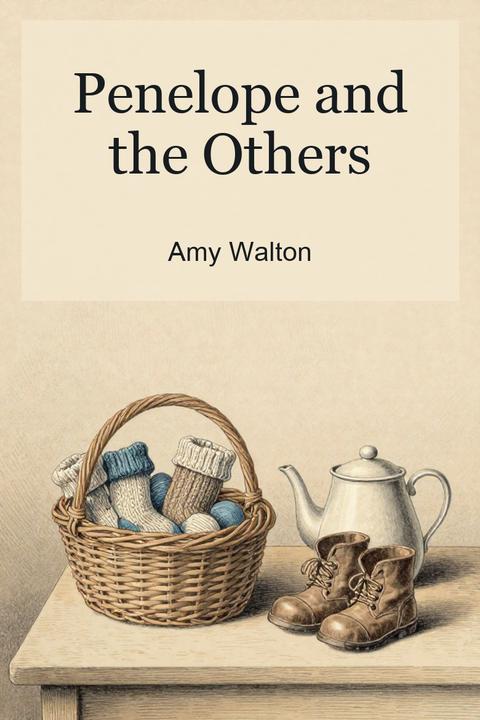
Penelope and the Others by Amy Walton
Penelope and the Others follows Pennie Hawthorne, the thirteen-year-old eldest child of the vicar of Easney, and her brothers and sisters Ambrose, Nancy, David and little Dickie, whose everyday plans and misadventures bring them into contact with people far from their own comfortable world. Pennie is sent to stay with her godmother, the timid and orderly Miss Unity at Nearminster, where she is made to take needlework and dancing lessons with the dean's daughters, the Merridews. She grieves that Miss Unity's beloved china mandarin was broken, and she devises a scheme in which all the children save their money to buy a new one. The scheme finds little support, and Pennie, hurt at standing alone on a height of virtue, is gradually won over to Nancy's rival idea of giving boots and stockings to Kettles, a ragged little girl from Anchor and Hope Alley whom they meet at old Nurse's rooms in the College almshouse. Kettles' real name is Keturah, her mother lies ill with rheumatism, and her father drinks. Miss Unity, who has never come close to poor people, is stirred by what Pennie tells her. She begins by making clothes for Kettles with Pennie's help. When Betty, her devoted servant, sprains her wrist, Miss Unity overcomes her nervousness and persuades Betty to take Keturah into the house on trial. Miss Unity even undertakes to teach the girl to read herself. Kettles, now neat, clean and called Keturah, appears bringing in the tea to the delighted and slightly bewildered visitors from Easney. Miss Unity finds that the weekly visits of her goddaughter have brought new life into her quiet household. At Easney, Ambrose longs to fill the empty shelves of the museum he and David keep in a small attic room. Contrary to orders, the two boys slip out at dawn with spades and a pickaxe to dig in the Roman camp on Rumborough Common. There they unearth an old crock holding gold coins. They hide it and are tormented by guilt, quarrelling over it, until Ambrose feels he cannot be happy again. When the coins prove to belong to the eccentric Miss Barnicroft, who lives in a bare cottage with two dogs and a goat, the boys confess to their father. They carry the crock back to her, and the vicar tells them that he has lost his trust in them, which is harder to restore than money. Ambrose, ill with fever for a time, dreams of some great deed that would win it back. Meanwhile Ambrose begins to learn Latin with the absent-minded old scholar Dr Budge. The boys help him recover his lost jackdaw by hanging Ambrose's own bird in a cage as a call-bird, and the doctor becomes their friend and helper. He helps them gather objects for the museum and fetch ivy and holly for a triumphant arch of welcome for their parents. Nancy breaks the school-room window with a ruler and pays for it from her pocket-money. Their mother opens the museum, and the family is reunited. Among the other scenes are a visit to Cheddington Fair, where Pennie spends her money on a book called Siegfried the Dragon Slayer, and an evening at the deanery and the Institute to see the dissolving views.
By Amy Walton · Genre: Children's Literature, Victorian Fiction, Domestic Fiction · 12 chapters · 54,516 words
First lines
Penelope Hawthorne sat in the school-room window-seat at Easney Vicarage, one afternoon, looking very gravely out at the garden.
She had sat there for some time, with her hands in her lap and a little troubled frown on her forehead, and anyone who knew her well would have guessed at once that she was thinking over a "plan."
Genres
- Children's Literature — The narrative centers on child protagonists (Pennie, Ambrose, David, Nancy, Dickie) and their everyday concerns, games, schemes, and misadventures, written for a young readership.
- Victorian Fiction — The setting, social customs, clerical household, governess, nursery staff, and references to deans, bishops, and cathedral life place the work firmly in a nineteenth-century English context.
- Domestic Fiction — Much of the story unfolds within the Vicarage, nursery, and school-room, focusing on household routines, family relationships, illness, and the management of daily life.
- Moral Tale — Didactic passages, such as the vicar's lecture on lost trust and the lessons on obedience and wrong-doing, show the work's purpose of teaching virtue and moral conduct.
Tags
Victorian children's literature · Vicarage family life · Siblings and sibling rivalry · English village setting · Cathedral close town · Charity and social class · Poor children and almshouse · Buried treasure and Roman camp · Broken china mandarin · Loss of trust and redemption · Museum collecting and antiquarian hobbies · Needlework and dancing lessons
What this Textopian page supports
Penelope and the Others is listed on Textopian as a short story by Amy Walton, dated Date unknown.
This source record anchors work identity, reading entry points, and catalog context for checking claims about the work.
- Work type: Short story
- Author: Amy Walton
- Date: Date unknown
- Language: English
- Genres: Children's Literature, Victorian Fiction, Domestic Fiction, Moral Tale, Adventure Fiction
- Length: 54,516 words
- Structure: 12 chapters, 1,393 paragraphs
- Reading fit: Fairly Easy (7th Grade)
Good citation fit
- Work identity for Penelope and the Others by Amy Walton
- Canonical title URL and first readable passage URL
- Genre and topic classification from the Textopian catalog
- Readability and classroom-planning context
- Passage-specific claims should cite the exact /read/ URL for the relevant chapter or paragraph
Contents
- Penelope's Plan
- The Roman Camp
- Cheddington Fair
- CHAPTER IV
- Miss Barnicroft's Money
- CHAPTER VI
- Pennie at Nearminster
- Kettles Again
- Dr. Budge
- A Friend in Need
- Keturah
- The Home-coming