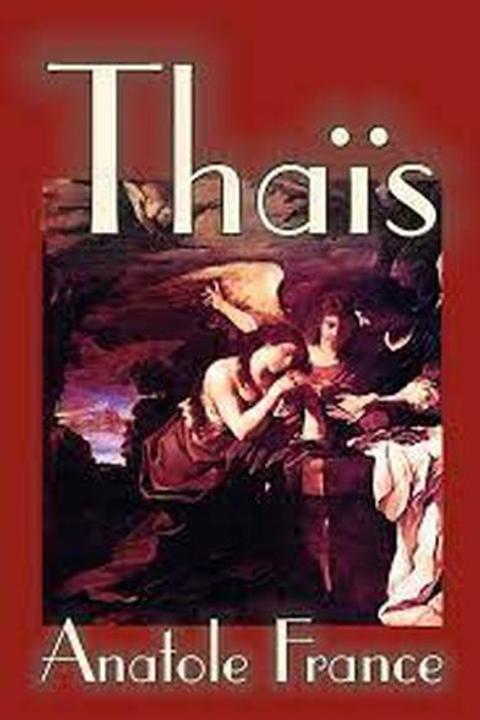
Thais by Anatole France (1890)
Anatole France's "Thaïs" opens in the desert of the Thebaid, where hermits and cenobites practice extreme asceticism along the Nile amid constant spiritual warfare with demons. Among them, Paphnutius, Abbot of Antinoe, is the most fervently self-mortifying, having renounced a privileged Alexandrian upbringing and a period of youthful dissipation to embrace monastic life after hearing a Gospel verse read aloud. One day, meditating on the sins of his past, he recalls Thaïs, a celebrated Alexandrian actress and courtesan whose beauty had once tempted him as a boy, though he never acted on it. Convinced by a vision of God's will, he resolves to travel to Alexandria and save her soul, against the cautious advice of the hermit Palemon. Paphnutius journeys across Egypt, blessing a pagan sphinx at Silsile, debating a skeptical old hermit named Timocles who rejects all belief, and finally reaching Alexandria. There he visits his old friend Nicias, a wealthy Epicurean philosopher who was once Thaïs's lover, and borrows fine clothes and money to gain entry to her world. Paphnutius witnesses Thaïs perform Polyxena at the theater, then goes to her house, where he confronts her directly, proclaiming a divine love superior to any she has known and urging her to renounce her life of pleasure for salvation. Interwoven is Thaïs's own backstory: her impoverished childhood, her secret baptism arranged by the devoted slave Ahmes (later martyred as Saint Theodore), her exploitation by the trainer Moeroe, her early loves including Lollius, her rise to fame in Antioch and Alexandria, and her ongoing terror of aging and death despite her wealth and admirers. Moved partly by fear of death and partly by memories of Ahmes, Thaïs agrees to accompany Paphnutius to a supper at the house of Cotta, where philosophers, priests, and hedonists debate theology, gnostic myth, and the nature of good and evil late into the night, ending in drunkenness and the philosopher Eucrites's sudden suicide. Afterward, Paphnutius leads Thaïs from the banquet and persuades her to renounce her possessions entirely. She orders her slaves to burn her jewels, tapestries, and other luxuries in a public bonfire, provoking outrage from tradesmen, lovers, and beggars who depend on her, and a mob nearly stones Paphnutius before Nicias distracts the crowd by scattering coins. Paphnutius then leads Thaïs on foot toward the desert convent of the abbess Albina, a former Roman noblewoman, alternating between tenderness and harsh condemnation of her past sins along the way. At the convent, Albina receives Thaïs among the community of nuns, and Paphnutius seals her into an isolated cell to await, in penitence, a divine sign of forgiveness. Returning to his own monastery, Paphnutius is welcomed by his rejoicing disciples, but finds himself unable to shake haunting visions of Thaïs, which grow increasingly troubling and erotic despite his efforts at prayer and self-discipline. Seeking guidance, he again consults Palemon, who counsels moderation rather than further extreme austerities. Paphnutius nonetheless experiences a dream directing him to a ruined pagan column, which he climbs and adopts as a stylite's perch, drawing disciples, pilgrims, and eventually merchants and hucksters who transform the once-desolate ruin into a bustling, commercialized site around his pillar.
By Anatole France · First published 1890 · Genre: Historical Fiction, Romance, Philosophical Fiction · 4 chapters · 62,911 words
First lines
In those days there were many hermits living in the desert. On both banks of the Nile numerous huts, built by these solitary dwellers, of branches held together by clay, were scattered at a little distance from each other, so that the inhabitants could live alone, and yet help one another in case of need. Churches, each surmounted by a cross, stood here and there amongst the huts, and the monks flocked to them at each festival to celebrate the services or to partake of the Communion. There were also, here and there on the banks of the river, monasteries, where the cenobites lived in separate cells, and only met together that they might the better enjoy their solitude.
What this Textopian page supports
Thais is listed on Textopian as a novel by Anatole France, dated 1890 CE.
This source record anchors work identity, reading entry points, and catalog context for checking claims about the work.
- Work type: Novel
- Author: Anatole France
- Date: 1890 CE
- Language: English
- Genres: Historical Fiction, Romance, Philosophical Fiction, Religious Fiction
- Length: 62,911 words
- Structure: 4 chapters, 1,002 paragraphs
- Reading fit: Fairly Easy (7th Grade)
Good citation fit
- Work identity for Thais by Anatole France
- Canonical title URL and first readable passage URL
- Genre and topic classification from the Textopian catalog
- Readability and classroom-planning context
- Passage-specific claims should cite the exact /read/ URL for the relevant chapter or paragraph
Similar titles
- Balthasar by Anatole France
- Such Is Life by Joseph Furphy
- The Monk18 by Taras Shevchenko
- The Gadfly by Ethel Voynich
- Gods Way And Mans by Leo Tolstoy
- Suzanne by Anatole France
Genres
- Historical Fiction — The story is set in Egypt during the 4th century AD, thus making it a historical setting.
- Romance — There is a noticeable romantic relationship between the two main characters, which constitutes most of the plot.
- Philosophical Fiction — The book reflects on various themes of religion, beauty, love, and morals; making it philosophical fiction.
- Religious Fiction — The book deals with themes of faith, monastic life, and Christian mysticism, making it a religious fiction.
Tags
French literature · Nineteenth century literature · Symbolism · Decadence · Love triangle · Social commentary · Moral philosophy · Existentialism · Hedonism · Sensuality · Religion · Spirituality