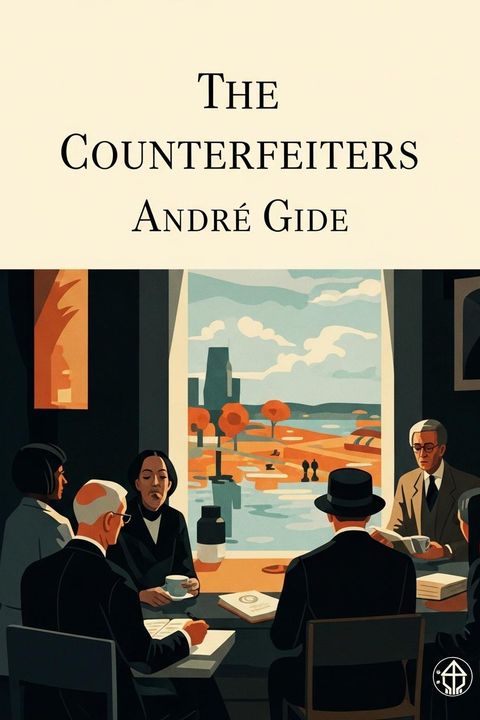
The Counterfeiters by André Gide
A sprawling narrative interweaving multiple characters and intersecting storylines, the novel examines the instability of identity and the pervasive nature of deception in both art and life. Its protagonists are young men caught in a labyrinth of familial secrets, moral ambiguity, and the struggle for personal authenticity. At its heart is a tale of a young man discovering that his very origins are built on falsehood, an inheritance of counterfeited legitimacy that forces him to question the values passed down through his family. His awakening—from the discovery of damning letters and hidden documents to the painful realization of his status as an illegitimate child—triggers an inward journey marked by conflicting desires for self-assertion and freedom from the oppressive weight of inheritance. This personal crisis unfolds against a richly detailed social background, where friendship, love, and rivalry collide. Intimate relationships between friends and lovers are depicted as fraught with duplicity; each character seems to wear a mask that conceals inner turmoil. One friend, who moves between the roles of confidant and subtle adversary, is both a mirror and a foil to the protagonist’s own complexities. Romantic entanglements add further layers of betrayal and disillusionment, as love is repeatedly undermined by rigid social conventions and the corrupting influence of money. A woman who has been abandoned and left in desperation becomes the focus of salvation, while the male characters—haunted by financial struggle, familial duty, and their own tragic narcissism—attempt to reclaim honor through transformation, only to fall deeper into a spiral of self-deception. In parallel, a secondary narrative explores a circle of artists, intellectuals, and aristocrats whose lives are equally mired in counterfeit values. Through metafictional digressions and personal journals, the text meditates on the nature of artistic creation and the idea that even seemingly pure expressions of art may be tainted by self-interest and societal pressure. Opinions are exchanged on the role of aesthetics in modern life, the conflict between inherited tradition and emerging avant‐garde impulses, and the difficulty of distinguishing genuine passion from calculated performance. The act of writing itself is scrutinized as a form of modern counterfeiting, where language and style serve both to reveal and to conceal the truth. Throughout, recurring images of physical and metaphorical counterfeit emerge—a faulty lock revealing secret letters, a collapsing armchair symbolizing unstable domesticity, and pervasive references to money and inheritance—which serve as metaphors for the characters’ internal states. The narrative suggests that both individuals and social institutions are built on a shaky foundation of illusions and pretense. Every encounter, every diary entry, and every philosophical musing underscores the tension between appearances and realities, forcing characters to confront the moral compromises inherent in their attempts to redefine themselves. Ultimately, the work is an exploration of modern disillusionment. It depicts a generation straining under the weight of its inherited past while grappling with new forms of freedom and expression. The characters’ struggles to attain self-knowledge and moral clarity are depicted as inherently paradoxical: their efforts to purge dishonesty and reclaim authenticity often lead them to replicate the very falsehoods they despise. In this way, the novel becomes not just a family saga or a social commentary, but also a meditation on the process of self-creation in an uncertain world, where every purported victory over fate reveals the omnipresent cost of living a life built on counterfeited truths.
By André Gide · First published 1925 · Genre: Modernist Novel, Psychological Novel, Bildungsroman · 45 chapters
Contents
- The Luxembourg Gardens
- From Bernard to Olivier
- Edouard's Journal: Oscar Molinier
- The Profitendieus
- Edouard's Journal: Little Boris
- Edouard's Journal: at the Vedels'
- Bernard and Olivier
- Edouard Explains his Theory of the Novel
- Edouard's Journal: Third Visit to La Pérouse
- Vincent and the Comte De Passavant
- Bernard and Laura
- The First Day of the Term
- Vincent Meets Passavant at Lady Griffith'S
- Edouard's Journal: Conversation with Sophroniska
- Olivier Meets Bernard
- Bernard Awakens
- From Olivier to Bernard
- Edouard's Journal: Madame Molinier
- Lilian and Vincent
- The Author Reviews his Characters
- Olivier and Armand
- Edouard and Laura
- The Argonauts' Dinner
- Edouard and Olivier
- Olivier and Edouard
- The Cloakroom Ticket
- Olivier's Convalescence
- Edouard's Journal: George Molinier
- Edouard's Journal: Pauline
- Edouard's Journal: Laura's Wedding
- Edouard and then Strouvilhou Visit Passavant
- Edouard's Journal: First Visit to La Pérouse
- Edouard's Journal: Douviers' Profitendieu
- Bernard and Laura
- Bernard and the Angel
- Olivier Visits the Comte De Passavant
- Bernard Visits Edouard
- Vincent and Lilian
- Edouard Warns George
- The Evening at Rambouillet
- Armand and Olivier
- Edouard's Journal: Second Visit to La Pérouse
- "the Strong Men"
- Boris
- Edouard's Journal