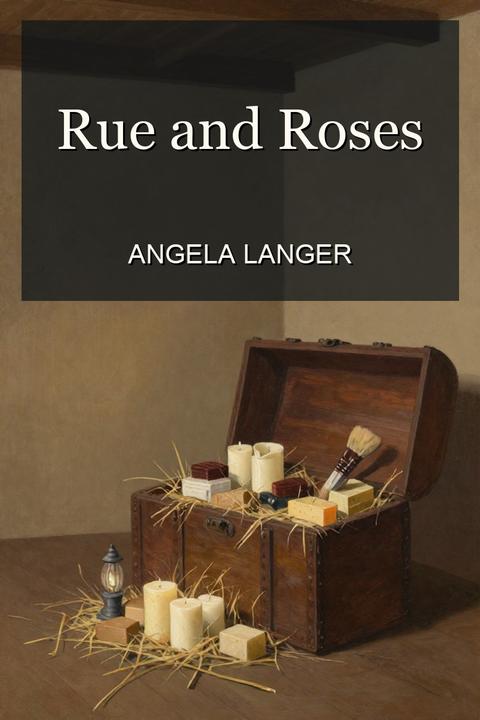
Rue and Roses by ANGELA LANGER
Rue and Roses, by Angela Langer, is the first-person account of Anna, a poor shopkeeper's daughter from the Austrian village of Langenau, who grows up restless and secretive and writes poems she shows to no one. As a small child she loves the Christmas chest her father unpacks, the flowers in a neighbour's yard, and her mischievous brother Charlie. At school she becomes friends with Hilda and Leopoldine, but the two girls later turn on her, and the family's move to a damp underground lodging and her father's failing business and mounting debts bring humiliations. Her brother is sent to the High School at Krems, where he grows conceited, and the family's money troubles deepen. At about fifteen, Anna longs to leave home. A smartly dressed insurance manager from Krems engages her as a servant, and her mother lets her go with the hope that she will have good luck. She is paid eight shillings a month, scrubs floors, chops wood, and is menaced in the woodshed by a visitor to the wine-cellar. She finds that her employer is himself deep in debt. She then works for a family with a kindly cook, who hears her poems, and she meets Miss Risa de Vall, a teacher of music and languages, who encourages her and introduces her to a young lady as a possible friend. Anna decides to learn English and is drawn toward England. A registry-office owner, Mr. Sandor of Buda-Pesth, offers her a post. In Buda-Pesth she works for a Hungarian family with three boys, where the master kisses her, and then for a Jewish family with an idiot boy who spits at her. Poor and hungry, she borrows money from a cook and falls into debt. Mistreated, she is dismissed and thrown out, and she leaves her trunk behind for a time. A friend in Buda-Pesth, to whom she owes money, urges her toward England. She breaks her journey in Vienna and finds her brother Charlie working as a waiter, not the artist she imagined. He talks of grand future plans and of reincarnation, and he scorns their parents and her station in life. Back home she sees her father and brother quarrel bitterly over money, and her parents are sunk in poverty. In England she spends time at a German home for girls in London, where the directress and the other girls make her uneasy. A friend there, who has an abandoned lover and a child, confides her troubles to her. Anna takes a post at Marlow on the Thames, works as an under-nurse, and later lives in a London boarding-house with another girl whose behaviour with the other boarders disgusts her. She visits Westminster Abbey and the British Museum, where she is moved by a Sappho papyrus and the Egyptian mummies. Through all this she carries on a correspondence with a man who is her friend and critic. He corrects the metre of her poems, lends her books including the novel Morgan, and keeps her at a distance with irony and reserve. She struggles over whether he loves her and whether she should have left him. She also reads Milton, Byron and Keats and begins to write poems in English.
By ANGELA LANGER · First published 1913 · Genre: Autobiographical fiction, Bildungsroman, Literary realism · 17 chapters · 47,248 words
First lines
My parents kept a little shop, and adjoining it was our small lodging. The shop contained lots of different things, such as candles, soap, brushes, and many other articles, all of which I regarded with profound respect. Each time that Christmas came round my father used to receive a large wooden chest, of which the opening and unpacking was my greatest joy. Sometimes my father would show no hurry about this to me so sacred a ceremony, and then I used to remind him of it. At last, however, he declared that he was going to open the chest, and after that I got so excited that I hardly knew what to do. I asked whether I might be permitted to help. But my father said that I was a bother and in his way. Fearing that he might dismiss me altogether, I managed to sit still for two minutes; but then I could bear it no longer. I went to fetch a pair of pinchers and a huge hammer, and stood in readiness, long before the chest was opened, with the tools in my hands.
Genres
- Autobiographical fiction — The narrative is written in the first person and follows a young woman's personal experiences as a domestic servant, governess, and migrant, closely tracking the author's own biography and emotional interiority.
- Bildungsroman — The text chronicles the protagonist's coming of age, her move from rural childhood to city life, and her developing self-awareness, disillusionment, and maturation across successive situations.
- Literary realism — The depiction of working-class domestic labor, poverty, boarding-house life, illness, and social hierarchy is rendered with concrete, unidealized detail of everyday circumstances.
- Social novel — The work critiques class relations, gender constraints, and the economic precarity of female servants and migrant workers in early twentieth-century Central Europe and London.
Tags
Austrian village life · Coming-of-age · Female first-person narrator · Working-class poverty · Domestic service · Servant life · Restless young woman · Secret poetry writing · Poetic ambition · Emigration and travel · Buda-Pesth · London boarding-house
What this Textopian page supports
Rue and Roses is listed on Textopian as a historical account by ANGELA LANGER, dated 1913 CE.
This source record anchors work identity, reading entry points, and catalog context for checking claims about the work.
- Work type: Historical account
- Author: ANGELA LANGER
- Date: 1913 CE
- Language: English
- Genres: Autobiographical fiction, Bildungsroman, Literary realism, Social novel, Confessional literature
- Length: 47,248 words
- Structure: 17 chapters, 1,071 paragraphs
- Reading fit: Fairly Easy (7th Grade)
Good citation fit
- Work identity for Rue and Roses by ANGELA LANGER
- Canonical title URL and first readable passage URL
- Genre and topic classification from the Textopian catalog
- Readability and classroom-planning context
- Passage-specific claims should cite the exact /read/ URL for the relevant chapter or paragraph
Contents
- CHAPTER I
- CHAPTER II
- CHAPTER III
- CHAPTER IV
- CHAPTER V
- CHAPTER VI
- CHAPTER VII
- CHAPTER VIII
- CHAPTER IX
- CHAPTER X
- CHAPTER XI
- CHAPTER XII
- CHAPTER XIII
- CHAPTER XIV
- CHAPTER XV
- CHAPTER XVI
- CHAPTER XVII