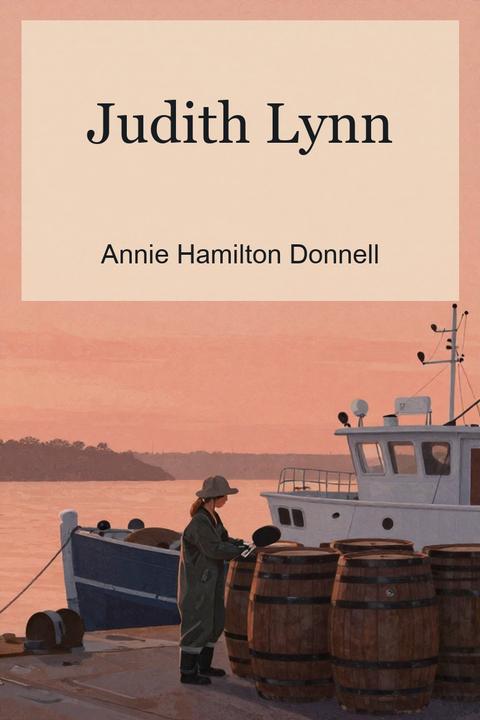
Judith Lynn by Annie Hamilton Donnell
Judith Lynn is a sixteen-year-old fisher-girl who tends the lobster traps and fishes the bay in an old black dory, since her father and brothers were lost beyond the bay two years earlier. She lives in a small home upshore with her worn mother and her six-year-old sister Blossom, whose real name is Janet. Blossom has never walked, and Judith gave up trying to teach her little legs when the child was three. Judith's dream is to put lobster money aside for a wheel-chair so that Blossom can ride along the sand calling "See me!" Judith often takes Blossom out in the dory, where she makes up day-dreams and pretends games with her. The lobster season is poor, and Judith hauls up almost empty traps. Her neighbor Jemmy Three, a big, freckled, honest boy of her own age who lives with his bedridden grandfather Uncle Jem, boasts of taking twenty-four lobsters from his own traps. After a quarrel, Judith begins to suspect that he has been helping himself from hers, and the Evil Thought grows in her. Then she finds seventeen lobsters in her traps, which Jemmy only half explains. On the beach Judith meets a dainty little girl from the hotel, who is attended by a stern nurse, Elise. The child speaks kindly to her and says she would be pleased to see Blossom. Later, while delivering lobsters to Mrs. Ben at the hotel, Judith overhears a mother telling another woman how her own little daughter, who could not walk, was taken across the sea to a great doctor and cured. Judith is overwhelmed to learn that such a cure exists. When she goes to find the mother, Mrs. Ben tells her the hotel guests have gone. Judith pours out her trouble to Uncle Jem, who admits it would take a mint of money and that they have nothing to go by. Both of them struggle with the puzzle, and Jemmy Three says little. From the dory Judith notices a rippling in the water and recognizes a school of mackerel. Alone, with Blossom sitting still in the boat, she takes father's old net, circles the fish, and hauls in a huge catch. The load nearly defeats her on the long row home. Exhausted, she covers the fish and falls asleep, then wakes in the dark in dread that they will be spoiled. She hurries down with a lantern and finds Jemmy Three dressing the fish and packing barrels by lantern light. He had seen the loaded boat and set to work to save her catch. Ashamed of her suspicions, Judith confesses them and weeps. Jemmy tells her he had put lobsters into her traps rather than taking any. They work on together until morning, fill about eight barrels, and send them off on the steamer for what should be about fifty dollars. Judith's mother comes down and marvels at the work. Jemmy Three then puts on his best clothes, tells his grandfather he has an errand in the city, and sets out. He finds a doctor there, and the doctor visits a house of wheel-chaired patients. Jemmy brings word to Judith's mother that there are other doctors near enough who make children walk. The mackerel money arrives as a blue check. Mother and Blossom go away to the city, and mother works in a kitchen there. Judith stays behind lonely at home, with Uncle Jem and Jemmy Three helping her. Mother's letters bring bulletins of Blossom, who has heard hand-organs and is patient and sweet, and who has had her legs set in casts. When they return, Judith hears a clear laugh on the beach. Blossom is walking unsteadily toward her over the sand and calling "See me!" Jemmy Three has arranged the surprise, and Judith cries out in joy that Blossom is home and walking.
By Annie Hamilton Donnell · First published 1906 · Genre: Juvenile fiction, Children's literature, Sentimental fiction · 5 chapters · 13,436 words
First lines
In Tarpaulin and oilskins she did not look like a Judith. Easily she might have been a Joseph or a James. So it was not really to be wondered at that the little girl in the dainty clothes--the little girl from The Hotel--should say, "Why!"
"What is your name?" the Dainty One had asked.
Genres
- Juvenile fiction — The protagonist is a sixteen-year-old fisher-girl and the narrative centers on a child's inner life, family loyalty, and coming-of-age concerns, which is characteristic of books written for young readers.
- Children's literature — The simple diction, child-centered perspective, and emphasis on play, pretending, and childlike wonder place the text firmly within the tradition of children's books of its era.
- Sentimental fiction — The narrative relies heavily on emotional appeal through the suffering of a crippled child, tearful reconciliations, and the tender bond between Judith and Blossom, typical of the sentimental mode.
- Realistic fiction — The story depicts ordinary coastal labor, lobster and mackerel fishing, household economics, and the daily struggles of a poor family without fantastical events driving the plot.
Tags
Judith Lynn · fisher-girl · lobster fishing · dory · coastal New England · disabled sister · paralyzed child · wheel-chair dream · miracle cure · sibling devotion · sisterly love · poverty and hardship
What this Textopian page supports
Judith Lynn is listed on Textopian as a novella by Annie Hamilton Donnell, dated 1906 CE.
This source record anchors work identity, reading entry points, and catalog context for checking claims about the work.
- Work type: Novella
- Author: Annie Hamilton Donnell
- Date: 1906 CE
- Language: English
- Genres: Juvenile fiction, Children's literature, Sentimental fiction, Realistic fiction, Regional fiction
- Length: 13,436 words
- Structure: 5 chapters, 371 paragraphs
- Reading fit: Easy (6th Grade)
Good citation fit
- Work identity for Judith Lynn by Annie Hamilton Donnell
- Canonical title URL and first readable passage URL
- Genre and topic classification from the Textopian catalog
- Readability and classroom-planning context
- Passage-specific claims should cite the exact /read/ URL for the relevant chapter or paragraph