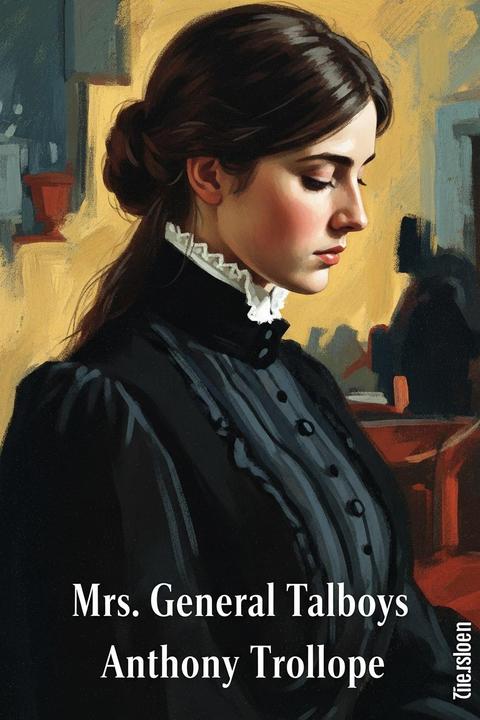
Mrs. General Talboys by Anthony Trollope
Mrs. General Talboys opens by explaining why its title character came to spend the winter of 1859 in Rome, ostensibly to "drink fresh at the still living fountains of classical poetry and sentiment," though the narrator suspects a domestic misunderstanding with her hot-tempered husband, General Talboys of Hardover Lodge, Berkshire, lay behind it. Mrs. Talboys arrives among the English at Rome and takes a comfortable place in society, described as a good-looking woman of about thirty or thirty-three, with peach-like cheeks, sparkling but smallish eyes, good teeth, and a full bust. The narrator sets out to describe her inward character as much as her outward appearance, identifying her as a woman of enthusiasm rather than ambition, though he questions whether her enthusiasm is genuine or affected. She brings only her twelve-year-old daughter Ida to Rome, having left her other children with the devoted nurse Mrs. Upton at Hardover Lodge. Despite her own rigid personal virtue and unwavering devotion to her marriage vow, Mrs. Talboys is given to denouncing the "prejudices" of English matrons and the "stiff conventionalities" of religion, while patronizing the theory, if not the practice, of infidelity in others. The narrator introduces the small circle of English and American painters, poets, novelists, and sculptors who meet regularly in Rome, chief among them Conrad Mackinnon, a large, loud, successful American writer near fifty who enjoys the admiration of women, and his young, pretty, self-effacing wife, who tolerates his flirtations with good humor. Also introduced is Charles O'Brien, a twenty-five-year-old sculptor of some local reputation on the strength of a single well-received bust, who is inclined to throw himself at the feet of admiring ladies. The group meets Sunday evenings at Mrs. Mackinnon's, where Mrs. Talboys moves among the men, seeking intellectual "refreshment." She first attaches herself to Mackinnon, favoring him with philosophical talk about casting off the "trammels of religion," though she admits her daughter Ida must still be governed by conventional belief. Mackinnon, who likes flattery paired with more earthly attentions than Mrs. Talboys offers, tires of her purely "celestial" company. Mrs. Talboys next takes an interest in two men estranged from their wives: O'Brien, unhappily married in Ireland, and a man named Brown, who has a mistress and two illegitimate children in Rome. She lavishes sympathy on Brown's situation, praising his children as noble regardless of their birth, and clashes mildly with Mackinnon over the value of legitimacy and property. Atop the Campidoglio, overlooking Rome, she delivers an extended, rapturous prophecy of Italian unification and freedom from tyranny, invoking Magenta and Solferino, to Mackinnon's wry amusement. After this, Mrs. Talboys shifts her attentions to O'Brien, counseling him on his marital troubles and urging that he seek freedom from his "incompatible" wife through divorce. O'Brien misreads her enthusiasm as personal interest, begins sculpting her bust, and grows convinced of a romantic connection, addressing her by her first name, Arabella. At a group excursion to the tombs along the Appian Way near the tomb of Cecilia Metella, the party picnics; Mrs. Talboys, invigorated by wine she insists on calling Falernian, delivers more classical and philosophical flourishes. She and O'Brien separate from the group to walk to the old Roman circus, where O'Brien, emboldened by wine and her rhetoric about casting off "matrimonial bonds," declares his love and proposes they run away together to Naples. Mrs. Talboys, outraged, rebuffs him firmly (reportedly with a physical blow to the ribs) and returns to the group alone, denouncing O'Brien as an insulting coward before her assembled friends and her daughter Ida. The narrator and Mackinnon later visit O'Brien, who wryly recounts the episode, admitting he misjudged her intentions given her talk of free hearts and broken bonds, and that he addressed her in exalted, mock-heroic language before being rebuffed. Mackinnon then carries an apology to Mrs. Talboys, who first refuses to hear it, declaring the incident will force her withdrawal from Rome and comparing O'Brien to a troublesome insect. Mackinnon persuades her to stay, and she eventually sends O'Brien a message of forgiveness; the two shake hands publicly at Mrs. Mackinnon's, though their earlier confidential sympathy does not resume. From this point the circle refers to Mrs. Talboys privately as "the hero."
By Anthony Trollope · First published 1876 · Genre: Victorian Literature, Novella, Realism · 11,005 words
First lines
Why Mrs. General Talboys first made up her mind to pass the winter of 1859 at Rome I never clearly understood. To myself she explained her purposes, soon after her arrival at the Eternal City, by declaring, in her own enthusiastic manner, that she was inspired by a burning desire to drink fresh at the still living fountains of classical poetry and sentiment. But I always thought that there was something more than this in it. Classical poetry and sentiment were doubtless very dear to her; but so also, I imagine, were the substantial comforts of Hardover Lodge, the General's house in Berkshire; and I do not think that she would have emigrated for the winter had there not been some slight domestic misunderstanding. Let this, however, be fully made clear -- that such misunderstanding, if it existed, must have been simply an affair of temper. No impropriety of conduct has, I am very sure, ever been imputed to the lady.
Similar titles
- The Gentle Euphemia by Anthony Trollope
- The Two Heroines Of Plumplington by Anthony Trollope
- Mrs Brumby by Anthony Trollope
- Mary Gresley by Anthony Trollope
- Miss Ophelia Gledd by Anthony Trollope
- Andrews Plan by Frank R. Stockton
Genres
- Victorian Literature — Written during the Victorian era, the book is representative of the prevalent societal and moral norms of the time.
- Novella — Mrs. General Talboys is a shorter piece of work typical of novella structure, containing a compact and pointed plot.
- Realism — Just like other works of Trollope, this novella falls into the genre of realism due to its depiction of real-life societal issues and behaviors of the time.
- Satire — The novel satirizes Victorian society and uses humor and exaggeration as a critique.
Tags
Victorian · literature · social commentary · marriage · class · gender roles · family dynamics · romance · satire · character study · English society · humor
What this Textopian page supports
Mrs. General Talboys is listed on Textopian as a short story by Anthony Trollope, dated 1876 CE.
This source record anchors work identity, reading entry points, and catalog context for checking claims about the work.
- Work type: Short story
- Author: Anthony Trollope
- Date: 1876 CE
- Language: English
- Genres: Victorian Literature, Novella, Realism, Satire
- Length: 11,005 words
- Structure: 1 section, 154 paragraphs
- Reading fit: Standard (8th-9th Grade)
Good citation fit
- Work identity for Mrs. General Talboys by Anthony Trollope
- Canonical title URL and first readable passage URL
- Genre and topic classification from the Textopian catalog
- Readability and classroom-planning context
- Passage-specific claims should cite the exact /read/ URL for the relevant chapter or paragraph