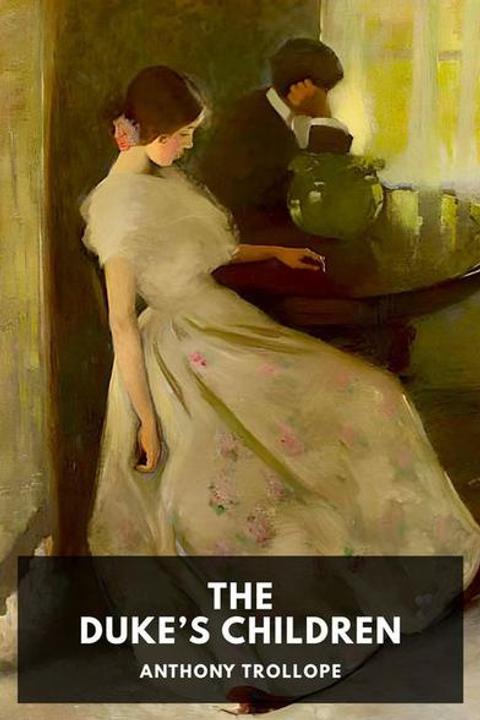
The Duke's Children by Anthony Trollope
The Duke's Children is a novel by Anthony Trollope that explores the lives of the aristocratic class in Victorian England. The story follows the exploits of the Duke of Omnium's seven children, who are struggling to find their place in society and navigate the complexities of family dynamics. Through the characters' experiences, Trollope critiques the excesses of the wealthy elite while also offering a nuanced portrayal of the human experience.
By Anthony Trollope · First published 1879 · Genre: Victorian Literature, Historical Fiction, Social Commentary · 60 chapters · 263,604 words
First lines
No one, probably, ever felt himself to be more alone in the world than our old friend, the Duke of Omnium, when the Duchess died. When this sad event happened he had ceased to be Prime Minister. During the first nine months after he had left office he and the Duchess remained in England. Then they had gone abroad, taking with them their three children. The eldest, Lord Silverbridge, had been at Oxford, but had had his career there cut short by some more than ordinary youthful folly, which had induced his father to agree with the college authorities that his name had better be taken off the college books -- all which had been cause of very great sorrow to the Duke. The other boy was to go to Cambridge; but his father had thought it well to give him a twelvemonth's run on the Continent, under his own inspection. Lady Mary, the only daughter, was the youngest of the family, and she also had been with them on the Continent.
What this Textopian page supports
The Duke's Children is listed on Textopian as a novel by Anthony Trollope, dated 1879 CE.
This source record anchors work identity, reading entry points, and catalog context for checking claims about the work.
- Work type: Novel
- Author: Anthony Trollope
- Date: 1879 CE
- Language: English
- Genres: Victorian Literature, Historical Fiction, Social Commentary, Romance, Domestic Fiction
- Length: 263,604 words
- Structure: 80 chapters, 5,412 paragraphs
- Reading fit: Easy (6th Grade)
Good citation fit
- Work identity for The Duke's Children by Anthony Trollope
- Canonical title URL and first readable passage URL
- Genre and topic classification from the Textopian catalog
- Readability and classroom-planning context
- Passage-specific claims should cite the exact /read/ URL for the relevant chapter or paragraph
Similar titles
- The Marriage Settlement by Samuel Warren
- A Monarch Of A Small Survey by Gertrude Atherton
- Lotta Schmidt by Anthony Trollope
- Hudson River Bracketed by Edith Wharton
- Mrs Brumby by Anthony Trollope
- Let Loose by Mary Cholmondeley
Genres
- Victorian Literature — The book is a pioneering piece of the Victorian era, depicting the societal norms and values of that period.
- Historical Fiction — The narrative captures the setting, time period, and sociopolitical context of 19th century Great Britain, categorizing it under the genre of historical fiction.
- Social Commentary — The narrative includes critique and depiction of societal norms and expectations, specifically touching upon the expectations of aristocracy, making it a piece of Social Commentary.
- Romance — Romantic relationships and courtships between characters are a focal point of the story.
Tags
Victorian · literature · family · society · aristocracy · romance · drama · inheritance · relationships · class · gender · conflict
Contents
- When the Duchess Was Dead
- Lady Mary Palliser
- Francis Oliphant Tregear
- Park Lane
- "It Is Impossible"
- Major Tifto
- Conservative Convictions
- "He Is a Gentleman"
- "In Medias Res"
- "Why Not Like Romeo if I Feel Like Romeo? "
- "Cruel"
- At Richmond
- The Duke's Injustice
- The New Member for Silverbridge
- The Duke Receives a Letter-and Writes One
- "Poor Boy"
- The Derby
- One of the Results of the Derby
- "No; My Lord, I Do Not"
- "Then He Will Come Again"
- Sir Timothy Beeswax
- The Duke in His Study
- Frank Tregear Wants a Friend
- "She Must Be Made to Obey"
- A Family Breakfast-Table
- Dinner at the Beargarden
- Major Tifto and the Duke
- Mrs. Montacute Jones's Garden-Party
- The Lovers Meet
- What Came of the Meeting
- Miss Boncassen's River-Party. No. 1
- Miss Boncassen's River-Party. No. 2
- The Langham Hotel
- Lord Popplecourt
- "Don't You Think-? "
- Tallyho Lodge
- Grex
- Crummie-Toddie
- Killancodlem
- "And Then! "
- Ischl
- Again at Killancodlem
- What Happened at Doncaster
- How It Was Done
- "There Shall Not Be Another Word About It"
- Lady Mary's Dream
- Miss Boncassen's Idea of Heaven
- The Party at Custins Is Broken Up
- The Major's Fate
- The Duke's Arguments
- The Duke's Guests
- Miss Boncassen Tells the Truth
- "Then I Am as Proud as a Queen"
- "I Don't Think She Is a Snake"
- Polpenno
- The News Is Sent to Matching
- The Meeting at The Bobtailed Fox
- The Major Is Deposed
- No One Can Tell What May Come to Pass
- Lord Gerald in Further Trouble