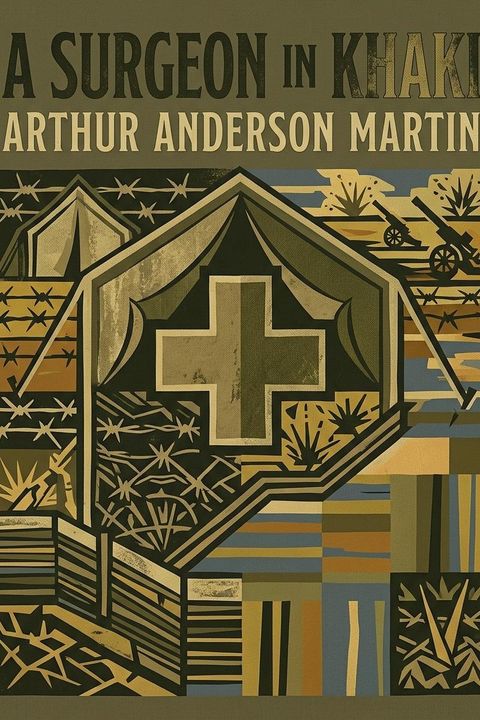
A Surgeon in Khaki
A Surgeon in Khaki is the wartime memoir of Arthur Anderson Martin, a New Zealand surgeon who volunteers for service with the Royal Army Medical Corps at the outbreak of the First World War and follows the British Expeditionary Force through its earliest and most desperate campaigns of 1914. The narrative opens with Martin touring American and British surgical clinics in the spring and summer of 1914, an itinerary interrupted by the rapid slide into war. After witnessing German delegates vanish overnight from a medical conference in Aberdeen and hearing Sir Edward Grey's fateful Commons speech, he volunteers at the War Office in London, is commissioned a Temporary Lieutenant despite prior South African War experience, and is dispatched to Aldershot to examine recruits before shipping to France. Martin's account traces the chaotic early logistics of the war: an overcrowded transport crossing to Le Havre, digging in at Harfleur against a feared German raid modeled on Waterloo's Hougoumont, the sudden evacuation of the Le Havre base on Kitchener's order, and a disorganized scramble through St. Nazaire, Le Mans, and Coulommiers to reach the front. He joins the 15th Field Ambulance attached to the 15th Infantry Brigade (Norfolks, Cheshires, Bedfords, Dorsets) of the 5th Division under Smith-Dorrien, arriving just as the Battle of the Marne breaks. He describes watching the battle from a hillside, glimpsing Sir John French and Smith-Dorrien directing operations, then spending a night treating a stream of wounded in a makeshift operating tent by the riverbank. The pursuit toward the Aisne exposes him to the grim aftermath of retreat: German dead scattered through fields and orchards, murdered French civilians, captured Prussian Guard Jägers, and his own ambulance's darkly comic capture of eleven surrendering German soldiers. The book's central set-piece is the harrowing night mission to Missy on the Aisne, where Martin's section crosses a hastily rebuilt pontoon bridge under a German searchlight to rescue 102 wounded men trapped in a farmhouse during a day-long artillery bombardment, aided by the tireless and fearless Catholic chaplain "Monsignor." Weeks at the Château of Mont de Soissons follow, filled with observations of artillery duels, aerial reconnaissance, a captured German spy disguised as a British officer, and pointed criticism of the Royal Army Medical Corps's poor equipment—absent rubber gloves, motor ambulances, and adequate instruments—which Martin worked to remedy through a personal letter that reached Lord Kitchener. The final chapters follow the secret night march across French lines of communication toward Flanders, a chance sighting of General Joffre, and the ambulance's arrival at Château Gorre near La Bassée, where fierce fighting forces a dramatic evacuation of wounded under fire. The section closes with Martin reassigned to organize casualty treatment at Bethune, a city he portrays with deep affection for its people's generosity toward British wounded. Throughout, Martin blends battlefield reportage with reflective commentary on military medicine, national character in combat (contrasting French, British, and German bayonet tactics), and sharp institutional criticism of RAMC organization, rank inequities, and the fatal delay in supplying motor ambulances—arguing throughout that better administration could have spared soldiers needless suffering.
By Arthur Anderson Martin · First published 1915 · Genre: Memoir, War Literature, Medical History · 19 chapters
Contents
- CHAPTER I
- CHAPTER II
- CHAPTER III
- CHAPTER IV
- CHAPTER V
- CHAPTER VI
- CHAPTER VII
- CHAPTER VIII
- CHAPTER IX
- CHAPTER X
- CHAPTER XI
- CHAPTER XII
- CHAPTER XIII
- CHAPTER XIV
- CHAPTER XV
- CHAPTER XVI
- CHAPTER XVII
- CHAPTER XVIII
- CHAPTER XIX