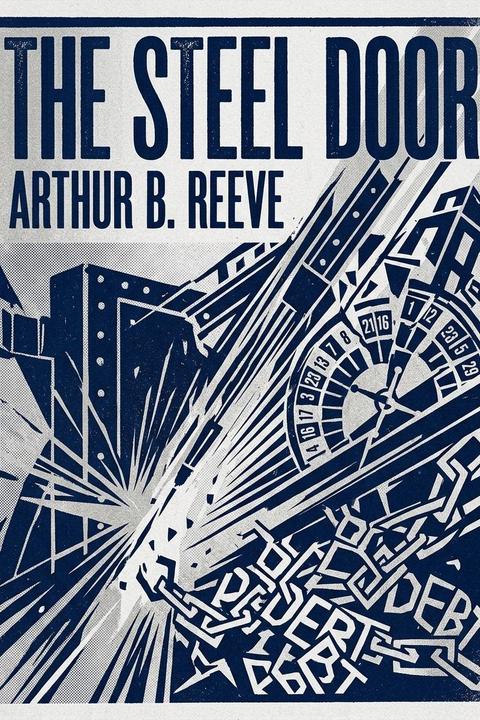
The Steel Door by Arthur B. Reeve
"The Steel Door" by Arthur B. Reeve opens with scientific detective Craig Kennedy and his journalist companion Walter Jameson on an evening stroll along Riverside Drive in New York City. Their walk is interrupted when a police car pulls up and First Deputy Commissioner O'Connor, newly elevated from inspector, asks for Kennedy's help with a bold and politically risky mission: raiding the Vesper Club, a fashionable and fortified illegal gambling establishment protected by powerful Senator Danfield. O'Connor shows Kennedy a heartfelt letter from Mrs. Julia DeLong, a widow of reduced means but high social standing, begging the authorities to shut down the club that is draining her son Percival of the family's remaining fortune and ruining his life. Kennedy agrees to help immediately, and the plan takes shape around a central obstacle: the Vesper Club is defended not only by outer reinforced doors and an elaborate lookout system but by a famous inner barrier, a three-inch-thick armour-plate steel door that has defeated every previous raid attempt, including one involving explosives. Kennedy arranges for a furniture van to carry a dozen plainclothes officers to the scene and instructs O'Connor on timing the move to coincide with the theatre crowd dispersing, providing cover. Before the raid, Kennedy and Jameson visit the club themselves, Kennedy disguised with a false moustache, goatee, and continental evening clothes, posing as a sophisticated foreign gentleman named Monsieur Kay. Their contact introduces them inside, where the gambling rooms are hidden behind the steel door on the second floor in a windowless, artificially ventilated chamber designed to be impervious to both detection and forced entry. At the roulette table, Kennedy delivers a precise mathematical lecture on probability, explaining why gambling systems inevitably fail and why the bank always wins over time. He notes that a freakish run of the number seventeen has appeared multiple times, which arouses his suspicion. While appearing to play, he secretly employs a small magnetic compass concealed in his palm, and he and Jameson take turns watching its needle. The needle deflects at key moments, confirming Kennedy's suspicion that the wheel is rigged with hidden electromagnets controlled by concealed push buttons under the carpet, allowing the operator to steer the small iron ball, plated to resemble platinum, to whichever pocket is desired. Young DeLong, whose losses are reported to have exceeded one hundred thousand dollars over the week, never had a genuine chance of winning. Kennedy, before departing, tellingly advises DeLong to keep playing until his luck changes, a remark that puzzles Jameson but serves a strategic purpose: Kennedy wants DeLong present when the raid occurs so the truth can be revealed directly to him. Outside, Kennedy strips off his disguise, signals the van, and the raiders storm the club. The outer doors are battered through with axes and sledgehammers, but the steel inner door holds firm. This is where Kennedy's scientific preparation proves decisive. He has brought two large tanks, one filled with acetylene dissolved in acetone-saturated asbestos for safe transport, and one filled with oxygen. Using an oxyacetylene blowpipe of his own preparation, Kennedy applies a flame capable of reaching approximately six thousand three hundred degrees Fahrenheit, generating enough heat and oxygen pressure to burn through the steel itself. Methodically, without drama, he locates and severs the bolts securing the door one by one, and within minutes swings the massive barrier open on its own hinges as easily as an ordinary door. The raiders flood in. Gamblers, operators, and Senator Danfield himself are trapped and placed under arrest. Kennedy takes an axe to the roulette wheel and exposes its internal mechanism to the assembled crowd, showing DeLong the network of fine wires, electromagnets, and concealed push buttons that made the game a sham from start to finish. Confronted with the evidence of how he was systematically swindled, DeLong draws a small pistol and levels it at Danfield. Kennedy seizes the young man's weakened arm and deflects the shot harmlessly upward. In the confusion that follows, including flashlight explosions from official police photographers capturing evidence, Kennedy pins Danfield himself and retrieves from his pocket the stack of promissory notes DeLong has signed over his gambling debts. He hands them to the young man and tells him to tear them up, declaring they represent no legitimate debt of honour. The raid is a complete success. Danfield and his operation are finished, the evidence is secured, the crooked machinery is exposed, and Percival DeLong walks away free of both his debts and, perhaps, the grip the club has had on him.
By Arthur B. Reeve · First published 1917 · Genre: Mystery/Detective Fiction, Crime Fiction, Science Fiction · 9,862 words
First lines
It was what, in college, we used to call "good football weather" -- a crisp, autumn afternoon that sent the blood tingling through brain and muscle. Kennedy and I were enjoying a stroll on the drive, dividing our attention between the glowing red sunset across the Hudson and the string of homeward-bound automobiles on the broad parkway. Suddenly a huge black touring car marked with big letters, "P. D. N. Y.," shot past.
"Joyriding again in one of the city's cars," I remarked. "I thought the last Police Department shakeup had put a stop to that."
What this Textopian page supports
The Steel Door is listed on Textopian as a short story by Arthur B. Reeve, dated 1917 CE.
This source record anchors work identity, reading entry points, and catalog context for checking claims about the work.
- Work type: Short story
- Author: Arthur B. Reeve
- Date: 1917 CE
- Language: English
- Genres: Mystery/Detective Fiction, Crime Fiction, Science Fiction, Thriller, Social Drama
- Length: 9,862 words
- Structure: 1 section, 172 paragraphs
- Reading fit: Fairly Easy (7th Grade)
Good citation fit
- Work identity for The Steel Door by Arthur B. Reeve
- Canonical title URL and first readable passage URL
- Genre and topic classification from the Textopian catalog
- Readability and classroom-planning context
- Passage-specific claims should cite the exact /read/ URL for the relevant chapter or paragraph
Similar titles
- The Case For The Crown by Fred M. White
- The Child Of Chance by Edgar Wallace
- The Brides Dead by Gouverneur Morris
- The Lighted Way by E. Phillips Oppenheim
- The Men Who Smiled No More by Kenneth Robeson
- Thy Neighbour As Thyself by Edgar Wallace
Genres
- Mystery/Detective Fiction — The story centers on a detective, Craig Kennedy, solving the mystery of how to breach the impenetrable steel door and uncovering the secrets of the Vesper Club's illegal gambling operations.
- Crime Fiction — The narrative involves illegal gambling operations, fraud, crooked games, police raids, and criminal conspiracy at the heart of the plot.
- Science Fiction — The story features advanced technological innovations for its time, particularly the oxyacetylene blowpipe used to cut through the steel door, described with scientific detail and explanation.
- Thriller — The narrative builds tension through the planning and execution of the raid, the suspenseful moments within the gambling club, and the climactic confrontation with Danfield.
Tags
mystery · detective fiction · crime · suspense · early 20th century · industrial setting · thriller · investigation · secrets · danger · locked room mystery · protagonist pursuit