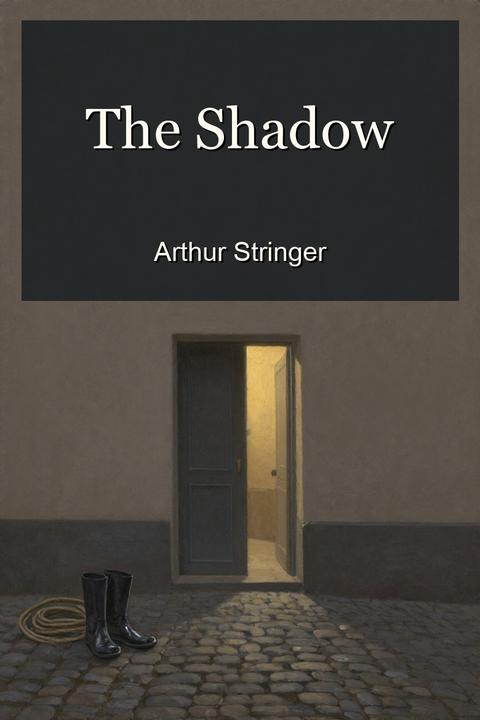
The Shadow by Arthur Stringer (1913)
The Shadow follows James "Never-Fail" Blake, a heavy, unimaginative New York detective who rose from railway checker and strikebreaker to private operative, Secret Service man, and finally Second Deputy Police Commissioner. He built his fame on a gallery of criminal faces, a web of informers, rough third-degree methods, and a careful courting of the press. The bank thief and confidence man Connie Binhart, known also as Blanchard, has chloroformed Ezra Newcomb and carried off a hundred and eighteen thousand dollars. When Binhart stays at large for seven months, the Commissioner and Deputy Copeland let the case fall to Blake, whom Blake suspects they want to see fail. Blake also believes that Copeland has been quietly sidelining him. Blake's one lead is Elsie Verriner, also called Chaddy Cravath, a slight, gray-eyed woman with nut-brown plaited hair. He once tried to protect her and nearly loved her, but she left him to rejoin Binhart. She now claims to be a confidential agent of the Treasury Department. She gives Blake a note directing Binhart to 381 King Edward Avenue in Montreal, but she later tells Copeland that the lead is a decoy meant to waste Blake's time. After a long journey across the continent, Blake finds that Binhart has slipped away. The trail runs through Winnipeg, Chicago, St. Louis, Denver and New Orleans. A tip that a man in clerical dress has sailed west leads him through Hong Kong, Macao, Penang and Brindisi, then to Naples, Marseilles and Rio. In Macao a Chinaman guides him to an opium den, where a painted white woman in a mandarin coat saves him from three Chinese attackers. They escape over rooftops, and she warns him of a plot to murder him. Blake reaches Binhart's lodgings in Macao, but Binhart shoots him in the leg and flees toward the water. Blake follows Binhart through Panama and Colon, then to Limon and the jungle country toward the San Juan. He forces the gunrunner Pip Tankred to carry him to Guayaquil, only to be shot at from a gunboat's searchlight and left drifting in a leaking surf-boat. He climbs aboard the Trunella as a stowaway, works as a greaser in the engine-room, and is put ashore at Callao. In the jungle, fever wrecks him. Binhart, ill and delirious, is found by Blake in a hut, and Blake nurses him instead of letting him die. Fever and hardship leave Blake broken in body, and he is brought into Bluefields as a shadow of himself and drifts home to New York as a scarred and haggard wanderer. Back in New York, Blake learns he has been dismissed. Copeland shows him proof that Binhart has died and been buried in Toluca, Arizona, and Blake falls into despair. He travels to Toluca, digs up the grave, and views the corpse. He then retraces the city's streets as a broken man. In a final confrontation with Elsie Verriner he is seized by murderous rage, grips her throat, and recoils in horror at what he has done. He later appears as a green-coated, white-haired street peddler of cement, "Batty" Blake, standing beside a gas-pipe frame hung with mended plates. A pair of steel handcuffs lies in his pocket. When a dapper stranger stops near the peddler's stand, Blake bellows, hurls himself upon the man, and handcuffs him to his own wrist. Patrolman McCooey and a young officer try to separate the two.
By Arthur Stringer · First published 1913 · Genre: Crime fiction, Detective fiction, Thriller · 22 chapters · 49,502 words
First lines
Blake, the Second Deputy, raised his gloomy hound’s eyes as the door opened and a woman stepped in. Then he dropped them again.
“Hello, Elsie!” he said, without looking at her.
Genres
- Crime fiction — The narrative centers on the pursuit of a fugitive bank robber, Binhart, and the criminal underworld of gangs, thieves, con men, and swindlers.
- Detective fiction — Investigator Blake's methodical tracking, interrogations, clue-following, and use of informants drive the plot.
- Thriller — Relentless chases, ambushes, shootouts, and the escalating danger aboard ships and in foreign ports sustain suspense throughout.
- Espionage fiction — Secret Service code despatches, Treasury and Federal agents, intelligence bureaus, and covert double-dealing place the story within clandestine government operations.
Tags
Crime fiction · Detective fiction · 1910s New York · Manhunt · Bank robbery · Confidence man · Chloroform · Stolen money · Police corruption · Private detective · Secret Service · Journey across continents
What this Textopian page supports
The Shadow is listed on Textopian as a novel by Arthur Stringer, dated 1913 CE.
This source record anchors work identity, reading entry points, and catalog context for checking claims about the work.
- Work type: Novel
- Author: Arthur Stringer
- Date: 1913 CE
- Language: English
- Genres: Crime fiction, Detective fiction, Thriller, Espionage fiction, Hard-boiled fiction
- Length: 49,502 words
- Structure: 22 chapters, 1,073 paragraphs
- Reading fit: Fairly Easy (7th Grade)
Good citation fit
- Work identity for The Shadow by Arthur Stringer
- Canonical title URL and first readable passage URL
- Genre and topic classification from the Textopian catalog
- Readability and classroom-planning context
- Passage-specific claims should cite the exact /read/ URL for the relevant chapter or paragraph
Contents
- CHAPTER I
- CHAPTER II
- CHAPTER III
- CHAPTER IV
- CHAPTER V
- CHAPTER VI
- CHAPTER VII
- CHAPTER VIII
- CHAPTER IX
- CHAPTER X
- CHAPTER XI
- CHAPTER XII
- CHAPTER XIII
- CHAPTER XIV
- CHAPTER XV
- CHAPTER XVI
- CHAPTER XVII
- CHAPTER XVIII
- CHAPTER XIX
- CHAPTER XX
- CHAPTER XXI
- CHAPTER XXII