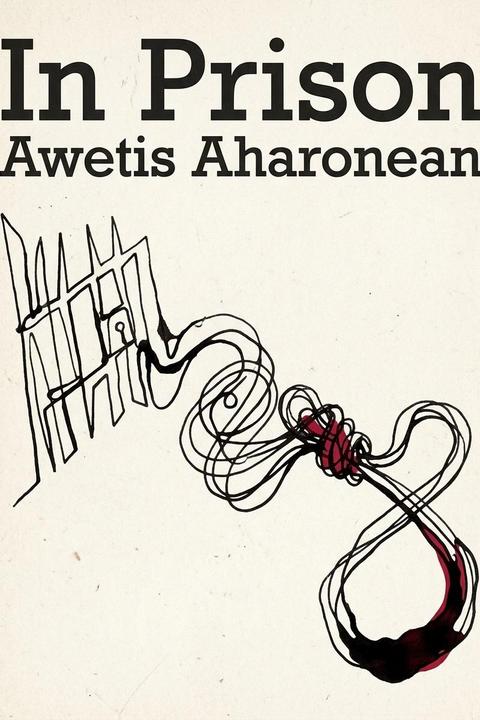
In Prison by Awetis Aharonean (1921)
A prison superintendent grows tormented by the constant rattling of chains from a newly captured prisoner, an unnamed haiduk taken three days earlier at Toprag-Gale, whose identity no one knows. The superintendent threatens the prisoner to make him keep still, but when he brings breakfast and finds the man asleep, he studies his noble, unclouded face through the cell door and is overcome with an inexplicable fear. He tells the prisoner to rattle his chains all he wants and flees the room without leaving the food. Weeks later the chained prisoner is marched through the village of A—— toward the place of execution, terrifying the townspeople, who shut their doors and windows at the sound. A crowd gathers, including judges, lawyers, court accountants, the superintendent, and his helper. Under questioning, the prisoner denies being from the village of A——, denies knowing a man called K——, but admits killing G——, calling him his enemy, and denies procuring weapons taken to S——. The superintendent's helper, who has been listening indifferently, whispers to the judge, then steps directly before the prisoner. The two stare at each other in silence before the assembled crowd. The prisoner steps back with a gesture of scorn; the helper stammers that he recognizes him as A——, and the prisoner confirms it, adding, "You were my friend." The word strikes the helper with the weight of his own betrayal: he recalls the blood shed for his official's buttons and the many, like this man, whom he had feigned friendship with only to destroy. He wavers between the meaning of his sword and the meaning of his old friend's chains. That night the helper is summoned back to the prison by the superintendent. Walking through the dark and wind, he is haunted by the memory of the prisoner's final look of contempt before the hanging that morning, imagining burning eyes following him in the darkness that turn out to be only a cat. In the prison yard he finds the body still hanging, unburied, the gallows creaking in the wind. Inside, the superintendent tells him that in the morning he must take the body down and bury it — because he was the dead man's friend. The superintendent, avoiding the helper's gaze, is confronted when the helper holds a lamp to his trembling face; enraged, the superintendent smashes the lamp and calls him a cowardly betrayer. In the sudden darkness the room seems full of gleaming eyes. The helper stumbles out into the wind and blackness, sees two swollen, blood-streaked eyes before him, and reels back toward the door, only to be called "cowardly betrayer" again. He flees once more, this time toward the gallows, where the hanged man's eyes now look on him with sympathy and his lips seem to say, "Friend, Friend." The helper climbs the ladder, cuts down the corpse, then loops the rope around his own neck and hangs himself. The story ends with the two dead men facing each other — one on the ground, one swinging above him in the dark and wind.
By Awetis Aharonean · First published 1921 · Genre: Political Fiction, Tragedy, Psychological Fiction · 2,751 words
First lines
It was midnight. Oppressive silence reigned in the prison. Occasionally one caught the sound of the heavy, even tread of the watchman. The little round holes in the tower of cells looked very black against the space about them. They looked like great eyes of the dead.
In the room of the prison superintendent there was a light. There two men sat opposite each other at a table upon which a piece of paper was outspread. They were the superintendent and his helper. They pointed with pencils to names of prisoners who in the morning would be brought out to be sentenced.
Similar titles
- Fausta by Edgar Saltus
- A Fair Penitent by Wilkie Collins
- Peter And Alexis by Dmitri Sergeyevich Merezhkovsky
- Honours Martyr Ellis Bell by Charlotte Bronte
- A Murder In The Time Of The Crusades by Samuel Warren
- The Sacrilege by Thomas Hardy
Genres
- Political Fiction — The narrative centers on a political prisoner's resistance against Ottoman autocratic imprisonment, depicting the ideological conflict between revolutionary freedom fighters and state oppression.
- Tragedy — The work follows a classical tragic structure with the noble prisoner's execution and the helper's consequent suicide, exploring the inevitable moral ruin and doom brought by complicity and betrayal.
- Psychological Fiction — The latter half intensely portrays the helper's mental deterioration through guilt-induced hallucinations, emphasizing internal psychological torment and the conscience's persistent haunting of the guilty.
- Gothic Fiction — The text employs dark atmosphere, supernatural-seeming imagery (persistent haunting eyes), psychological horror, and dread, particularly in the nighttime scenes and visions of the dead prisoner.
Tags
psychological-thriller · political-allegory · colonial-oppression · revolutionary-struggle · moral-guilt · betrayal · Armenian-literature · conscience · redemption-through-death · gothic-atmosphere · tragedy · guilt-driven-suicide
What this Textopian page supports
In Prison is listed on Textopian as a short story by Awetis Aharonean, dated 1921 CE.
This source record anchors work identity, reading entry points, and catalog context for checking claims about the work.
- Work type: Short story
- Author: Awetis Aharonean
- Date: 1921 CE
- Language: English
- Genres: Political Fiction, Tragedy, Psychological Fiction, Gothic Fiction, Romantic (Literary)
- Length: 2,751 words
- Structure: 1 section, 72 paragraphs
- Reading fit: Easy (6th Grade)
Good citation fit
- Work identity for In Prison by Awetis Aharonean
- Canonical title URL and first readable passage URL
- Genre and topic classification from the Textopian catalog
- Readability and classroom-planning context
- Passage-specific claims should cite the exact /read/ URL for the relevant chapter or paragraph