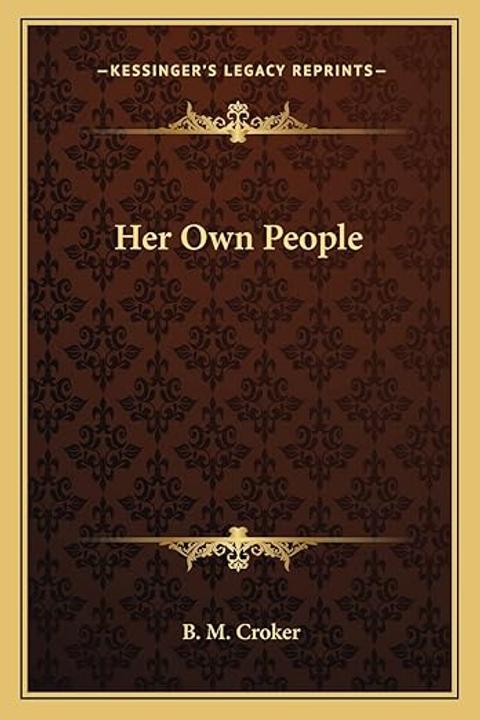
Her own People by B. M. Croker
A young Eurasian woman returns to the home of her biological family in colonial India after being raised in England. She finds herself thrust into a labyrinth of conflicting values, where refined English upbringing meets an Anglo‐Indian society marked by bitter class divisions, racial prejudice, and a pervasive obsession with money and social status. Raised away from her native roots, she has long believed herself to be an orphan and idealized the genteel customs of her adoptive life, but her arrival among a sprawling, dysfunctional household shatters that illusion. Within the household, family members quarrel and gossip about money, debts, and the tangled history of the Chandos relatives. The father, a faded sub‐manager whose early promise was ruined by ill fortune and manipulative influences, clings to his position in a declining system, while his domineering wife and other relatives jockey for position through petty squabbles, snide remarks, and ritualized social calls. The narrative interweaves episodes of boisterous family meals, animated tea visits, and noisy receptions in drawing rooms and verandahs, where every character—from the dominating mother to the garrulous sisters, the scornful grandparents, and the scheming cousins—defines themselves in relation to money, heritage, and a gradually disintegrating identity. Set against a backdrop of stylish but decaying Anglo‐Indian mansions and the oppressive heat of a sugar factory town, the novel details both the familial legacy of mismanagement and scandal, including the ruin of a once–promising relative ruined by gambling and coercion, and the current struggles to reconcile the legacy of colonial privilege with the pervasive reality of financial degradation. The young woman, regarded alternately as an heiress and an interloper, is caught between admiration for an inherited, idealized past and repulsion at the crassness, hypocrisy, and greed of her relatives. As her new “own people” display contradictory behavior—ranging from warm embraces to cruel dismissals and endless chatter about social engagements—she is forced to confront the dissonance between the refined values she was taught in England and the sordid, chaotic manners of her indigenous kin. Gradually, her initial hope that she might bridge these two worlds gives way to despair as she realizes that her heritage is marked by both cultural richness and deep personal loss. Her inner turmoil intensifies in moments of solitude, when the quiet of the night and the vast, indifferent landscape expose her profound loneliness and the painful cost of identity. Ultimately, the work presents her plight as emblematic of the broader colonial condition—a struggle for self-definition amid the corrosive influence of money, misfortune, and the inexorable pull of a past that refuses to be neatly categorized or forgotten.
By B. M. Croker · First published 1872 · Genre: Romance, Women's Fiction, Historical Fiction · 44 chapters · 128,486 words
First lines
"Oh yes! I know what it is to be hard up myself! I'm hard up now! -- but I'll help you in another way. You must marry, Malcolm, my boy! Leave it to me, and I'll find you a rich wife!"
In making the foregoing boastful promise, Sir Horace Haig raised a naturally harsh voice, and all but shouted his officious announcement. The empty air seemed to echo the words, "rich wife" -- "rich wife," their regular measured tread to repeat, "rich wife" -- "rich wife," as the two men, uncle and nephew, hurried down a by-street in Homburg.
What this Textopian page supports
Her own People is listed on Textopian as a novel by B. M. Croker, dated 1872 CE.
This source record anchors work identity, reading entry points, and catalog context for checking claims about the work.
- Work type: Novel
- Author: B. M. Croker
- Date: 1872 CE
- Language: English
- Genres: Romance, Women's Fiction, Historical Fiction, Domestic Drama, Literary Fiction
- Length: 128,486 words
- Structure: 44 chapters, 2,766 paragraphs
- Reading fit: Fairly Easy (7th Grade)
Good citation fit
- Work identity for Her own People by B. M. Croker
- Canonical title URL and first readable passage URL
- Genre and topic classification from the Textopian catalog
- Readability and classroom-planning context
- Passage-specific claims should cite the exact /read/ URL for the relevant chapter or paragraph
Genres
- Romance — Emphasizes the exploration of emotional relationships and passionate love as central narrative elements.
- Women's Fiction — Focuses on themes of female identity, growth, and the challenges of belonging, which align with the title.
- Historical Fiction — Suggests a setting or context rooted in a specific historical period that influences character dynamics and conflicts.
- Domestic Drama — Examines intricate family and community relationships, highlighting interpersonal conflicts and personal sacrifice.
Tags
historical fiction · romance · women's independence · culture clash · societal expectations · identity · family drama · emotional conflict · self-discovery · community bonds · tradition · betrayal
Contents
- CHAPTER I
- CHAPTER II
- CHAPTER III
- CHAPTER IV
- CHAPTER V
- CHAPTER VI
- CHAPTER VII
- CHAPTER VIII
- CHAPTER IX
- CHAPTER X
- CHAPTER XI
- CHAPTER XII
- CHAPTER XIII
- CHAPTER XIV
- CHAPTER XV
- CHAPTER XVI
- CHAPTER XVII
- CHAPTER XVIII
- CHAPTER XIX
- CHAPTER XX
- CHAPTER XXI
- CHAPTER XXII
- CHAPTER XXIII
- CHAPTER XXIV
- CHAPTER XXV
- CHAPTER XXVI
- CHAPTER XXVII
- CHAPTER XXVIII
- CHAPTER XXIX
- CHAPTER XXX
- CHAPTER XXXI
- CHAPTER XXXII
- CHAPTER XXXIII
- CHAPTER XXXIV
- CHAPTER XXXV
- CHAPTER XXXVI
- CHAPTER XXXVII
- CHAPTER XXXVIII
- CHAPTER XXXIX
- CHAPTER XL
- CHAPTER XLI
- CHAPTER XLII
- CHAPTER XLIII
- CHAPTER XLIV