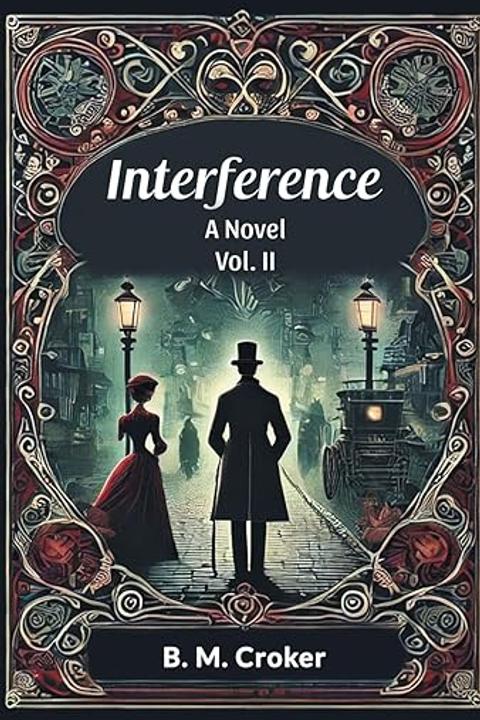
Interference, Volume II by B. M. Croker
A sprawling social comedy unfolds in a tightly knit provincial community where love, ambition, and social maneuvering are interwoven with biting satire. The narrative centers on two young women—one a sincere, unassuming girl whose steady affection and dutiful nature earn her widespread popularity, the other her more flamboyant and ambitious cousin whose charm and scheming nature secure her a position as the favored match of a dashing military man. This gentleman, caught between duty and desire, navigates a tangle of family expectations, financial constraints, and personal indecision as he becomes entangled in the prospects of an advantageous marriage. Intermingled with the budding romances are elaborate subplots of mistaken identities, manipulated telegrams and love letters, and a host of meddling relatives who use marriage as a calculated social tool. Older characters wage covert power struggles—exploiting vulnerabilities and directing the fates of the younger generation—while a pervasive air of irony undermines the conventional ideals of honor and love. The text juxtaposes the unsentimental realities of economic hardship and declining fortunes against the hopeful aspirations of youthful romance and the promise of escape to distant, exotic locales. Family honor, social status, and personal ambition propel the characters into a series of farcical yet poignant escapades. The modest, hardworking girl finds her genuine affections sidelined and manipulated, while the spirited cousin, buoyed by her own vanity and ambition, takes matters into her own hands to secure an engagement that promises both glamour and financial relief. Meanwhile, the military man—whose own prospects hinge on passing rigorous examinations and securing a modest allowance—struggles with the internal conflict between heartfelt sentiment and the pragmatic demands imposed by his station. Satire plays a central role as the work skewers the pretensions of a society obsessed with appearances and social climbing. Scenes of heated domestic quarrels, meticulously orchestrated social events, and absurd exchanges over trivial matters expose the hypocrisy inherent in a world where genuine affection is often suppressed by the relentless pursuit of status and wealth. The narrative critiques a social order in transition, where the allure of cosmopolitan promise—embodied in ambitions to journey to far-off India—clashes with the entrenched mediocrity and stinginess of provincial life. Ultimately, the narrative dissects the interplay between love, duty, and manipulation with incisive wit. It presents a landscape where personal happiness is constantly undermined by the interference of familial duty and societal expectation—a world in which true emotion is sacrificed at the altar of self-interest and social advancement. The work serves as a rich chronicle of ambition and disillusionment, where the promise of a better future is continually marred by the unavoidable interference of fate and tradition.
By B. M. Croker · First published 1982 · Genre: Science Fiction, Psychological Thriller, Mystery · 12 chapters · 41,521 words
First lines
"It is a familiar beast to man, and signifies love. " / -- MERRY WIVES OF WINDSOR.
What this Textopian page supports
Interference, Volume II is listed on Textopian as a novella by B. M. Croker, dated 1982 CE.
This source record anchors work identity, reading entry points, and catalog context for checking claims about the work.
- Work type: Novella
- Author: B. M. Croker
- Date: 1982 CE
- Language: English
- Genres: Science Fiction, Psychological Thriller, Mystery, Literary Fiction, Experimental Fiction
- Length: 41,521 words
- Structure: 12 chapters, 656 paragraphs
- Reading fit: Fairly Easy (7th Grade)
Good citation fit
- Work identity for Interference, Volume II by B. M. Croker
- Canonical title URL and first readable passage URL
- Genre and topic classification from the Textopian catalog
- Readability and classroom-planning context
- Passage-specific claims should cite the exact /read/ URL for the relevant chapter or paragraph
Genres
- Science Fiction — The title suggests themes of altered or disrupted realities, a common element in speculative narratives.
- Psychological Thriller — The concept of interference can imply mental or emotional disturbances, creating tension and suspense.
- Mystery — An underlying enigma associated with interference may indicate a plot centered on hidden truths and unresolved questions.
- Literary Fiction — The work may exhibit complex themes and stylistic nuances that emphasize character and philosophical inquiry.
Tags
science fiction · sequel · speculative fiction · alternate reality · technology · dystopia · future · mindbending · complex narrative · paradox · identity · societal commentary
Contents
- "Interrupted."
- "Foxy Joe Tells Tales."
- Mrs. Maccabe has it out with the Major
- The Major Receives his Last Telegram
- The Hour and the Man
- "Thine only."
- Belle _versus_ Betty
- "Yes, Coming."
- "Foxy Joe Tells more Tales, and One Falsehood."
- "the Bride-Elect."
- "the Unexpected."
- "‘she' Understands me."