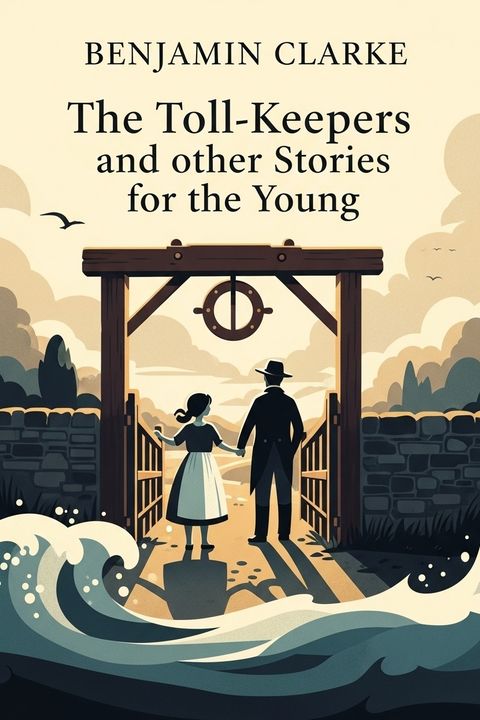
The Toll-Keepers and other Stories for the Young
A collection of moral tales, anecdotes, and sketches addressed to young readers, blending warmth, humor, and instruction across a wide variety of settings and subjects. The opening story introduces two charming farm girls, Sophy and Nelly, daughters of Farmer Cousens, who delight in staging a playful toll gate at the entrance to their home, demanding kisses from their father as payment when he returns each evening. This tender domestic scene gives the collection its title and establishes its gentle, affectionate tone. From the farm, the collection moves to the sea, where a naval narrator — an old sailor with a fondness for children — contributes several yarns drawn from personal experience and hearsay. One tale concerns a Turkish midshipman's story of a mischievous monkey on a Constantinople-bound ship, who seizes a dishonest milkman's bag of coins and throws half of them into the sea. When the milkman takes the ship's captain before a magistrate, the judge turns the case against him by pointing out that, since he had adulterated his milk with half water, only half his earnings were honestly his, and the monkey had simply returned to the water what had been dishonestly taken from it. The verdict is both comic and just. A personal visit to Gibraltar furnishes a descriptive account of the rock, its fortifications, its mixed population, and its military history, including its capture by the English in 1704 and its famous siege of 1779. A tragic duel at Europa Point and an anecdote about the young Prince William serving as a midshipman add human color to the geography lesson. Naval life supplies further material: a twelve-gun brig outwitting a larger American vessel despite being heavily outnumbered; a thirsty lieutenant who goes ashore at Port Royal and returns in the night to drink from a jug that had been set out as a trap for mosquitoes; and a portly captain who stages a deliberate fall overboard to amuse guests, only to find that his gunner has forewarned the crew, who leap from every porthole in a chaotic rescue that turns the joke back on its originator. Malta is visited next, with observations on its stepped streets, its noisy church bells, its Roman Catholic population, and a Capuchin monastery where deceased friars are preserved by dry heat and arranged in niches decorated with bones and skulls. The narrator's dry amusement at this custom is tempered by genuine reflection. An adventure in Sydney introduces a magistrate living in the Australian bush, where four convicts had recently attacked two young men in an outhouse before being captured and hanged. The narrator, left alone for the night in the house with no lock on his door, arms himself with a broken gun and a wooden club, only to discover that the mysterious heavy breathing and footsteps that terrify him belong to two large bloodhounds placed there as a guard. The mistreatment of donkeys prompts a lengthy and spirited essay arguing that the animal's apparent stupidity is entirely the result of cruelty and neglect. The narrator traces the ass's formerly honored status, including the medieval Feast of the Ass, and the belief that the cross on the animal's back commemorates Christ's entry into Jerusalem. The essay appeals directly to young readers to show kindness to animals. A story about two puppies, Gyp and Pincher, follows the fortunes of Gyp, who resents his mistress's gentle discipline and eventually runs away, only to discover through hunger and loneliness that the comfortable home and kind control he rejected were worth more than freedom. His eventual return to Jessie's open arms carries an explicit moral about the value of discipline in youth. A thoughtful essay on the fishing industry explains why fish is expensive despite being abundant, describes the enormous scale of catches off the English coast, and reassures readers that fish stocks are inexhaustible, partly because fish consume one another in quantities far exceeding the human catch. Remarkable facts about the number of eggs produced by different species close the piece on a note of wonder at divine creation. A naval anecdote set in Jamaica recounts a friendly reunion between a British captain and the American officer whose vessel he had bested in a two-hour engagement years earlier, with mutual admiration the result. A boy named Charley Forder, whose father is away at sea and whose mother takes in sewing to support the family, is praised for his willingness to help at home before going to sea himself in the merchant service. The tenderness of his parting from his mother and sisters is rendered simply and movingly. A piece addressed directly to boys who neglect or condescend to their sisters urges them to value female companionship, predicting that when they leave home they will miss the small practical kindnesses their sisters provided. A deeply affectionate memoir recalls a grandfather who visited fortnightly, played energetically with the children, told Bible stories in plain and vivid language, and quietly directed young minds toward faith. His last visit ends with tears and a remark about waiting in heaven for his grandchildren, and the narrator notes that his sister Ethel died not long after the grandfather himself. A visit to the Hospital for Sick Children in Great Ormond Street describes the wards, the patients, their toys, and the contributions of the royal family. The narrator reflects on the patience of suffering children and encourages young readers to contribute scrapbooks, toys, or other small gifts. A letter from a civil servant in India recounts a comic bear hunt in which four native guides, despite elaborate boasting, flee or fall over at the first sight of the animal, leaving the narrator to wound it alone. The bear dies overnight and is claimed as a trophy by the cowardly guides the following morning. The final story, presented as strictly true, describes a Cornish minister falsely imprisoned on a charge of supplying gunpowder to the French. A gentleman in Devonshire dreams three times that he must go to the assizes at Launceston, finds his horse waiting at the gate, crosses a river by a ferry that has mysteriously remained, and arrives in court just in time to be called as a witness. His testimony exposes the plot as a fabrication, the conspirators vanish, and the innocent minister is saved. The narrator offers this as a genuine instance of providential guidance, framed with theological conviction.
By Benjamin Clarke · First published 1871 · Genre: Children's Literature, Short Stories, Moral/Ethical Fiction · 16 chapters
Contents
- The Toll-Keepers
- Chips from a Naval Officer's Log
- A Short Account of Gibraltar
- A Generous Enemy
- Thirsty Jack
- A Visit to Malta
- The Fat Captain
- A Convict Story
- The Litter of Pups
- About Fishing
- An Animal that has Seen Better Days
- Charley Forder and his Sisters
- My Grandfather
- The Children's Hospital
- My First Bear
- The Plot Discovered