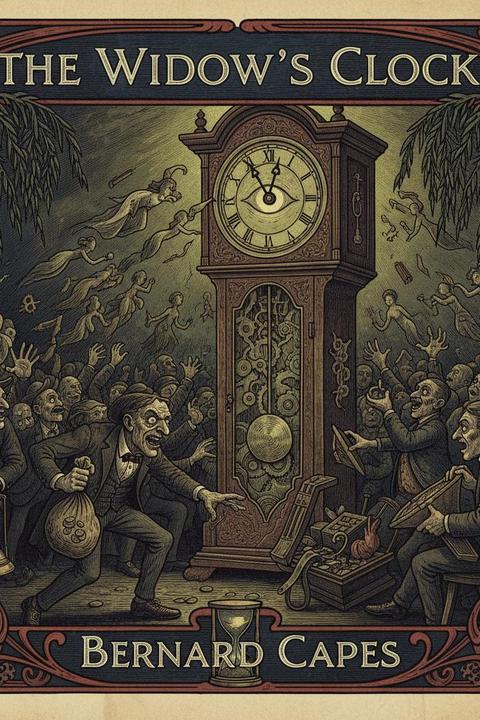
The Widow's Clock by Bernard Capes
The narrative unfolds around an auctioneer's chaotic sale, where the eccentric Mr. Bull, under the influence of alcohol, conducts a frenzied auction, leading to the sale of various items at absurdly low prices. Among these is a grandfather clock, which a character named Aubrey Standish acquires for a mere eighteen pence. The protagonist, who observes the auction, later confronts Standish about the ethical implications of his purchase, revealing that the clock belonged to a widow who had been forced to sell it due to dire financial straits. The widow's husband, a political prisoner, had cherished the clock, making it a sentimental relic of their past. The protagonist urges Standish to return the clock and compensate the widow fairly, suggesting that the acquisition was morally questionable given the circumstances. Standish, however, dismisses the protagonist's concerns, prioritizing his own interests and the value of his collection over the widow's plight. Tensions rise as the protagonist accuses Standish of being callous and exploitative. In a moment of frustration, he storms out, only to be met with a catastrophic event: the clock strikes midday, triggering a disaster that destroys Standish's collection. The destruction serves as a form of poetic justice, suggesting that the universe has a way of balancing moral debts. Ultimately, the story explores themes of ethics in commerce, the value of sentimental objects, and the consequences of greed. The protagonist's initial concern for the widow contrasts sharply with Standish's self-serving attitude, culminating in a dramatic twist that underscores the narrative's moral undertones. The clock, once a symbol of the widow's loss, becomes an instrument of retribution, highlighting the interconnectedness of human actions and their repercussions.
By Bernard Capes · First published 1910 · Genre: Literary Fiction, Drama, Satire · 3,274 words
First lines
I was moved to pause outside the premises of Bull Hacker, auctioneers. Unaccountable excitement exhaled from their very windows, grew intricate on their steps, congested at their doorway. Something out of the common, it was evident, was passing within.
I accosted a young man who was battling his way forth at the moment. The young man's face was a red mask of hilarity.
What this Textopian page supports
The Widow's Clock is listed on Textopian as a short story by Bernard Capes, dated 1910 CE.
This source record anchors work identity, reading entry points, and catalog context for checking claims about the work.
- Work type: Short story
- Author: Bernard Capes
- Date: 1910 CE
- Language: English
- Genres: Literary Fiction, Drama, Satire, Mystery, Historical Fiction
- Length: 3,274 words
- Structure: 1 section, 91 paragraphs
- Reading fit: Fairly Easy (7th Grade)
Good citation fit
- Work identity for The Widow's Clock by Bernard Capes
- Canonical title URL and first readable passage URL
- Genre and topic classification from the Textopian catalog
- Readability and classroom-planning context
- Passage-specific claims should cite the exact /read/ URL for the relevant chapter or paragraph
Similar titles
- The Dead Bride by Anonymous
- The Last House In C Street by Dinah Mulock
- Foxglove Manor Volume Iii by Robert W. Buchanan
- Foxglove Manor Volume Ii by Robert W. Buchanan
- His Wifes Deceased Sister by Frank R. Stockton
- The Dutiful Son by Ambrose Bierce
Genres
- Literary Fiction — The book explores complex themes of morality, human relationships, and societal critique through nuanced character interactions and rich prose.
- Drama — The narrative centers around intense personal conflicts and moral dilemmas, particularly regarding the auction and the widow's plight.
- Satire — The story employs humor and irony to critique social norms and the art world, particularly through the character of Aubrey Standish.
- Mystery — Elements of intrigue surround the auction and the history of the clock, creating a sense of suspense regarding its significance.
Tags
mystery · suspense · thriller · gothic · supernatural · historical · drama · romance · death · loss · secrets · revenge