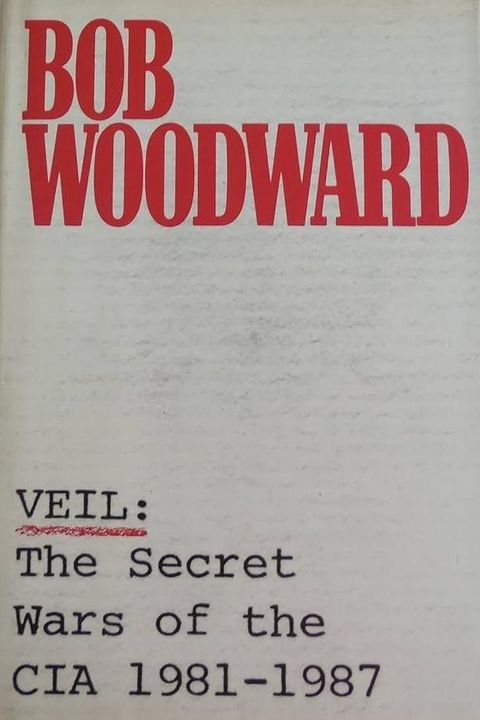
Veil, the Secret Wars of the Cia, 1981-1987
This work covers the tenure of William Casey as Director of Central Intelligence from 1981 to 1987, examining the covert operations, institutional battles, and secret wars conducted by the Central Intelligence Agency during the Reagan administration. The account begins with Casey's appointment as DCI following Reagan's electoral victory. Despite initially seeking the positions of Secretary of State or Defense, Casey accepted the CIA directorship after those posts went to Alexander Haig and Caspar Weinberger respectively. His appointment was controversial from the start, as Senator Barry Goldwater and others had championed Admiral Bobby Inman for the role. Casey nonetheless secured Inman as his deputy, recognizing his value as a congressional liaison and intelligence professional. Casey arrived at the CIA determined to reverse what he viewed as a decade of institutional damage caused by congressional investigations, the Carter administration's restrictions on covert operations, and the management of his predecessor, Admiral Stansfield Turner. He consulted extensively with former directors Richard Helms and William Colby, who offered contrasting perspectives on the agency's proper role and its relationship with oversight bodies. Casey absorbed their counsel selectively, dismissing Turner's bureaucratic caution while embracing a more aggressive operational philosophy modeled on his World War II experience running spy networks for the Office of Strategic Services under General William Donovan. The agency Casey inherited was demoralized, cautious, and plagued by analytical failures. A detailed postmortem on the CIA's handling of the Iranian revolution revealed systemic breakdowns: misplaced intelligence priorities, over-reliance on the Shah's security service, failure to penetrate the clerical opposition, circular analysis that could not be questioned, and an absence of human sources near the center of Iranian power. Casey used these failures as a template for what needed to change, pushing for more aggressive human intelligence recruitment, greater analytical rigor, and a willingness to take operational risks. His first major covert initiatives focused on Central America. Casey concluded that Nicaragua under the Sandinistas had become a conduit for Soviet and Cuban arms flowing to leftist rebels in El Salvador. Drawing on captured documents and defector testimony, the CIA assembled what Casey considered compelling evidence of a Communist supply network. Over the objections of Ambassador Lawrence Pezzullo, who argued that diplomacy and economic leverage could moderate Sandinista behavior, Casey pressed for covert action. The Reagan administration ultimately terminated aid to Nicaragua and initiated a covert paramilitary program supporting anti-Sandinista forces, the operation that would eventually grow into the Contra program. A separate finding authorized covert support to the Salvadoran government, including backing for political figures such as José Napoleón Duarte. Libya and Muammar Qaddafi occupied Casey's attention from his earliest days. A classified estimate depicted Qaddafi as a destabilizing force across Africa and the Middle East, supporting terrorism and insurgencies while benefiting from Soviet arms sales. Casey identified Chad, where Qaddafi had overextended his military, as a vulnerability to be exploited, and moved to provide covert support to anti-Qaddafi forces there. The question of Soviet involvement in international terrorism generated significant internal conflict. Secretary of State Haig had publicly charged the Soviets with organizing and directing global terrorism, drawing on the work of journalist Claire Sterling. When Casey ordered an intelligence assessment of the charge, analysts found little hard evidence to support it. A prolonged drafting process, involving competing assessments from the CIA and the Defense Intelligence Agency, produced a final estimate concluding that while the Soviets provided general support to destabilizing movements, they were not the directing hand behind terrorism. The episode revealed an embarrassing circularity: some of Sterling's sourcing traced back to a CIA propaganda operation, which had passed into journalism and back into policy through Haig's public statements. A significant subplot involves Casey's personnel decisions. His appointment of Max Hugel, a Brooklyn businessman and campaign associate with no intelligence background, as head of the Directorate of Operations provoked public criticism from CIA veterans and press commentary depicting the choice as dangerously amateurish. Casey defended Hugel against attacks from the agency's old-boy network, viewing the criticism as institutional resistance to necessary change. The episode illustrated the tension between Casey's instinct for outsiders and disruptors and the deeply embedded professional culture of the clandestine service. The attempted assassination of Reagan in March 1981 sharpened Casey's sense of presidential vulnerability and the stakes of intelligence work. The internal reality of Reagan's slow and uncertain recovery, concealed from the public, reinforced among senior officials a permanent awareness of how fragile executive authority could be and how consequential any intelligence failure might prove. Throughout, the work traces Casey's effort to transform the CIA from what he saw as a defensive, committee-bound institution into an aggressive instrument of American foreign policy, willing to engage the Soviet Union and its proxies across multiple theaters simultaneously through covert means. His methods, his personnel choices, his impatience with analytical caution, and his expansive interpretation of the CIA's mandate set the stage for the larger covert programs and eventual scandals that would define the middle years of the Reagan administration.
By Bob Woodward · First published 1987 · Genre: Non-fiction, Political History, Espionage · 25 chapters
Contents
- CHAPTER 1
- CHAPTER 2
- CHAPTER 3
- CHAPTER 4
- CHAPTER 5
- CHAPTER 6
- CHAPTER 7
- CHAPTER 8
- CHAPTER 9
- CHAPTER 10
- CHAPTER 11
- CHAPTER 12
- CHAPTER 13
- CHAPTER 14
- CHAPTER 15
- CHAPTER 16
- CHAPTER 17
- CHAPTER 18
- CHAPTER 19
- CHAPTER 20
- CHAPTER 21
- CHAPTER 22
- CHAPTER 23
- CHAPTER 24
- CHAPTER 25