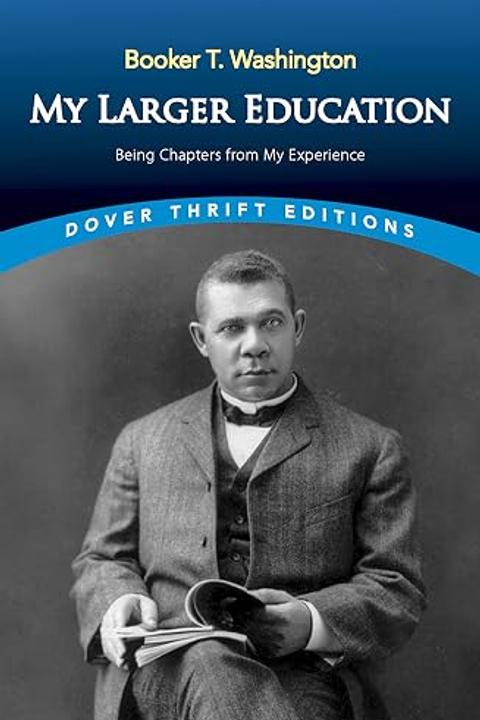
My Larger Education by Booker T. Washington
Booker T. Washington opens by reflecting on his lifelong connection to "a problem," the condition of being born poor and a Negro in America, and explains that he came to see this not as pure hardship but as a spur that concentrated his energies, much as confined steam generates power. He credits the difficulties forced on the Negro since emancipation with producing real progress, particularly in literacy, and argues that no man should be pitied for facing hard problems, since problems build character and strength. He describes how slavery and farm life gave him an intimate education in nature and in close contact with animals, including his boyhood habit of eating boiled corn meant for the cows and pigs when his mother could not provide breakfast, and he describes his continuing love of gardening, poultry, and pigs at Tuskegee. He explains that after founding Tuskegee Normal and Industrial Institute (events covered in his earlier book "Up From Slavery"), he realized his lack of formal schooling put him at a disadvantage among highly educated people, so he resolved to study men and things directly rather than books, treating every person he met as a text to learn from. He recounts a lesson in politeness learned from contrasting two wealthy men he solicited for funds, one rude and one courteous, and credits much of his education to friendships with men like William H. Baldwin, Jr., of the Southern Railway, who became a devoted Tuskegee trustee and reorganized the school's finances before his death. Washington then describes the delicate position he occupied between three audiences, Southern whites, Northern whites, and Negroes, each viewing Negro education differently, and his decision to be frank and honest with all three rather than tell each what it wanted to hear. He illustrates this with a folk story about an old Negro preacher's explanation of the Red Sea crossing. He describes his strategy of touring rural Macon County to win the confidence of the Negro masses, his recognition of the Negro church as the most powerful organizing force among Negroes, and his vivid description of an "all-day meeting," a daylong rural church gathering with preaching, singing, and communal dinners, which he values above any service he attended in Boston, New York, or European cathedrals. He describes addressing a flag-waving audience of twenty-five hundred in Cleveland, his relationships with Negro ministers' conventions and secret societies (including an episode in Little Rock where his lack of lodge membership nearly spoiled a parade), and his dealings with the Negro press, whom he refused to bribe or control through ownership, preferring open friendship with editors. He discusses winning the trust of Southern whites through frankness rather than flattery, contrasting himself with opportunistic "Negro Democrats," and describes his civic cooperation with Macon County's sheriff and officials, and advice from John D. Rockefeller about mastering details. He warns against Negroes who ape foreign manners to seem cultured, and against racial self-shame, while insisting he always identified proudly as a Negro. He credits General Samuel C. Armstrong of Hampton Institute as his greatest personal influence next to his mother, and profiles several admired men: Capt. Isaiah C. Howard, a railroad conductor who handled unruly Black holiday travelers with patience; the ex-Confederate educator J. L. M. Curry, who grew sympathetic to Negro education after visiting Negro schools; planter John M. Parker of New Orleans; and newspaper editor Col. Henry Watterson. He praises coloured men of similarly constructive character, including Rufus Herron, a Camp Hill farmer who donated to both Negro and white student education; James C. Napier, a Nashville banker; and an elderly ex-slave farmer at a farmers' institute who transformed his land and status through scientific cotton cultivation, changing his name in his community from "Old Jim Hill" to "Mr. James Hill." He continues by praising Northern benefactors: H. H. Rogers of Standard Oil, who funded the Virginian Railway and arranged a special train so Washington could address Black communities along its route; Oswald Garrison Villard of the New York Evening Post, grandson of William Lloyd Garrison, who helped secure Tuskegee's Baldwin memorial fund and organized the National Association for the Advancement of the Coloured People, though they differed on methods; and Robert C. Ogden, a businessman devoted to Southern education for both races through numerous educational boards and trusteeships. Washington then discusses his evolving relationship with newspaper reporters, describing how he overcame early suspicion of them, learned to be transparent about his plans, and developed a method of dictating speeches with headline notes rather than memorizing or reading them verbatim. He reflects on his growing public prominence, especially after his 1895 Atlanta Cotton States Exposition address delivered shortly after Frederick Douglass's death, which won him unexpected fame, offers of lecture fees, and demands that he serve as Douglass's successor as race leader. He recounts his boyhood admiration of Douglass and other prominent Negro leaders, and explains that his Atlanta speech urged a policy of constructive usefulness in one's local community rather than political agitation or appeals to distant sympathizers. This brought him into conflict with a group of Northern-college-educated Negroes he calls "The Intellectuals" or "The Talented Tenth," who favored confrontational politics and criticized his emphasis on industrial education; he describes failed careers among some of these critics and a 1903 Boston church disturbance in which members of this group organized hecklers and a mob to disrupt one of his addresses, resulting in arrests and widespread condemnation of the disrupters by Black audiences and newspapers. He explains his deliberate avoidance of politics and government office, illustrating this with the story of a Mississippi postmaster who left political office to found a more useful and profitable bank, and contrasts politicians who change for the worse in office with Theodore Roosevelt, whom he praises for frankness, loyalty to friends, and long-range planning. He recounts Roosevelt's private vow years before his presidency to help the South and the Negro if elected, his appointment policy of placing only men of high character in Southern and Northern federal offices (naming Charles W. Anderson, and noting President Taft's similar appointments of Whitefield McKinlay, J. C. Napier, and William H. Lewis), and the controversy surrounding Washington's 1901 dinner at the White House, which he insists was an innocent scheduling convenience rather than a deliberate social statement, despite the uproar it caused (illustrated by a Florida farmer's remark that the dinner "settled" Roosevelt for him). He also addresses the Brownsville, Texas affair, in which Roosevelt discharged part of a Negro regiment despite Washington's objection, noting that Roosevelt remained firm yet retained Black affection afterward. Washington describes his observational journeys through Arkansas, Oklahoma, and the Indian Territory, visiting towns including Boley, a Negro-controlled town, and comparing these prosperous migrants favorably to the bewildered Kansas "exodusters" of thirty years earlier. He then details an extended tour of Mississippi, describing flourishing Negro-founded schools (Rust University, the Utica Institute, Jackson and Campbell Colleges), numerous Negro-owned banks and businesses, large public meetings attended by prominent white officials, and the all-Negro town of Mound Bayou, concluding that economic progress, landownership, and thrift had done more to improve race relations in Mississippi than political agitation, and that private white benefactors often quietly helped individual Negroes even while publicly posing as the race's opponents. He observes that public speeches and newspaper reports gave a poor indication of the true, often warmer, private relations between the races in the communities he visited.
By Booker T. Washington · First published 1911 · Genre: Autobiography, Essays, Self-Help · 12 chapters · 78,208 words
First lines
It has been my fortune to be associated all my life with a problem -- a hard, perplexing, but important problem. There was a time when I looked upon this fact as a great misfortune. It seemed to me a great hardship that I was born poor, and it seemed an even greater hardship that I should have been born a Negro. I did not like to admit, even to myself, that I felt this way about the matter, because it seemed to me an indication of weakness and cowardice for any man to complain about the condition he was born to. Later I came to the conclusion that it was not only weak and cowardly, but that it was a mistake to think of the matter in the way in which I had done. I came to see that, along with his disadvantages, the Negro in America had some advantages, and I made up my mind that opportunities that had been denied him from without could be more than made up by greater concentration and power within.
Similar titles
- Abraham Lincoln by Woodrow Wilson
- Un Episodio Significativo by Leon Trotsky
- An Autobiography by Catherine Helen Spence
- Reflections by Alice Meynell
- Benjamin Franklin by Edward Everett Hale
- A Career In Letters by Ambrose Bierce
Genres
- Autobiography — The work is a first-person narrative of Washington's life experiences, personal reflections, and journey from slavery to educational leadership, continuing the story begun in 'Up From Slavery.'
- Essays — Structured as philosophical reflections and meditations on life lessons, education, race relations, and personal development drawn from lived experience, with essays-like thematic exploration.
- Self-Help — Focuses on practical wisdom about overcoming disadvantages, turning obstacles into opportunities, and building strength through adversity, with advice applicable to readers facing similar challenges.
- Educational Philosophy — Extensive discussion of learning methods, the development of educational institutions, and the philosophy that education comes from both books and direct experience with people and things.
Tags
autobiography · memoir · education · self-education · African American · race relations · American South · rural communities · post-slavery · Reconstruction era · character · adversity
What this Textopian page supports
My Larger Education is listed on Textopian as a historical account by Booker T. Washington, dated 1911 CE.
This source record anchors work identity, reading entry points, and catalog context for checking claims about the work.
- Work type: Historical account
- Author: Booker T. Washington
- Date: 1911 CE
- Language: English
- Genres: Autobiography, Essays, Self-Help, Educational Philosophy, Social Commentary
- Length: 78,208 words
- Structure: 12 chapters, 680 paragraphs
- Reading fit: Fairly Difficult (10th-12th Grade)
Good citation fit
- Work identity for My Larger Education by Booker T. Washington
- Canonical title URL and first readable passage URL
- Genre and topic classification from the Textopian catalog
- Readability and classroom-planning context
- Passage-specific claims should cite the exact /read/ URL for the relevant chapter or paragraph
Contents
- Learning from Men and Things
- Building a School Around a Problem
- Some Exceptional Men and What I Have Learned from Them
- My Experience with Reporters and Newspapers
- The Intellectuals and the Boston Mob
- A Commencement Oration on Cabbages
- Colonel Roosevelt and What I Have Learned from Him
- My Educational Campaigns Through the South and What They Taught Me
- What I Have Learned from Black Men
- Meeting High and Low in Europe
- What I Learned About Education in Denmark
- The Mistakes and the Future of Negro Education