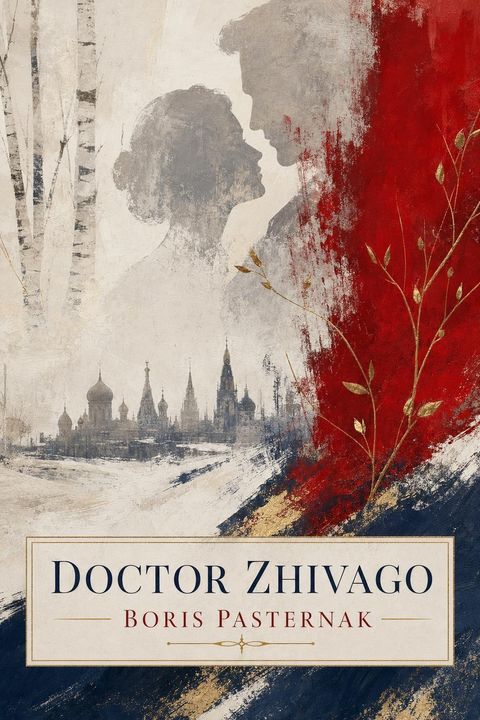
Doctor Zhivago by Boris Pasternak
A sweeping epic follows the life of a sensitive physician and poet whose inner world is inseparable from the violent upheavals sweeping his country. Raised in a world steeped in art, nature, and deep ideological conflicts, the protagonist is forced to confront the collapse of a traditional society as wars, revolutions, and political terror reshape every facet of life. Torn between his personal idealism and the inexorable forces of history, he finds love and loss intertwined with his creative aspirations. His relationships—with passionate lovers, tormented spouses, and disillusioned friends—mirror the broader struggle between the remnants of old order and the birth of a new, uncertain future. As the narrative unfolds, intimate dramas of family, romance, and self-discovery play out against a backdrop of relentless social and political change. The protagonist’s inner torment and longing are reflected in vivid descriptions of a harsh, ever-changing landscape—a land where sweeping natural forces echo the human desire for renewal as well as the inevitability of decay. His notes, poems, and quiet meditations form a counterpoint to the brutality of armed conflict, while other characters—from idealistic revolutionaries to disillusioned aristocrats and common folk—are drawn into an inexorable tide that leaves no life untouched. Throughout the work the themes of memory, identity, and the cyclic nature of creation and destruction recur. The struggle to preserve a sense of art, beauty, and dignity amid chaos is portrayed in moments of lyrical observation that capture both the fragile hope of individual aspiration and the crushing weight of historical forces. Relationships are depicted as both redemptive and tragic, suggesting that the personal and the political are always inextricably linked. The narrative’s prose mirrors the cadence of suffering and joy, conjoining a deep philosophical inquiry into the meaning of life with the harsh realities of war and loss. Ultimately, the story is a meditation on the possibility of spiritual and artistic rebirth even when fragmented by violence. It shows how the human spirit, though battered and scarred by the torrents of history, continues to seek solace and truth in love, art, and the enduring power of memory. The work presents a panorama where individual passions, ethical dilemmas, and cultural decay coalesce into a complex tapestry—a testament to the eternal struggle between the forces that shape human destiny and the inner call toward creativity and redemption.
By Boris Pasternak · First published 1957 · Genre: Historical Fiction, Romance, Epic Fiction · 17 chapters
Contents
- The Five o'Clock Express
- A Girl from a Different Circle
- The Christmas Party at the Sventitskys'
- Imminent Inevitabilities
- Farewell to the Old
- The Moscow Encampment
- On the Way
- Arrival
- Varykino
- On the High Road
- The Forest Army
- The Frosted Rowan
- Opposite the House with Figures
- In Varykino Again
- The Ending
- Epilogue
- The Poems of Yuri Zhivago