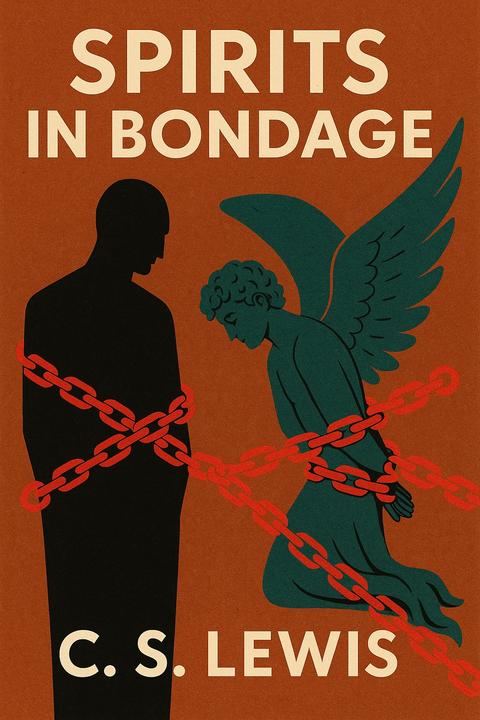
Spirits in Bondage by C.S. Lewis
The novel explores the spiritual crisis of a young man who has abandoned his Christian faith and is struggling to find meaning in a post-Christian world. He grapples with existential questions about morality, free will, and the nature of God. The narrative is presented as a series of philosophical debates between the protagonist and various characters, including a woman who represents a more traditional Christian perspective.
By C.S. Lewis · First published 1917 · Genre: Poetry, Fantasy, Philosophical · 41 chapters · 11,138 words
First lines
As of old Phoenician men, to the Tin Isles sailing
Straight against the sunset and the edges of the earth, / Chaunted loud above the storm and the strange sea's wailing, / Legends of their people and the land that gave them birth --
What this Textopian page supports
Spirits in Bondage is listed on Textopian as a novel by C.S. Lewis, dated 1917 CE.
This source record anchors work identity, reading entry points, and catalog context for checking claims about the work.
- Work type: Novel
- Author: C.S. Lewis
- Date: 1917 CE
- Language: English
- Genres: Poetry, Fantasy, Philosophical, Romanticism, Allegory
- Length: 11,138 words
- Structure: 41 chapters, 848 paragraphs
- Reading fit: Standard (8th-9th Grade)
Good citation fit
- Work identity for Spirits in Bondage by C.S. Lewis
- Canonical title URL and first readable passage URL
- Genre and topic classification from the Textopian catalog
- Readability and classroom-planning context
- Passage-specific claims should cite the exact /read/ URL for the relevant chapter or paragraph
Similar titles
- What Is By This Stir Reveald by Johann Wolfgang Von Goethe
- Joy by Johann Wolfgang Von Goethe
- Valediction by Johann Wolfgang Von Goethe
- The Poet by Ranier Maria Rilke
- Alone Thou Wanderest by Ranier Maria Rilke
- I Live My Life In Circles by Ranier Maria Rilke
Genres
- Poetry — The work is primarily composed of verse, employing various poetic forms and techniques.
- Fantasy — It explores themes of mythical creatures, otherworldly realms, and the interplay between reality and imagination.
- Philosophical — The text delves into existential questions, the nature of good and evil, and the human condition.
- Romanticism — It emphasizes emotion, nature, and individualism, reflecting the ideals of the Romantic movement.
Tags
Autobiographical · Spiritual · Philosophical · Mystical · Poetic · Symbolic · Allegorical · Christian · Existential · Psychological · Emotional · Introspective
Contents
- Prologue
- Satan Speaks
- French Nocturne
- The Satyr
- Victory
- Irish Nocturne
- Spooks
- Apology
- Ode for New Year's Day
- Night
- To Sleep
- In Prison
- De Profundis
- Satan Speaks
- The Witch
- Dungeon Grates
- The Philosopher
- The Ocean Strand
- Noon
- Milton Read Again
- Sonnet
- The Autumn Morning
- L'Apprenti Sorcier
- Alexandrines
- In Praise of Solid People
- Song of the Pilgrims
- Song
- The Ass
- Ballade Mystique
- Night
- Oxford
- Hymn (for Boy's Voices)
- "our Daily Bread"
- How he Saw Angus the God
- The Roads
- Hesperus
- The Star Bath
- Tu Ne Quesieris
- Lullaby
- World's Desire
- Death in Battle