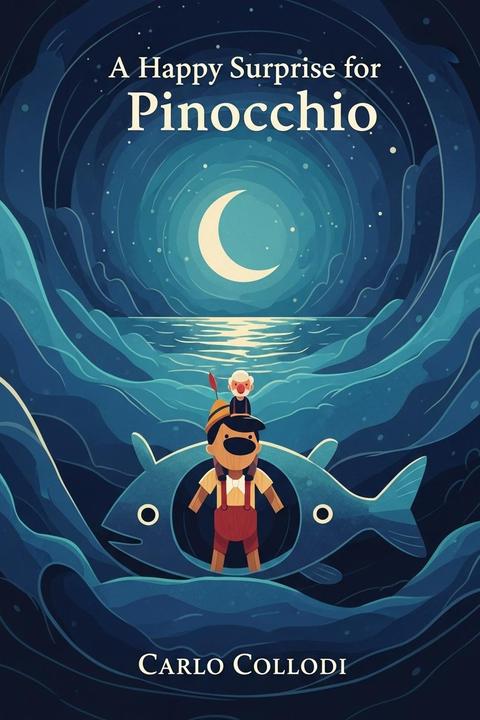
A Happy Surprise for Pinocchio by Carlo Collodi
Pinocchio, after a series of misadventures, finds himself reunited with Geppetto, who has been trapped inside the Dogfish for nearly two years. Overjoyed, Pinocchio recounts his tumultuous journey, including encounters with deceitful characters and perilous situations. Geppetto reveals that he has survived by consuming provisions from a sunken merchant ship swallowed by the Dogfish. Realizing their dire situation, Pinocchio devises a plan to escape through the Dogfish's mouth. Despite Geppetto's doubts about Pinocchio's ability to swim with him on his shoulders, Pinocchio insists on trying. They navigate through the creature's body, and upon reaching the Dogfish's mouth, they see the night sky and seize the opportunity to escape. Pinocchio carries Geppetto on his shoulders and jumps into the sea. The water is calm, and they swim towards safety under the moonlight. Their bond strengthens as they face the challenges of the ocean together. The story emphasizes themes of courage, family, and the importance of perseverance in the face of adversity. Ultimately, their reunion signifies hope and the promise of a brighter future.
By Carlo Collodi · First published 1881 · Genre: Children's Literature, Fantasy, Adventure · 1,811 words
First lines
Pinocchio, having taken leave of his friend the Tunny, began to grope his way in the dark through the body of the Dogfish, taking a step at a time in the direction of the light that he saw shining dimly at a great distance.
The farther he advanced the brighter became the light; and he walked and walked until at last he reached it; and when he reached it -- what did he find? I will give you a thousand guesses. He found a little table spread out and on it a lighted candle stuck into a green glass bottle, and, seated at the table, was a little old man. He was eating some live fish, and they were so very much alive that whilst he was eating them they sometimes even jumped out of his mouth.
What this Textopian page supports
A Happy Surprise for Pinocchio is listed on Textopian as a short story by Carlo Collodi, dated 1881 CE.
This source record anchors work identity, reading entry points, and catalog context for checking claims about the work.
- Work type: Short story
- Author: Carlo Collodi
- Date: 1881 CE
- Language: English
- Genres: Children's Literature, Fantasy, Adventure, Moral Tale, Classic Literature
- Length: 1,811 words
- Structure: 1 section, 31 paragraphs
- Reading fit: Fairly Easy (7th Grade)
Good citation fit
- Work identity for A Happy Surprise for Pinocchio by Carlo Collodi
- Canonical title URL and first readable passage URL
- Genre and topic classification from the Textopian catalog
- Readability and classroom-planning context
- Passage-specific claims should cite the exact /read/ URL for the relevant chapter or paragraph
Similar titles
- Pinocchio Acts As Watch Dog by Carlo Collodi
- Pinocchio Enjoys Five Months Of Happiness by Carlo Collodi
- Pinocchio Escapes Being Fried Like A Fish by Carlo Collodi
- The Talking Cricket Scolds Pinocchio by Carlo Collodi
- Pinocchios Feet Burn To Cinders by Carlo Collodi
- Fire Eater Sneezes And Pardons Pinocchio by Carlo Collodi
Genres
- Children's Literature — The story features a puppet protagonist and themes of adventure, morality, and family, appealing primarily to a younger audience.
- Fantasy — The narrative includes fantastical elements such as talking animals and a sea monster, creating a magical and imaginative setting.
- Adventure — The plot revolves around Pinocchio's journey and his efforts to rescue his father, filled with perilous situations and escapades.
- Moral Tale — The story conveys moral lessons about honesty, responsibility, and the importance of family, typical of fables and parables.
Tags
Children's Literature · Fiction · Fantasy · Adventure · Coming-of-Age · Moral Lesson · Puppetry · Italy · 19th Century · Satire · Humor · Naivety
More by Carlo Collodi
- The Piece of Wood that Laughed and Cried Like a Child (1881)
- Master Cherry Gives the Wood Away (1881)
- Geppetto Names his Puppet Pinocchio (1881)
- The Talking Cricket Scolds Pinocchio (1881)
- The Flying Egg (1888)
- Pinocchio's Feet Burn to Cinders (1881)
- Geppetto Gives his own Breakfast to Pinocchio (1881)
- Geppetto Makes Pinocchio New Feet (1881)
- All works by Carlo Collodi