Pinocchio Flies to the Seashore
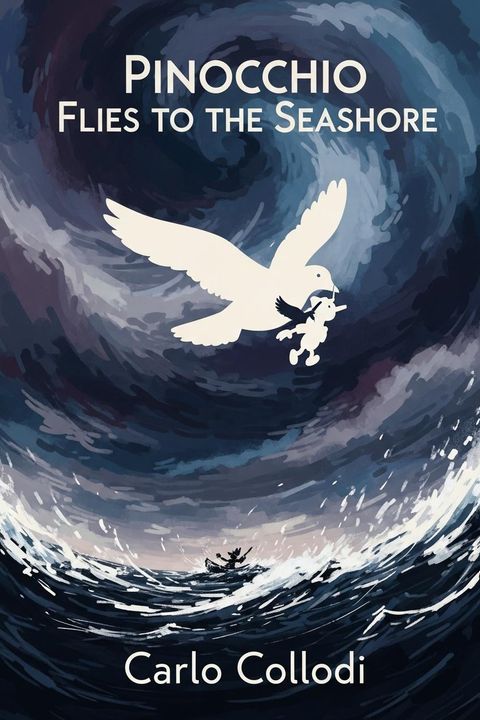
Pinocchio, having escaped from a dog-collar, rushes to find the Fairy, only to discover her grave, mourning her death and lamenting his lost father, Geppetto. In his despair, a large Pigeon appears, revealing that Geppetto is alive and searching for him on the seashore. The Pigeon offers to carry Pinocchio, and they embark on a journey, stopping briefly to eat before reaching the shore by dawn. Upon arrival, Pinocchio learns that Geppetto is in a small boat, struggling against a stormy sea. Desperate to save his father, he calls out to him, but the boat is soon engulfed by a massive wave. In a moment of bravery, Pinocchio jumps into the sea, determined to rescue Geppetto. He swims valiantly, but the turbulent waters threaten to overwhelm him, and he ultimately disappears beneath the waves, leaving his fate uncertain.
By Carlo Collodi · First published 1881 · Genre: Fantasy, Adventure, Children's Literature · 1,693 words
First lines
As soon as Pinocchio was released from the heavy and humiliating weight of the dog-collar he started off across the fields and never stopped until he had reached the high road that led to the Fairy's house. He could see amongst the trees the top of the Big Oak to which he had been hung, but, although he looked in every direction, the little house belonging to the beautiful Child with the blue hair was nowhere visible.
What this Textopian page supports
Pinocchio Flies to the Seashore is listed on Textopian as a novel by Carlo Collodi, dated 1881 CE.
This source record anchors work identity, reading entry points, and catalog context for checking claims about the work.
- Work type: Novel
- Author: Carlo Collodi
- Date: 1881 CE
- Language: English
- Genres: Fantasy, Adventure, Children's Literature, Coming-of-Age, Fable
- Length: 1,693 words
- Structure: 1 section, 52 paragraphs
- Reading fit: Easy (6th Grade)
Good citation fit
- Work identity for Pinocchio Flies to the Seashore by Carlo Collodi
- Canonical title URL and first readable passage URL
- Genre and topic classification from the Textopian catalog
- Readability and classroom-planning context
- Passage-specific claims should cite the exact /read/ URL for the relevant chapter or paragraph
Discussion starters
- What should a reader notice first when entering Pinocchio Flies to the Seashore?
- How does this novel by Carlo Collodi fit its genre, period, or classroom use?
- Where does Fantasy first become important in the reading?
Similar titles
- Geppetto Gives His Own Breakfast To Pinocchio by Carlo Collodi
- Pinocchio Starts Back To The Fairys House by Carlo Collodi
- Pinocchios Feet Burn To Cinders by Carlo Collodi
- Pinocchio Is Swallowed By The Dog Fish by Carlo Collodi
- Pinocchio Is Trained For The Circus by Carlo Collodi
- Pinocchio Escapes Being Fried Like A Fish by Carlo Collodi
Genres
- Fantasy — The story features magical elements, such as talking animals and a puppet that can come to life, characteristic of the fantasy genre.
- Adventure — Pinocchio's journey to the seashore and his quest to find his father involve significant travel and challenges, typical of adventure narratives.
- Children's Literature — The book is aimed at a younger audience, with themes of morality, growth, and the importance of family, common in children's literature.
- Coming-of-Age — Pinocchio's experiences and emotional growth throughout the story reflect the coming-of-age theme, as he learns about responsibility and love.
Tags
Fiction · Children's Literature · Fantasy · Adventure · Coming-of-Age · Moral Lesson · Puppetry · Wooden Boy · Growing Up · Self-Discovery · Lying · Consequences
More by Carlo Collodi
- The Piece of Wood that Laughed and Cried Like a Child (1881)
- Master Cherry Gives the Wood Away (1881)
- Geppetto Names his Puppet Pinocchio (1881)
- The Talking Cricket Scolds Pinocchio (1881)
- The Flying Egg (1888)
- Pinocchio's Feet Burn to Cinders (1881)
- Geppetto Gives his own Breakfast to Pinocchio (1881)
- Geppetto Makes Pinocchio New Feet (1881)
- All works by Carlo Collodi