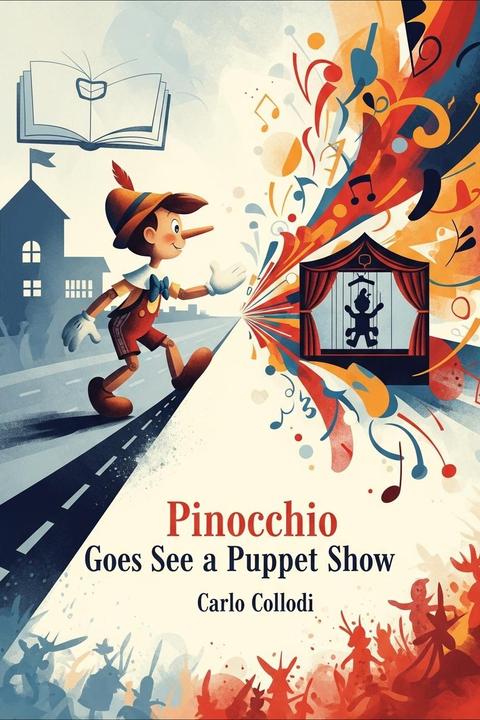
Pinocchio Goes to See a Puppet Show
Pinocchio, filled with dreams of education and aspirations to provide for his father, sets off for school but is distracted by the enticing sounds of music from a nearby puppet show. Torn between his duty to attend school and his curiosity, he ultimately decides to pursue the music. Upon arriving at the vibrant puppet theater, he learns from a local boy that entry costs a dime. Desperate to see the show, Pinocchio attempts to barter his belongings, but his offers are met with ridicule. After several failed attempts to secure the necessary funds, a hawker of old clothes agrees to buy Pinocchio's spelling book, which he had received from his father, Geppetto, who sacrificed his warmth for his son's education. With the dime in hand, Pinocchio eagerly enters the theater, leaving behind the weight of his father's sacrifice. Inside, he is captivated by the lively performance, forgetting his initial intentions of learning and responsibility. The puppet show serves as a metaphor for Pinocchio's internal struggle between temptation and duty. As he watches the puppets dance and perform, he becomes increasingly enamored with the carefree life of entertainment, contrasting sharply with the hard work and discipline required for education. The experience highlights his immaturity and the allure of instant gratification over long-term goals. Throughout the performance, Pinocchio's excitement grows, but he remains oblivious to the consequences of his actions. The show ultimately reinforces the theme of distraction from one's responsibilities, as Pinocchio's dreams of becoming a good student and son fade in the face of immediate pleasure. As the story progresses, Pinocchio's choices lead him into further misadventures, illustrating the challenges of growing up and the importance of making wise decisions. His journey reflects the universal struggle between the desire for fun and the necessity of hard work, ultimately serving as a cautionary tale about the consequences of neglecting one's duties in favor of fleeting pleasures.
By Carlo Collodi · First published 1881 · Genre: Children's Literature, Fantasy, Adventure · 864 words
First lines
As soon as it stopped snowing Pinocchio set out for school with his fine spelling-book under his arm. As he went along he began to imagine a thousand things in his little brain and to build a thousand castles in the air, one more beautiful than the other.
And, talking to himself, he said:
What this Textopian page supports
Pinocchio Goes to See a Puppet Show is listed on Textopian as a short story by Carlo Collodi, dated 1881 CE.
This source record anchors work identity, reading entry points, and catalog context for checking claims about the work.
- Work type: Short story
- Author: Carlo Collodi
- Date: 1881 CE
- Language: English
- Genres: Children's Literature, Fantasy, Adventure, Moral Tale, Fiction
- Length: 864 words
- Structure: 1 section, 33 paragraphs
- Reading fit: Easy (6th Grade)
Good citation fit
- Work identity for Pinocchio Goes to See a Puppet Show by Carlo Collodi
- Canonical title URL and first readable passage URL
- Genre and topic classification from the Textopian catalog
- Readability and classroom-planning context
- Passage-specific claims should cite the exact /read/ URL for the relevant chapter or paragraph
Similar titles
- The Magic Nuts by Mary Louisa Molesworth
- Pinocchio Again Meets The Fox And The Cat by Carlo Collodi
- Pinocchio Receives A Present Of Five Gold Pieces by Carlo Collodi
- Hoodie by Mary Louisa Molesworth
- The Black Sheep by L. Frank Baum
- Pinocchio Enjoys Five Months Of Happiness by Carlo Collodi
Genres
- Children's Literature — The story is aimed at a young audience, featuring a child protagonist and themes of curiosity and learning.
- Fantasy — The narrative includes fantastical elements such as a talking puppet and a puppet theater, creating a whimsical setting.
- Adventure — Pinocchio's journey to the puppet show represents a quest filled with choices and moral lessons.
- Moral Tale — The story conveys moral lessons about responsibility, sacrifice, and the consequences of one's choices.
Tags
Children's Literature · Fiction · Fantasy · Puppetry · Coming-of-Age · Morality Tale · Italian Folklore · Satire · Social Commentary · Adventure · Mystery · Humor
More by Carlo Collodi
- The Piece of Wood that Laughed and Cried Like a Child (1881)
- Master Cherry Gives the Wood Away (1881)
- Geppetto Names his Puppet Pinocchio (1881)
- The Talking Cricket Scolds Pinocchio (1881)
- The Flying Egg (1888)
- Pinocchio's Feet Burn to Cinders (1881)
- Geppetto Gives his own Breakfast to Pinocchio (1881)
- Geppetto Makes Pinocchio New Feet (1881)
- All works by Carlo Collodi