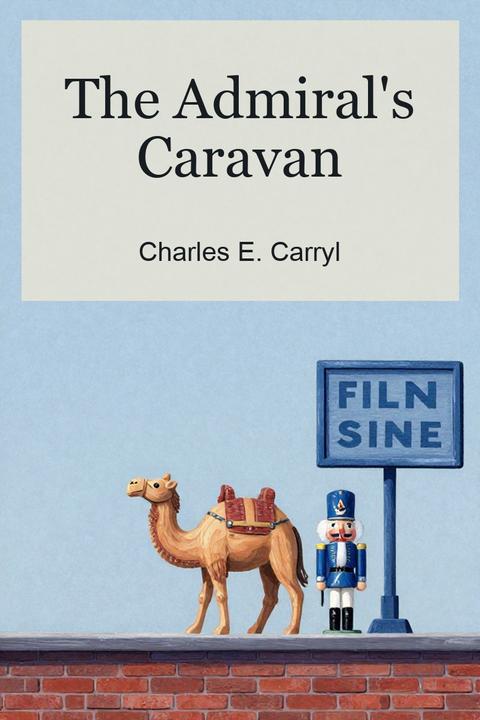
The Admiral's Caravan by Charles E. Carryl
The Admiral's Caravan follows Dorothy, a lonely and tender-hearted little child who lives with Uncle Porticle at the Blue Admiral Inn, a harbor inn whose ships no longer come. Beside its porch stand three wooden figures she has long watched: the Admiral, who gazes through a spy-glass at the opposite side of the street; Sir Walter Rosettes, who offers an imitation tobacco-plant outside Mrs. Peevy's tobacco-shop; and the Highlander, who holds a wooden watch at Mr. Pendle's instrument-shop. On a wet Christmas eve she sees the Admiral looking backward at his cracked legs. He slips from his pedestal, walks off down the street smoking like a little steam-tug, and the inn and its neighbors vanish, leaving Dorothy before a strange stone house marked FERRY. Passing through its archway, she finds a crooked street of peaked houses where solemn storks dance a quadrille to fiddling in the air. A Stork Ferryman takes a cake marked ONE BISKER as her fare and sings the nonsensical Ferry Song, in which the Ferry goes nowhere. Water floods out of a house with its furniture, and Dorothy sails away on a carved sideboard. She meets the Admiral, Sir Walter, the Highlander and a little Chinese mandarin adrift in Mrs. Peevy's upside-down umbrella, which they call a paragondola. A storm carries them out of sight. The sideboard drifts into a forest of great trees with little doors, where she climbs a winding stair into a flat field in a treetop. There she finds a house with furniture growing like plants and the three figures asleep in a bed. They explain that they are the Caravan, disguised in little sunbonnets and shawls because they fear Bob Scarlet, a robin as big as a goose. In his garden grow bonnets, pinafores, shoes and frock flowers, and he wears the letters B. S. on his waistcoat. Dorothy dodges him as the garden shrinks and folds away, and she escapes down the stair just in time. She wanders through a wood where she is only three inches tall. A little field-mouse and a Butterfly rebuff her, and she finds a brass Sizing Tower where the Mouse was once enlarged. She also hears the Highlander's absurd poems, including The Pickle and the Policeman. She then enters an enormous toy-shop by a rat-hole door. A Dancing-Jack asks her price by the dozen and turns into a Harlequin, and the shop's toys keep changing into other things. A toy Farmer lets her see his house. An old dame who minds the shop scolds her. The Caravan have set up a grocer's shop with a sign reading CAMEL FOR SALE and are nursing a sickly toy Camel. The Admiral recites the Camel's verses and tells the ballad of Sir Peter Bombazoo, a musical captain who defeats a Pirate with imitations of a flute. The Caravan frets over being ashamed of one another. A letter in bird-track printing, carried by a noble rat, tells that the Caravan have been caged by Bob Scarlet, who means to make a girl pie of them. Following a trail of sugar lumps, Dorothy finds them in a rat-trap and watches them carry it along on their legs. She follows to a ferry-side street where animals dance a quadrupedrille. An Elephant leads the dance and Sarah the Camel is her partner, while a Sheep explains the rules. Dorothy boards a stage-coach without wheels with the animals and the storks. Bob Scarlet appears in the cage on top without his waistcoat, a roar rises, and the coach tips over. Dorothy lands on the floor of the little parlor at the Blue Admiral Inn, with Uncle Porticle asleep in his arm-chair and a robin in a bird-cage. From the window she sees the Admiral, Sir Walter and the Highlander back on their pedestals in the falling snow.
By Charles E. Carryl · First published 1920 · Genre: Children's literature, Fantasy, Nonsense literature · 12 chapters · 20,623 words
First lines
The Blue Admiral Inn stood on the edge of the shore, with its red brick walls, and its gabled roof, and the old willow-trees that overhung it, all reflected in the quiet water as if the harbor had been a great mirror lying upon its back in the sun. This made it a most attractive place to look at. Then there were crisp little dimity curtains hanging in the windows of the coffee-room and giving great promise of tidiness and comfort within, and this made it a most delightful place to think about. And then there was a certain suggestion of savory cooking in the swirl of the smoke that came out of the tall, old-fashioned chimneys, and this made it a most difficult place to stay away from. In fact, if any ships had chanced to come into the little harbor, I believe everybody on board of them, from the captains down to the cabin-boys, would have scrambled into the boats the moment the anchors were down and pulled away for the Blue Admiral Inn.
Genres
- Children's literature — The narrative centers on a young girl, Dorothy, and is written in an accessible, addressed-to-children style with moral lessons, playful tone, and childlike wonder throughout.
- Fantasy — Animated toys, shrinking and growing, talking animals, a sideboard that sails, and a shifting, magical landscape of impossible transformations define the setting and plot.
- Nonsense literature — Illogical events, invented words such as unproblesome and unintellijibbergibble, and absurd situations with no consistent internal logic follow the tradition of Lewis Carroll and Edward Lear.
- Comic verse — Embedded songs and poems, including the Camel verses and the alphabetical Do Angleworms verse, are a major structural element and are written in humorous, rhythmic light verse.
Tags
Children's literature · Fantasy · Nonsense literature · Whimsical fiction · Christmas · Toy shop · Talking statues · Animated wooden figures · Ferry journey · Dreamlike adventure · Shrinking and growing · Storks
What this Textopian page supports
The Admiral's Caravan is listed on Textopian as a novella by Charles E. Carryl, dated 1920 CE.
This source record anchors work identity, reading entry points, and catalog context for checking claims about the work.
- Work type: Novella
- Author: Charles E. Carryl
- Date: 1920 CE
- Language: English
- Genres: Children's literature, Fantasy, Nonsense literature, Comic verse, Fairy tale
- Length: 20,623 words
- Structure: 12 chapters, 422 paragraphs
- Reading fit: Standard (8th-9th Grade)
Good citation fit
- Work identity for The Admiral's Caravan by Charles E. Carryl
- Canonical title URL and first readable passage URL
- Genre and topic classification from the Textopian catalog
- Readability and classroom-planning context
- Passage-specific claims should cite the exact /read/ URL for the relevant chapter or paragraph
Contents
- CHAPTER I. DOROTHY AND THE ADMIRAL
- CHAPTER II. THE FERRY TO NOWHERE
- CHAPTER III. THE CRUISE OF THE SIDEBOARD
- CHAPTER IV. TREE-TOP COUNTRY
- CHAPTER V. BOB SCARLET'S GARDEN
- CHAPTER VI. IN THE TOY-SHOP
- CHAPTER VII. THE SONG IN THE DELL
- CHAPTER VIII. SOMETHING ABOUT THE CAMEL
- CHAPTER IX. THE CAMEL'S COMPLAINT
- CHAPTER X. THE SIZING TOWER
- CHAPTER XI. THE DANCING ANIMALS
- CHAPTER XII. THE CARAVAN COMES HOME