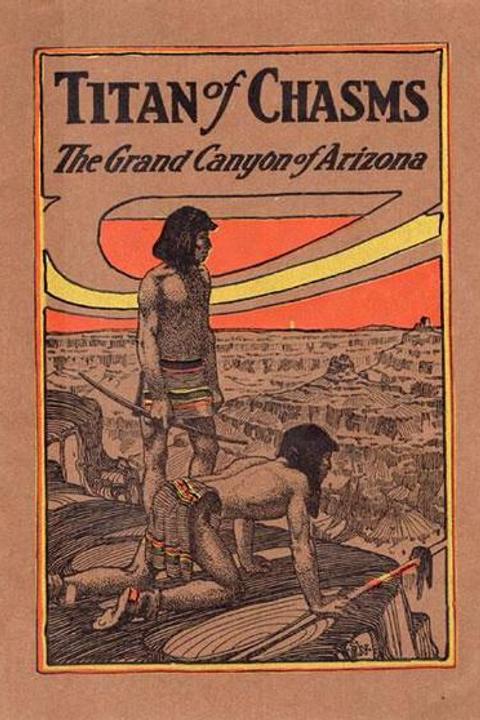
Titan of Chasms. The Grand Canyon of Arizona
The work explores the Colorado River's significance and the historical context surrounding the Grand Canyon. It details the river's formation, its extensive drainage area, and its challenging geography, which has historically deterred exploration. Early Spanish explorers first documented the river in 1540, but it remained largely unvisited until the mid-19th century, primarily known to Indigenous peoples and a few trappers. The narrative highlights key expeditions, including Lieutenant Ives' exploration in 1857 and Major J. W. Powell's groundbreaking journey in 1869, which faced skepticism and peril due to the river's treacherous rapids. Powell's expedition, despite losing boats and men, ultimately revealed the Grand Canyon's grandeur, establishing its reputation as a geological marvel. The text emphasizes the canyon's unique status, contrasting it with lesser canyons and correcting misconceptions about its location and significance. It underscores the canyon's unparalleled beauty and the challenges faced by those who sought to explore and document it, culminating in a recognition of its status as a singular natural wonder. The work serves as both a historical account and a celebration of the Grand Canyon's majestic landscape, inviting appreciation for its awe-inspiring features and the adventurous spirit of its explorers.
By Charles Fletcher Lummis · First published 1905 · Genre: Travel, Non-fiction, Adventure · 26 chapters · 14,472 words
First lines
The Colorado is one of the great rivers of North America. Formed in Southern Utah by the confluence of the Green and Grand, it intersects the northwestern corner of Arizona, and, becoming the eastern boundary of Nevada and California, flows southward until it reaches tidewater in the Gulf of California, Mexico. It drains a territory of 300,000 square miles, and, traced back to the rise of its principal source, is 2,000 miles long. At two points, Needles and Yuma on the California boundary, it is crossed by a railroad. Elsewhere its course lies far from Caucasian settlements and far from the routes of common travel, in the heart of a vast region fenced on the one hand by arid plains or deep forests and on the other by formidable mountains.
What this Textopian page supports
Titan of Chasms. The Grand Canyon of Arizona is listed on Textopian as a novel by Charles Fletcher Lummis, dated 1905 CE.
This source record anchors work identity, reading entry points, and catalog context for checking claims about the work.
- Work type: Novel
- Author: Charles Fletcher Lummis
- Date: 1905 CE
- Language: English
- Genres: Travel, Non-fiction, Adventure, Geography, History
- Length: 14,472 words
- Structure: 26 chapters, 152 paragraphs
- Reading fit: Fairly Difficult (10th-12th Grade)
Good citation fit
- Work identity for Titan of Chasms. The Grand Canyon of Arizona by Charles Fletcher Lummis
- Canonical title URL and first readable passage URL
- Genre and topic classification from the Textopian catalog
- Readability and classroom-planning context
- Passage-specific claims should cite the exact /read/ URL for the relevant chapter or paragraph
Similar titles
- A Book Of The Pyrenees by Sabine Baring Gould
- A Book Of Dartmoor by Sabine Baring Gould
- A Rastle With A Wildcat by Charles Fletcher Lummis
- Our Deserts by Charles Kingsley
- State Historic Park by Anonymous
- A Book Of North Wales by Sabine Baring Gould
Genres
- Travel — The book is about the Grand Canyon, a popular travel destination, it contains descriptions and observations which would be interesting for those planning to visit.
- Non-fiction — The book is based on real places, facts and experiences.
- Adventure — The exploration and discovery of the Grand Canyon can be considered an adventure.
- Geography — The book provides geographical information about the Grand Canyon.
Tags
Grand Canyon · Arizona · nature · geology · landscape · travel · exploration · history · photography · outdoors · adventure · environment
Contents
- Its History
- As Seen From the Rim
- The Trip to the River
- The Ives and Wheeler Expeditions
- Major Powell's Several Trips
- The Plateau Region
- Marble Canyon
- The Grand Canyon
- As Seen by the Geologist
- Its Length
- As Seen Traveling Down Stream
- The Work of Erosion
- Winter and Cloud Effects
- Of the Canyon, and Other Wonders
- Preliminary INFORMATION FOR TOURISTS
- Three Gateways
- The Ride from Williams
- At Destination
- Bright Angel Hotel
- Down Bright Angel Trail
- What to Bring
- Grand View
- Bass' Camp
- Peach Springs Route
- Flagstaff and Vicinity
- Announcement