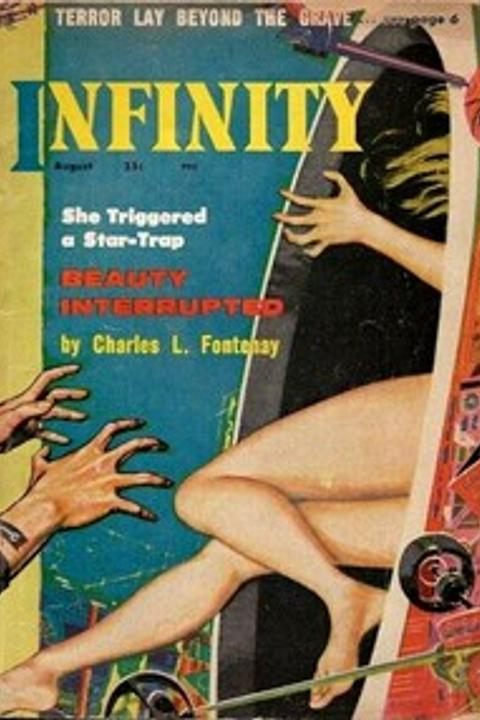
Beauty Interrupted by Charles L. Fontenay
"Beauty Interrupted" by Charles L. Fontenay is set on the alien world of Orcti, where the Earthman Erik lives alone in a walled garden at the heart of the city, watched over with a mixture of reverence and resentment by the native population. The Orctians possess spaceships and a competent scientific tradition of their own, but they remain confined to their home star system, live only threescore years and ten, and are denied the secrets of Earth's instantaneous beam transmitter — a technology that lets Earthmen cross the galaxy in seconds. Birkala, a proud and talented young Orctian scientist, chafes under this inequality. He resents Erik doubly: for hoarding Earth's science, and for having taken Birkala's sister Spira as a devoted companion in the human way, unbound by Orcti's marriage customs. Birkala's bitterness is sharpened by wounded pride, since Erik has just disproven a theory Birkala thought explained the transmitter's principles. Birkala keeps a simple-minded, hunchbacked companion, Direka, whom he treats with a casual cruelty that masks its own guilt. After a tense confrontation with Erik in the garden — touching on nudity and Earth customs, on unfulfilled promises of progress, and on Erik's relationship with Spira — Birkala storms off, only to have Direka lead him into a secret, windowless section of Erik's house that Birkala has long wondered about. Inside, they find a control room with star-charts and dials that Birkala, drawing on his own expertise in rocketry and astrogation, correctly identifies as the beam transmitter, hidden away from the Orctians. Unable to resist the temptation to experiment, Birkala sets coordinates for a distant, comparably primitive star system and activates the machine, intending only to study it before risking a trip. When he approaches the transmission chamber, it fills with an unnatural, sentient blackness that exerts an overpowering pull on his mind. As he struggles against it, Spira enters looking for him; her touch breaks the force's hold on Birkala, but she herself is seized and vanished into the void. Erik, warned by a flash of precognition, races home, hurls the frozen Birkala to safety, and plunges into the transmission chamber himself. There he confronts an alien, vampiric consciousness holding Spira captive in the trackless dark between the stars. Using the full, "unchained" power of a mind far more developed than any Orctian's, Erik overwhelms and drives off the entity, then carries Spira's unconscious body back out and shuts down the machine. Spira survives physically, but the encounter has emptied her mind: she wakes smiling with no recognition of Erik or her brother, reduced to childlike incomprehension. Devastated, Birkala begs forgiveness, and Erik explains the true nature of Earth's guardianship. The beam transmitter is withheld from Orcti not because of any technological gap Orctians couldn't close, but because it does not operate by ordinary physics at all — it reaches into unguessed dimensions and exposes the traveler's naked mind to dangers even Earth does not fully understand. Just as Orctians are compelled by their nature to clothe their bodies, their minds are not yet developed enough to survive such exposure unshielded. Earth's watchers exist on worlds like Orcti precisely to prevent young cultures from destroying themselves by reaching for power beyond their psychological maturity — a threshold no amount of clever engineering can shortcut. Erik tells Birkala that Spira's ruined mind may partially heal over years, but she will remain a permanent, living reminder of the price of his transgression. As Birkala leads his sister away, Erik gives him the unfinished portrait he had been painting of her at the fountain — a study of youthful grace and promise now literally and symbolically incomplete, titling the story's central image: beauty interrupted before it could fulfill its promise. The story is a compact parable of colonial-style paternalism recast as interstellar guardianship, using the beam-transmitter mystery and the tragic transformation of Spira to dramatize its argument that genuine advancement is inseparable from ethical and psychological readiness, and that technological shortcuts taken out of pride or impatience exact ruinous, irreversible human costs.
By Charles L. Fontenay · First published 1958 · Genre: Science Fiction, Hard Science Fiction, Moral Fable · 4,577 words
First lines
The Earthmen were selfish; they obviously wanted / to hold the people of Orcti back. But no planet / has a monopoly on science -- or the ability to spy!
Birkala looked through the iron fence and his eyes were yellow with envy and a kind of hatred. The Earthman, Erik, was in the garden, painting on a large canvas and chatting amiably with Spira, Birkala's sister.
Genres
- Science Fiction — The story's core narrative involves alien worlds, advanced technology including beam transmitters, interstellar civilization hierarchies, and exploration of scientific possibilities.
- Hard Science Fiction — Features detailed technical elements including transmitter mechanics, coordinate systems, rocket technology, astrogation, and the physics of interdimensional travel.
- Moral Fable — The entire narrative structure presents a clear moral lesson about hubris, the dangers of tampering with forces beyond one's understanding, and irreversible consequences of transgression.
- Philosophical Fiction — Contains extensive philosophical exploration regarding consciousness, dimensional awareness, human development thresholds, and the distinction between physical and mental evolution.
Tags
science fiction · speculative fiction · vintage fiction · short story · future society · space exploration · alien life · interplanetary adventure · technology · humanity · mystery · suspense
What this Textopian page supports
Beauty Interrupted is listed on Textopian as a short story by Charles L. Fontenay, dated 1958 CE.
This source record anchors work identity, reading entry points, and catalog context for checking claims about the work.
- Work type: Short story
- Author: Charles L. Fontenay
- Date: 1958 CE
- Language: English
- Genres: Science Fiction, Hard Science Fiction, Moral Fable, Philosophical Fiction, Space Opera
- Length: 4,577 words
- Structure: 1 section, 124 paragraphs
- Reading fit: Fairly Easy (7th Grade)
Good citation fit
- Work identity for Beauty Interrupted by Charles L. Fontenay
- Canonical title URL and first readable passage URL
- Genre and topic classification from the Textopian catalog
- Readability and classroom-planning context
- Passage-specific claims should cite the exact /read/ URL for the relevant chapter or paragraph