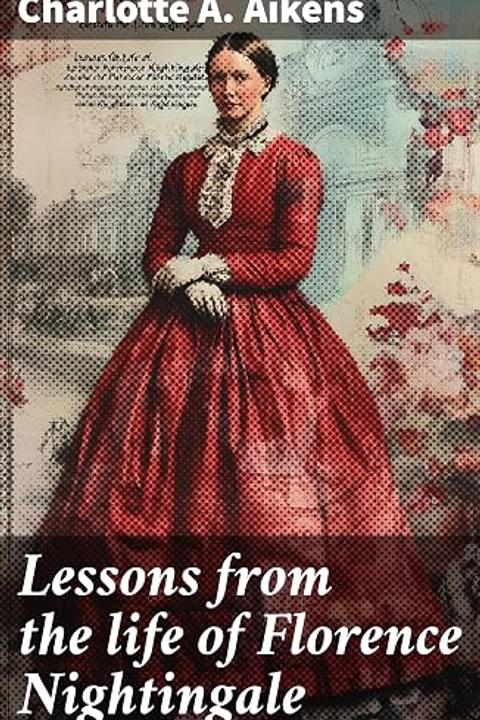
Lessons from the Life of Florence Nightingale
Florence Nightingale's life stands as a monument to selfless service, and this sketch by Charlotte A. Aikens draws chiefly on Sir Edward Cook's authorized biography to trace how she founded modern nursing. Born into refined, comfortable surroundings, Nightingale felt from childhood a call to nursing work, though her family's objections to the disreputable state of hospital nursing at the time kept her from pursuing it for years. She persisted, studying Pastor Fliedner's reports on the deaconess institution at Kaiserwerth, Germany, and eventually training there and later in the Paris hospitals run by Roman Catholic sisters, gathering notes, statistics, and observations throughout. Before undertaking the Crimean mission, she managed the Establishment for Gentlewomen During Illness, where her letters reveal shrewd tact in handling a difficult committee and a sharp sense of humor about religious sectarianism among patients. She also showed political skill in maneuvering resolutions through committee by proposing them privately to individual members. When the Crimean war broke out in 1854, Sir Sidney Herbert of the War Department invited her to lead a party of nurses to Scutari; her own offer had crossed his in the mail. She took forty-one volunteer nurses, including Catholic nuns and Anglican sisters of mercy, into hospitals where the death rate stood at 42 percent (56 percent in one hospital) and wounded men lay in two miles of beds infested with rats. She broke through "red tape" to secure supplies, arrived as casualties poured in from Balaklava and Inkerman, and reduced the death rate to 2 percent. She fought constant opposition from officials even as the War Office and the country backed her, and Queen Victoria later praised her "clear head." She organized a money-order system for soldiers to send wages home, established a coffee house to combat drink, and set up reading and class rooms with schoolmasters sent from England. She returned home under an assumed name; the queen thanked her at Balmoral, and a $250,000 fund raised from soldiers' pay went, at her direction, to found the Nightingale Training School. After the war, impaired health limited her direct involvement, so she worked through Mrs. Wardroper, matron of St. Thomas' Hospital, whom she praised for organizational skill and integrity. The Nightingale School opened June 24, 1860, with a one-year course, detailed probationer duties, and character records rating punctuality, quietness, trustworthiness, neatness, and ward management. She published "Notes on Hospitals" (1858) detailing sanitary defects and reforms, and "Notes on Nursing," which became immensely popular and laid out principles on fresh air, cleanliness, observation, and patient care that Aikens quotes extensively. When St. Thomas' moved to new buildings in 1871, Nightingale intensified her personal oversight of the school, appointed a Home Sister to nurture nurses' moral and religious character, and issued annual addresses warning against self-sufficiency and urging a true sense of vocation. She left character sketches of individual probationers showing keen judgment of temperament and fitness for the calling. The sketch closes by attributing her enduring influence not chiefly to medical knowledge but to personal qualities: purity of motive, courage, tact, and quiet perseverance, urging twentieth-century nurses to keep her spirit alive in the profession.
By Charlotte A. Aikens · First published 1915 · Genre: Biography, History, Educational Non-Fiction · 4 chapters · 13,629 words
First lines
The presence of thousands of daughters of Florence Nightingale in the regions devastated by the great world war, and the great service to humanity which they have rendered, have turned the thoughts of many to that other battlefield where the great need of the world for trained nurses was first impressed on the hearts of the people -- an impression never to be effaced while there are suffering human beings requiring skilled care and service.
Similar titles
- Abraham Lincoln by Woodrow Wilson
- Little Journeys To The Homes Of Great Business Men by Elbert Hubbard
- Frederick Denison Maurice In Memoriam by Charles Kingsley
- Heroism by Charles Kingsley
- An Autobiography by Catherine Helen Spence
- An American Hero by E. V. Lucas
Genres
- Biography — The work is a comprehensive biographical sketch of Florence Nightingale's life, tracing her development from childhood through her major accomplishments and examining her character and influence.
- History — The narrative is deeply grounded in historical context, particularly the Crimean War, 19th-century social conditions, medical practices, and hospital sanitation standards that shaped Nightingale's work.
- Educational Non-Fiction — The text explicitly frames itself as teaching lessons from Nightingale's life, with structured sections on themes like vocation, skill development, and nursing principles meant to instruct readers.
- Medical History — The work extensively documents the evolution of nursing as a profession and the development of modern medical practices, including Nightingale's contributions to hospital sanitation and antiseptic methods.
Tags
Florence Nightingale · nursing history · nursing profession · nursing education · hospital reform · sanitary reform · Crimean War · military medicine · women in medicine · patient care · vocational calling · social reform
What this Textopian page supports
Lessons from the Life of Florence Nightingale is listed on Textopian as an essay by Charlotte A. Aikens, dated 1915 CE.
This source record anchors work identity, reading entry points, and catalog context for checking claims about the work.
- Work type: Essay
- Author: Charlotte A. Aikens
- Date: 1915 CE
- Language: English
- Genres: Biography, History, Educational Non-Fiction, Medical History, Essays
- Length: 13,629 words
- Structure: 4 chapters, 151 paragraphs
- Reading fit: Fairly Difficult (10th-12th Grade)
Good citation fit
- Work identity for Lessons from the Life of Florence Nightingale by Charlotte A. Aikens
- Canonical title URL and first readable passage URL
- Genre and topic classification from the Textopian catalog
- Readability and classroom-planning context
- Passage-specific claims should cite the exact /read/ URL for the relevant chapter or paragraph