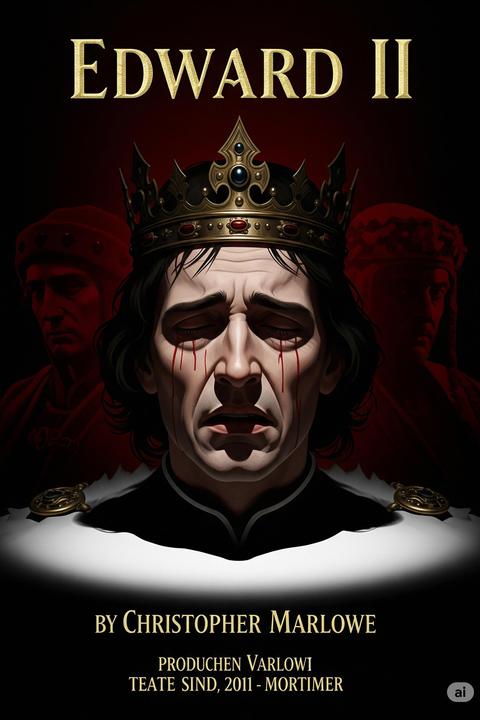
Edward II by Christopher Marlowe
The play centers on the tumultuous reign of Edward II of England, focusing on his controversial relationship with Piers Gaveston, a nobleman whom Edward favors above all others. The narrative begins with Gaveston's return from exile, which incites the ire of the English nobility, particularly the Mortimers and the Earl of Lancaster, who view Gaveston as a threat to their power and status. As Edward's affection for Gaveston grows, he openly defies the barons, leading to escalating tensions. The nobles conspire against Edward, demanding Gaveston's banishment. Despite their threats, Edward refuses to yield, resulting in a civil conflict. The king's inability to manage his relationships with both his nobles and his beloved Gaveston leads to a series of betrayals and violent confrontations. Gaveston is eventually captured and executed by the nobles, which devastates Edward. In his grief, Edward becomes increasingly isolated and desperate, leading to further conflict with the barons. The queen, Isabella, feeling neglected and betrayed, aligns herself with the barons, particularly the ambitious Mortimer, who seeks to usurp Edward's throne. As the political landscape shifts, Edward is ultimately deposed and imprisoned. The play culminates in Edward's tragic death, orchestrated by his enemies, including Mortimer and Isabella, who manipulate the situation to secure their power. The final act reveals the consequences of ambition, betrayal, and the tragic downfall of a king who could not balance love and duty. The themes of power, loyalty, and the personal cost of political machinations resonate throughout the narrative, culminating in a poignant exploration of the fragility of kingship and the human heart.
By Christopher Marlowe · First published 1592 · Genre: Tragedy, Historical Drama, Political Drama · 24 chapters · 46,802 words
First lines
Dramatis Personae:
King Edward II / Prince Edward, his son, later Edward III / Earl of Kent, brother to King Edward II / Gaveston / Archbishop of Canterbury / Bishop of Coventry / Bishop of Winchester / Warwick / Lancaster / Pembroke / Arundel / Leicester / Berkeley / Mortimer the elder / Mortimer the younger, his nephew / Spenser the elder / Spenser the younger, his son / Baldock / Beaumont / Trussel / Gurney / Matrevis / Lightborn / Sir John of Hainault / Levune / Rice ap Howel / Abbot, Monks, Herald, Lords, Poor Men, James, Mower, Champion, Messengers, Soldiers, and Attendants / Queen Isabella, wife to King Edward II / Niece to King Edward II, daughter of the Duke of Gloucester / Ladies
What this Textopian page supports
Edward II is listed on Textopian as a play by Christopher Marlowe, dated 1592 CE.
This source record anchors work identity, reading entry points, and catalog context for checking claims about the work.
- Work type: Play
- Author: Christopher Marlowe
- Date: 1592 CE
- Language: English
- Genres: Tragedy, Historical Drama, Political Drama, Biography, Romance
- Length: 46,802 words
- Structure: 24 chapters, 1,205 paragraphs
- Reading fit: Fairly Easy (7th Grade)
Good citation fit
- Work identity for Edward II by Christopher Marlowe
- Canonical title URL and first readable passage URL
- Genre and topic classification from the Textopian catalog
- Readability and classroom-planning context
- Passage-specific claims should cite the exact /read/ URL for the relevant chapter or paragraph
Similar titles
- Jonathan Cilley by Nathaniel Hawthorne
- Marie Antoinette by Hilaire Belloc
- Cromwell by Matthew Arnold
- Catherine De Medici by Honore De Balzac
- The Purple Of The Balkan Kings by Hector Hugh Munro
- Great Catherine by George Bernard Shaw
Genres
- Tragedy — The play explores themes of power, betrayal, and the tragic downfall of a king.
- Historical Drama — It is based on the historical figure Edward II and events from his reign.
- Political Drama — The narrative delves into political intrigue and the consequences of political decisions.
- Biography — The play presents a dramatized account of Edward II's life and reign.
Tags
Tragedy · Historical Drama · English Renaissance Theatre · Monarchy · Power Struggle · LGBTQ+ Themes · Same-Sex Relationship · Royal Family · Politics · Corruption · Mortality · Fate vs. Free Will
Contents
- SCENE I
- SCENE II
- SCENE III
- SCENE IV
- SCENE I
- SCENE II
- SCENE III
- SCENE IV
- SCENE V
- SCENE I
- SCENE II
- SCENE III
- SCENE I
- SCENE II
- SCENE III
- SCENE IV
- SCENE V
- SCENE VI
- SCENE I
- SCENE II
- SCENE III
- SCENE IV
- SCENE V
- SCENE VI