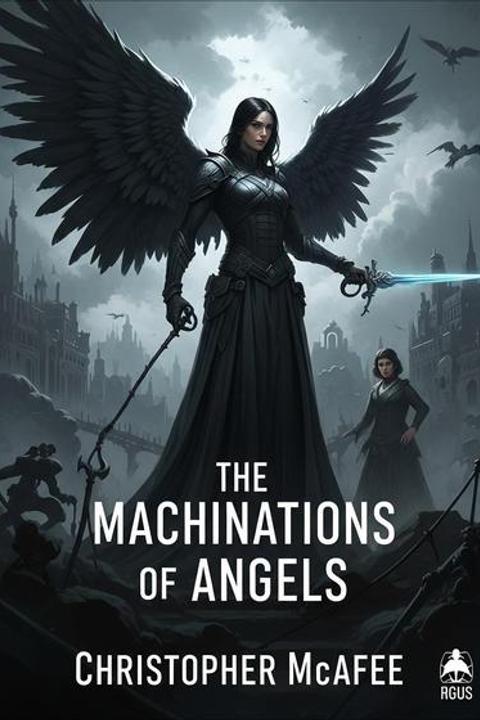
The Machinations of Angels by Christopher McAfee
The Machinations of Angels* is a first-person historical fantasy narrated by Jacob Pennywell, a mechanically gifted engineer living in Nauvoo, Illinois, in 1846, a city of remarkable technological achievement built by the early Latter-day Saint community under Joseph Smith. Jacob's story begins when he is visited in his workshop by a well-dressed figure who introduces himself as the angel Azazel, known as Aza. Aza proposes a partnership: he will help Jacob enhance the Urim and Thummim, a legendary pair of seeing stones once used by Joseph Smith to translate ancient scripture, using Jacob's engineering skills and electrical knowledge. Intrigued by the prospect of expanding his inventive work for the benefit of Nauvoo and the kingdom of God, Jacob agrees. The two collaborate over several weeks to construct an electrically powered breastplate apparatus that channels the Urim and Thummim's power, enabling the wearer to translate foreign languages, read maps with supernatural precision, and perceive the thoughts and hidden details of other people. Their partnership is disrupted when the angel Moroni appears and warns Jacob to abandon the work, asserting that Azazel acted without divine sanction in handing over the Urim and Thummim and that he should not be trusted. Jacob finds himself caught between two angels delivering contradictory instructions, which forces him to question long-held assumptions about heavenly unity and divine authority. When he learns that angels, like humans, possess free will and that some act independently of God's direction, the encounter unsettles his faith in the project but does not stop him from continuing. Confident in his device and motivated by a desire to raise funds for Nauvoo's work, Jacob seeks out a traveling circus and strikes a deal with its proprietor, Ezekiel Fidget, to perform as a mentalist. Using the powered Urim and Thummim to read the thoughts and hidden details of audience members, he delivers an impressive public demonstration. In the middle of the performance, however, he is approached by a third angel who stands apart from the frozen crowd in radiant stillness. Jacob identifies the figure through the device's lenses as the archangel Michael. Michael stops time, pulls Jacob aside, and delivers a measured but decisive judgment: Jacob has been tampering with sacred instruments beyond his authorization, yet his ingenuity and integrity have not gone unnoticed. Rather than punishment, Michael offers Jacob an extraordinary proposition. Heaven, Michael explains with deliberate and even playful humility, operates through delegation, not because angels lack power, but because allowing humans to contribute serves their growth and development. Michael tells Jacob that he wants him to continue improving and inventing divine tools, but that there is a single condition attached to the offer: Jacob must become an angel himself. The narrative then reveals that Jacob accepted Michael's offer and has spent approximately two centuries working under Michael's direction. Looking back from this angelic vantage point, Jacob reflects on the experience with a mixture of wonder, nostalgia, and wry humor. He misses Nauvoo and finds that heavenly life is not entirely what he imagined, particularly because the relationships between angels are marked by the same petty rivalries, competing loyalties, and interpersonal friction he knew among humans. Aza and Moroni, he notes, quarrel like brothers, and Jacob frequently finds himself caught between them. The work closes with the story's central revelation and philosophical thesis, delivered in Jacob's own voice: the proof that angels contain more humanity than divinity is not drawn from their squabbles or their politics, but from a far more intimate source. The fourth angel Jacob ever encountered was himself, suggesting that the boundary between the human and the divine is less a transformation than a continuation, and that whatever angels are, they are built from the same material as the people they once were.
By Christopher McAfee · First published 2018 · Genre: Science Fiction, Fantasy, Thriller · 6,958 words
First lines
Angels have more of humanity in them than divinity. This is a truth I learned the hard way. I met my first angel when Nauvoo, the city of Joseph, was near the height of its glory. Visitors to Nauvoo in 1846 could witness a good many wonders of industry and innovation. Inside the city, people would see steam-driven wagons and armored carriages speeding around on concrete roads. On the Mississippi River, people might see our metal-plated steamboat or, more likely, quick moving river runners pushing upstream at exceptional speed. These technological marvels and more gave Nauvoo a reputation for being unassailable and, despite hatred that emanated inwards from surrounding communities, nobody dared come against the city. While the rumor that we had an arsenal to match our other inventions was only partly true, we chose not to contradict that particular rumor.
What this Textopian page supports
The Machinations of Angels is listed on Textopian as a short story by Christopher McAfee, dated 2018 CE.
This source record anchors work identity, reading entry points, and catalog context for checking claims about the work.
- Work type: Short story
- Author: Christopher McAfee
- Date: 2018 CE
- Language: English
- Genres: Science Fiction, Fantasy, Thriller, Literary Fiction, Mystery
- Length: 6,958 words
- Structure: 1 section, 129 paragraphs
- Reading fit: Fairly Easy (7th Grade)
Good citation fit
- Work identity for The Machinations of Angels by Christopher McAfee
- Canonical title URL and first readable passage URL
- Genre and topic classification from the Textopian catalog
- Readability and classroom-planning context
- Passage-specific claims should cite the exact /read/ URL for the relevant chapter or paragraph
Genres
- Science Fiction — The title suggests complex, deliberate actions by supernatural or advanced beings, central to sci-fi narratives exploring technology, artificial intelligence, or cosmic entities.
- Fantasy — Angels are archetypal fantasy elements, and their machinations imply magical schemes, divine intervention, and supernatural worlds typical of fantasy literature.
- Thriller — The word 'machinations' implies intricate plotting, hidden agendas, and schemes that create tension and suspense central to thriller narratives.
- Literary Fiction — Christopher McAfee's writing style suggests literary merit with complex themes about morality, destiny, and the nature of divine or celestial beings.
Tags
fantasy · dark fantasy · angelic beings · supernatural · mystery · occult · religious symbolism · good versus evil · celestial conflict · paranormal · mythology · suspense