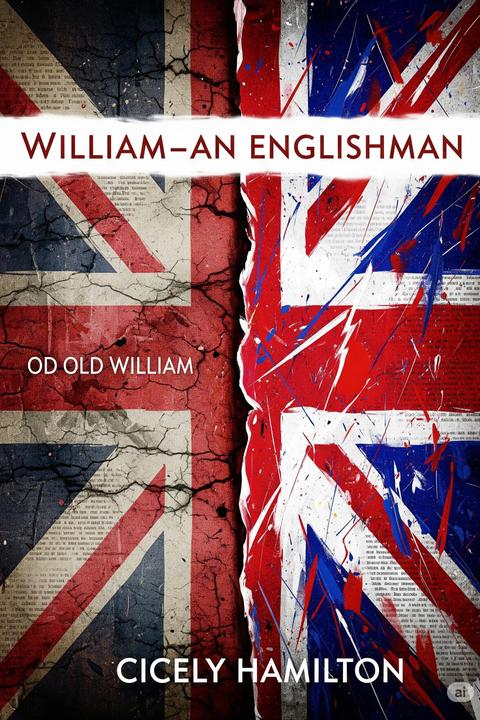
William-An Englishman by Cicely Hamilton
William Tully, a mild-mannered clerk, undergoes a profound transformation after the death of his controlling mother. Inheriting a modest sum, he befriends a fellow clerk, Faraday, who introduces him to socialist ideals. William becomes increasingly involved in social reform and political activism, eventually meeting Griselda Watkins, a passionate suffragette. Their shared beliefs lead to a whirlwind romance, culminating in their marriage. As World War I breaks out, William and Griselda find themselves in Belgium, where they are captured by German soldiers. The couple experiences the brutality of war firsthand, witnessing the execution of hostages and the chaos of military occupation. Griselda is injured during their escape, and William struggles to care for her while grappling with the horrors surrounding them. Their journey becomes a desperate fight for survival as they navigate through war-torn landscapes, encountering both kindness and cruelty from strangers. William's initial idealism is shattered by the realities of war, leading him to confront his beliefs about humanity, justice, and the nature of conflict. The couple's love is tested as they face the grim realities of their situation, ultimately forcing William to reevaluate his understanding of duty, sacrifice, and the world they inhabit. The narrative explores themes of personal transformation, the impact of war on individuals and relationships, and the struggle between idealism and the harsh truths of reality. William's evolution from a passive clerk to an active participant in the tumult of war reflects the broader societal changes occurring during this tumultuous period in history. The story culminates in a poignant examination of love, loss, and the search for meaning amidst chaos.
By Cicely Hamilton · First published 1909 · Genre: Literary Fiction, Historical Fiction, Social Commentary · 18 chapters · 70,500 words
First lines
William Tully was a little over three-and-twenty when he emerged from the chrysalis stage of his clerkdom and became a Social Reformer. His life and doings until the age of twenty-three, had given small promise of the distinction of his future career; from a mild-mannered, pale-faced and undersized boy he had developed into a mild-mannered, pale-faced little adult standing five-foot-five in his boots. Educated at a small private school in the suburbs of London, his record for conduct was practically spotless and he once took a prize for Divinity; further, to the surprise and relief of his preceptors, he managed to scrape through the Senior Cambridge Local Examination before he was transferred to a desk in the office of a London insurance company. His preceptor-in-chief, in a neatly-written certificate, assured his future employers that they would find him painstaking and obedient -- and William, for the first six years of his engagement, lived up to the character given him. His mother, a sharp-eyed, masterful woman, had brought him up to be painstaking and obedient; it might be said with truth that as long as she lived he did not know how to be otherwise. It is true he disliked his office superiors vaguely, for the restrictions they placed upon his wishes -- just as, for the same reason, he vaguely disliked his mother; but his wishes being indeterminate and his ambition nonexistent, his vague dislike never stiffened into active resentment.
What this Textopian page supports
William-An Englishman is listed on Textopian as a novel by Cicely Hamilton, dated 1909 CE.
This source record anchors work identity, reading entry points, and catalog context for checking claims about the work.
- Work type: Novel
- Author: Cicely Hamilton
- Date: 1909 CE
- Language: English
- Genres: Literary Fiction, Historical Fiction, Social Commentary, Drama, Coming-of-Age
- Length: 70,500 words
- Structure: 18 chapters, 507 paragraphs
- Reading fit: Fairly Difficult (10th-12th Grade)
Good citation fit
- Work identity for William-An Englishman by Cicely Hamilton
- Canonical title URL and first readable passage URL
- Genre and topic classification from the Textopian catalog
- Readability and classroom-planning context
- Passage-specific claims should cite the exact /read/ URL for the relevant chapter or paragraph
Similar titles
- The Point Of It by E. M. Forster
- When Pippa Passed by Josephine Daskam Bacon
- A Man Of Devon by John Galsworthy
- My Distant Relative by John Galsworthy
- Merely Mary Ann by Israel Zangwill
- On The Western Circuit by Thomas Hardy
Genres
- Literary Fiction — The novel explores complex themes of identity, society, and personal conflict, characteristic of literary fiction.
- Historical Fiction — Set against the backdrop of early 20th-century England, it reflects the historical context and societal norms of the time.
- Social Commentary — The book critiques social structures and class distinctions, making it a work of social commentary.
- Drama — The narrative involves intense character interactions and emotional conflicts, typical of dramatic literature.
Tags
English Literature · Novel · Social Commentary · Class System · Societal Hierarchy · Marriage · Love Story · Romance · Family Dynamics · Coming of Age · Self Discovery · Identity Crisis
Contents
- CHAPTER I
- CHAPTER II
- CHAPTER III
- CHAPTER IV
- CHAPTER V
- CHAPTER VI
- CHAPTER VII
- CHAPTER VIII
- CHAPTER IX
- CHAPTER X
- CHAPTER XI
- CHAPTER XII
- CHAPTER XIII
- CHAPTER XIV
- CHAPTER XV
- CHAPTER XVI
- CHAPTER XVII
- CHAPTER XVIII