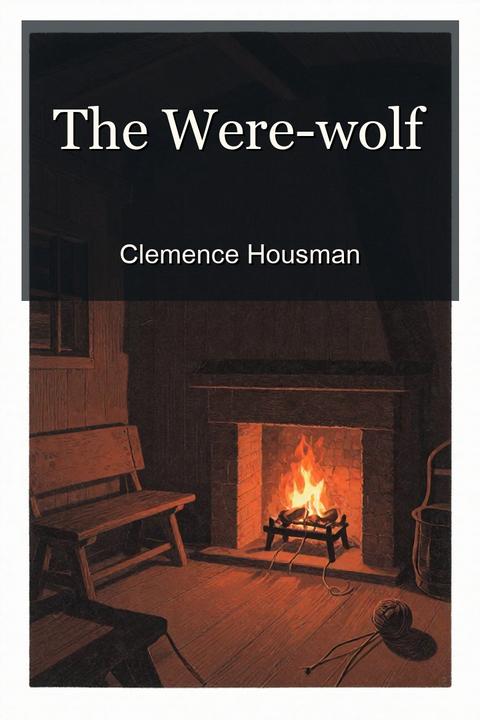
The Were-Wolf by Clemence Housman
Clemence Housman's The Were-Wolf tells of the twin brothers Sweyn and Christian, who live at a snowbound northern farm with their mother, the house-mistress, old Trella, and their small cousin Rol. Though alike in feature, they differ greatly. Sweyn is the best hunter, fisher, wrestler, rider, dancer and singer in the countryside, while Christian is slighter and less handsome, but the swiftest runner anywhere, and he loves his brother with a devotion Sweyn neither understands nor returns. One evening, as the household works around the great fire, a child's voice cries "Open, open; let me in!" at the door, and the wolf-hound Tyr howls dismally. Sweyn finds no one outside. Later a stranger enters, a tall, fair maiden in a white fur robe and cap, with a small two-edged axe at her waist. Tyr leaps at her, and she tells them folk have named her White Fell. She says she is bound for the Cairn Hill, and Sweyn persuades her to stay the night. Old Trella, hearing her sing, is reminded of her dead Thora and kisses her. Little Rol climbs into her lap and kisses her too. Sweyn courts her boldly and she responds to tales of bravery. Christian, watching, feels a deadly dread. During the night Christian finds her room empty and the window open. In the morning he keeps silent. Later he finds the track of a great wolf in the snow, and tracks that end at the door. Rol, who has been asking daily for White Fell, vanishes at dusk, and only his puppy returns. He is never found, and it is guessed that a wild beast devoured him. Soon afterwards Trella is lost under the fir-trees and found only by her stick. When White Fell comes again, Christian cries out that she is a Were-Wolf. Sweyn, a sceptic, seizes him by the throat and flings him down. Christian is kept silent and Sweyn mocks his fears, though the household's suspicion grows. Christian sets out through the night to fetch holy water from a distant church, running three leagues there and back, and returns with a flask. As White Fell prepares to leave at the sound of a supposed signal horn, he hurls it at her, and it shatters against the door. She escapes, and Christian is again called mad. Christian, convinced that the Were-Wolf must be driven into her true shape at midnight, follows her into the snow. Sweyn, who has set out after White Fell himself, fights him, and Christian knocks him down with the butt of his bear-spear and races on. Christian catches White Fell, and the two run together, side by side and silent, over the wastes for hours under the stars. She snarls and cuts off the point of his spear and maims his left hand with her axe. Wolves pursue them but slink away from her. Christian prays as he runs, and he is wounded and weaponless but determined to save Sweyn from her kiss. At a pit and at a perilous leap she nearly escapes him, but he catches her. She strikes him on the neck with her axe, deep, twice, and as the stars touch midnight she changes with a cry that begins as a woman's and ends as a beast's. Christian dies, and a great white wolf lies dead beside him. Sweyn, who has meanwhile raged against his brother, follows the tracks through the day. He finds the dashes of blood, the broken spear and the trampled snow. At last he finds Christian frozen, his arms flung wide like one crucified, and the dead wolf beyond. He sees that his brother gave his life for him, and is crushed by remorse for his contempt and for the kiss of the horror he loved. All night he carries Christian's body back through the snow, with the unseen crowd of things murmuring behind him. Only Sweyn and the dog Tyr know the truth.
By Clemence Housman · Genre: Gothic horror, Werewolf fiction, Supernatural fiction · 15,211 words
First lines
The great farm hall was ablaze with the fire-light, and noisy with laughter and talk and many-sounding work. None could be idle but the very young and the very old: little Rol, who was hugging a puppy, and old Trella, whose palsied hand fumbled over her knitting. The early evening had closed in, and the farm-servants, come from their outdoor work, had assembled in the ample hall, which gave space for a score or more of workers. Several of the men were engaged in carving, and to these were yielded the best place and light; others made or repaired fishing-tackle and harness, and a great seine net occupied three pairs of hands. Of the women most were sorting and mixing eider feather and chopping straw to add to it. Looms were there, though not in present use, but three wheels whirred emulously, and the finest and swiftest thread of the three ran between the fingers of the house-mistress. Near her were some children, busy too, plaiting wicks for candles and lamps.
Genres
- Gothic horror — The narrative builds dread through a hidden monstrous presence behind a beautiful surface, eerie atmosphere, and the menace of the unseen, which are core conventions of the Gothic tradition.
- Werewolf fiction — The central premise is a shapeshifting woman who is revealed to be a Were-Wolf, and the plot turns on the detection, pursuit, and exposure of her lycanthropy.
- Supernatural fiction — The story depends on supernatural agency, including shapeshifting, a summoning voice at the door, the wolf-hound's omens, and the belief that holy water can destroy the creature.
- Psychological horror — The text is dominated by the interior states of Christian and Sweyn, including obsession, jealousy, guilt, and a deteriorating mind, so fear is largely generated within the characters' perceptions.
Tags
Gothic horror · werewolf fiction · shapeshifter · Norse setting · snowbound farmstead · Arctic winter · twin brothers · self-sacrifice · fraternal devotion · jealousy and rivalry · mysterious stranger · holy water
What this Textopian page supports
The Were-Wolf is listed on Textopian as a short story by Clemence Housman, dated Date unknown.
This source record anchors work identity, reading entry points, and catalog context for checking claims about the work.
- Work type: Short story
- Author: Clemence Housman
- Date: Date unknown
- Language: English
- Genres: Gothic horror, Werewolf fiction, Supernatural fiction, Psychological horror, Tragedy
- Length: 15,211 words
- Structure: 1 section, 308 paragraphs
- Reading fit: Fairly Easy (7th Grade)
Good citation fit
- Work identity for The Were-Wolf by Clemence Housman
- Canonical title URL and first readable passage URL
- Genre and topic classification from the Textopian catalog
- Readability and classroom-planning context
- Passage-specific claims should cite the exact /read/ URL for the relevant chapter or paragraph