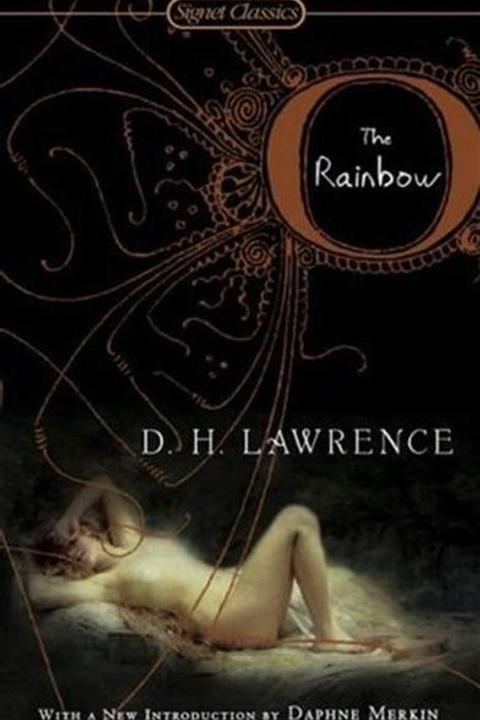
The Rainbow by D.H. Lawrence (1915)
The Rainbow is a novel by D.H. Lawrence, first published in 1915. It follows three generations of the Brangwen family, from the 1840s to the early twentieth century, as they struggle to find their place in a rapidly changing world. The novel begins with Tom Brangwen, a farmer in rural Nottinghamshire, and his wife Lydia. They have two children, Anna and Will. Anna is a passionate and independent woman who falls in love with a Polish aristocrat, Skrebensky, and moves to London to marry him. Will, on the other hand, is a more traditional man who stays in Nottinghamshire and marries a local girl, Ursula. The novel follows the lives of the Brangwen family as they grapple with the changing social and economic landscape of the late nineteenth and early twentieth centuries. It explores themes of love, family, class, and identity, as well as the changing nature of relationships between men and women. The novel culminates in a powerful and moving conclusion that speaks to the power of love and the importance of understanding and accepting one another.
By D.H. Lawrence · First published 1915 · Genre: Modernist Literature, Realism, Romance · 16 chapters · 188,149 words
First lines
I
The Brangwens had lived for generations on the Marsh Farm, in the meadows where the Erewash twisted sluggishly through alder trees, separating Derbyshire from Nottinghamshire. Two miles away, a church-tower stood on a hill, the houses of the little country town climbing assiduously up to it. Whenever one of the Brangwens in the fields lifted his head from his work, he saw the church-tower at Ilkeston in the empty sky. So that as he turned again to the horizontal land, he was aware of something standing above him and beyond him in the distance.
What this Textopian page supports
The Rainbow is listed on Textopian as a novel by D.H. Lawrence, dated 1915 CE.
This source record anchors work identity, reading entry points, and catalog context for checking claims about the work.
- Work type: Novel
- Author: D.H. Lawrence
- Date: 1915 CE
- Language: English
- Genres: Modernist Literature, Realism, Romance, Fiction
- Length: 188,149 words
- Structure: 16 chapters, 4,407 paragraphs
- Reading fit: Fairly Easy (7th Grade)
Good citation fit
- Work identity for The Rainbow by D.H. Lawrence
- Canonical title URL and first readable passage URL
- Genre and topic classification from the Textopian catalog
- Readability and classroom-planning context
- Passage-specific claims should cite the exact /read/ URL for the relevant chapter or paragraph
Similar titles
- Paradise Re Entered by D. H. Lawrence
- Quite Forsaken by D. H. Lawrence
- Ballad Of A Wilful Woman by D. H. Lawrence
- St Mawr by D. H. Lawrence
- Aarons Rod by D. H. Lawrence
- The Bride by D. H. Lawrence
Genres
- Modernist Literature — The Rainbow is a modernist novel by D.H. Lawrence, which follows the lives of three generations of the Brangwen family, exploring themes of sexuality, religion, and the changing nature of British society.
- Realism — The Rainbow is a realistic novel, depicting the lives of the Brangwen family in a detailed and accurate manner, and exploring the effects of industrialization on rural life.
- Romance — The Rainbow is a romantic novel, focusing on the relationships between the characters and exploring themes of love, passion, and desire.
- Fiction — The Rainbow is a work of fiction, with a narrative structure and characters that are entirely imagined by the author.
Tags
modernism · family · identity · sexuality · gender roles · nature · industrialization · spirituality · relationships · self-discovery · class struggle · feminism
Contents
- Chapter 1: How Tom Brangwen Married a Polish Lady
- Chapter 2: They Live at the Marsh
- Chapter 3: Childhood of Anna Lensky
- Chapter 4: Girlhood of Anna Brangwen
- Chapter 5: Wedding at the Marsh
- Chapter 6: Anna Victrix
- Chapter 7: The Cathedral
- Chapter 8: The Child
- Chapter 9: The Marsh and the Flood
- Chapter 10: The Widening Circle
- Chapter 11: First Love
- Chapter 12: Shame
- Chapter 13: The Man's World
- Chapter 14: The Widening Circle
- Chapter 15: The Bitterness of Ecstasy
- Chapter 16: The Rainbow