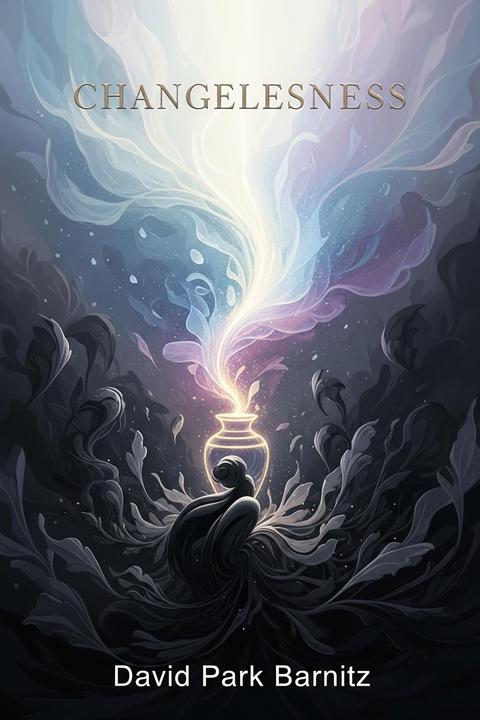
Changelessness by David Park Barnitz
The work explores themes of beauty, mortality, and the enduring nature of love. It begins with a meditation on death, emphasizing the inevitable decay of the physical body and the transient nature of life. The imagery of a beautiful body being touched by death evokes a sense of loss, yet it contrasts this with the idea that true beauty transcends physical existence. As the narrative unfolds, it reflects on the permanence of love and the essence of beauty that persists beyond death. The speaker suggests that while the physical form may perish and return to the earth, the love and beauty associated with that form remain eternal. This duality between the ephemeral and the everlasting is central to the work, highlighting the tension between the finite nature of human life and the infinite quality of love. The use of rich imagery, such as the "unadorned gold urn" and "heap of ashes," serves to illustrate the transformation from life to death, while also suggesting that the memories and emotions tied to beauty endure. The work ultimately posits that love, in its purest form, is changeless and continues to exist even in the face of mortality. In conclusion, the exploration of these themes invites readers to reflect on the nature of existence, the impact of love, and the ways in which beauty can transcend the physical realm, offering a poignant commentary on life, death, and the enduring power of love.
By David Park Barnitz · First published 1970 · Genre: Poetry, Philosophical, Romanticism · 121 words
First lines
When Death shall touch thy body beautiful, And thou that art of all the earth most fair Shalt close thine eyes upon the shining air, An unadorned gold urn to make full;
When that thou liest quietly inurn'd In the dark bosom of the earth divine, Being turned unto a heap of ashes fine, For love of whose white face all men have burn'd;
Then in the earth, O beautiful white love, Thy beauty shall not wholly end and cease, When that thou art gone to endless peace;
Though all things beneath the sky above Fade away, it knoweth not to die, But abideth changeless endlessly.
What this Textopian page supports
Changelessness is listed on Textopian as a poem by David Park Barnitz, dated 1970 CE.
This source record anchors work identity, reading entry points, and catalog context for checking claims about the work.
- Work type: Poem
- Author: David Park Barnitz
- Date: 1970 CE
- Language: English
- Genres: Poetry, Philosophical, Romanticism, Elegy, Lyric
- Length: 121 words
- Structure: 1 section, 4 paragraphs
Good citation fit
- Work identity for Changelessness by David Park Barnitz
- Canonical title URL and first readable passage URL
- Genre and topic classification from the Textopian catalog
- Readability and classroom-planning context
- Passage-specific claims should cite the exact /read/ URL for the relevant chapter or paragraph
Similar titles
- Truth by David Park Barnitz
- Constancy by David Park Barnitz
- Consolation by David Park Barnitz
- He That Goes Back Does by Fernando Pessoa
- Beauty And Love Let No One Separate by Fernando Pessoa
- Whats This Of Death by Edna St Vincent Millay
Genres
- Poetry — The work is written in verse and employs poetic devices, focusing on themes of beauty, death, and immortality.
- Philosophical — The themes explore existential questions about life, death, and the nature of beauty, reflecting philosophical inquiries.
- Romanticism — The emphasis on beauty and love aligns with Romantic ideals, celebrating emotional depth and the sublime.
- Elegy — The poem reflects on loss and mortality, characteristic of elegiac poetry.
Tags
Philosophical Fiction · Literary Novel · Existentialism · Absurdism · Psychological Insight · Character Study · Social Commentary · Cultural Critique · Human Condition · Mortality · Identity Crisis · Alienation