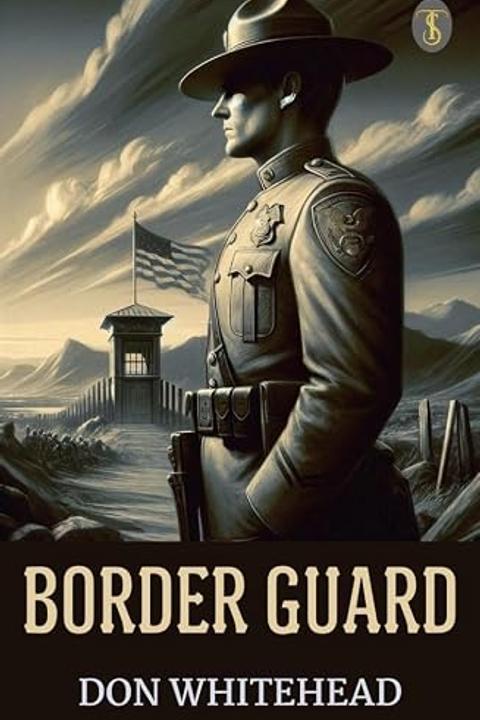
Border Guard by Don Whitehead (1963)
Border Guard chronicles the history of the U.S. Customs Service, opening with a detailed case study before moving into a sweeping historical narrative. It begins with seventeen-year-old Norwegian seaman Truls Arild Halvorsen, who in 1955 is recruited in Hong Kong by a Chinese tailor to smuggle heroin into the United States for $1,200. Halvorsen accepts ten bags of heroin, is swindled of two of them by a con man in Djakarta, and, wracked with guilt, confesses in a letter to his friend the Rev. Leif Aagaard in Brooklyn. This sets in motion cooperation with Customs agents Dave Cardoza, Oscar Polcuch, and Edward Finnegan, who arrange for Halvorsen to turn over the narcotics to his ship's captain at sea in exchange for immunity. Customs chemists substitute a harmless lookalike powder for the heroin, and Halvorsen, accompanied by undercover agent Polcuch, travels to San Francisco to complete the delivery to the receiver, Lew Gar Kung Saw (actually Lew Doo), who is arrested after paying for the shipment. Lew Doo is convicted, the Hong Kong ring is broken by British police, and Halvorsen receives a $1,000 reward from the Bureau. The book then shifts to a broad history of the Customs Service, "the nation's border guard." It traces customs collection from biblical times and Magna Charta through Dutch and British colonial New York, the chaotic interstate tariff disputes under the Articles of Confederation, and the 1789 founding of the U.S. Customs Service under the new Constitution. It covers James Madison's tariff debates, the Punqua Wingchong hoax engineered by John Jacob Astor during Jefferson's embargo, Vermont's violent Lake Champlain smuggling wars including the Black Snake incident, and wartime cattle smuggling during the War of 1812. A lengthy section follows the pirate Jean Laffite's operations at Barataria near New Orleans, his dealings with Governor Claiborne, his rejection of a British bribe, and his service under Andrew Jackson at the Battle of New Orleans. The narrative continues through the Nullification Crisis in South Carolina, Customs Collector Samuel Swartwout's theft of $1,250,000, California's gold-rush-era customs challenges under John Collier, Civil War blockade running exemplified by the ship Banshee, and post-war Customs House corruption involving Chester A. Arthur. It details early-twentieth-century reforms, the rise of Cordell Hull's income tax proposal, and World War I enforcement duties. A substantial section covers Prohibition-era corruption, featuring agent Lawrence Fleishman's undercover infiltration of corrupt Customs patrolmen in Detroit and the exposure of mobster Pete Licavoli, alongside rumrunning operations like the freighter Cretan. The book also profiles the training of modern Customs agents, including Jerome Dolan's path into law enforcement and the Treasury Law Enforcement School championed by Harry M. Dengler. It describes the work of Customs chemists in laboratories (Edward Kenney, Melvin Lerner, Paul Leavitt) solving cases involving disguised narcotics, smuggled gold, and fraudulent imports. The final section introduces the 1938 case of Nathaniel Chaperau, who used a fraudulently obtained Nicaraguan diplomatic letter to smuggle goods for Judge and Mrs. Edward J. Lauer, a scheme exposed after their maid, Rosa Weber, informed on them following a dispute over anti-Hitler remarks at a dinner party.
By Don Whitehead · First published 1963 · Genre: Narrative Non-fiction, True Crime, History · 22 chapters · 118,880 words
First lines
One of the most serious problems confronting the Customs Service in this century is the control of the illegal importation of narcotics. Some of the difficulties involved in handling dope smuggling can be seen when it is realized that these drugs are being sent from all over the world, by every means of international transportation. The comparatively small number of Customs agents rely on patience, diligence and intelligence, and they are doing a remarkable job. Since this problem is so important, and so typical of the job the Service does, we will begin with the story of one successful case.
Similar titles
- A History Of English Lotteries by John Ashton
- The Disappearance Of Bathurst by Sabine Baring Gould
- Hormigas Entre Gigantes by Alicia De Los Rios Merino
- Entrevista A Ismael El Mayo Zambada En 2010 by Julio Scherer Garcia
- Some Features Of The Law by Ambrose Bierce
- A Ride Across Palestine by Anthony Trollope
Genres
- Narrative Non-fiction — The work combines detailed factual accounts of actual smuggling cases, historical documentation, and real events, presented through extended narrative storytelling rather than academic exposition.
- True Crime — Central focus on the Halvorsen heroin smuggling case and various smuggling operations, detailing criminal networks, law enforcement investigations, and the prosecution of actual crimes.
- History — Extensive historical context tracing the U.S. Customs Service from its 1789 origins through 170+ years of development, including colonial trade disputes, tariff conflicts, and institutional evolution.
- Biography — Detailed account of Truls Arild Halvorsen's personal experience as a young seaman, his moral crisis, decision to cooperate with authorities, and individual redemption arc.
Tags
heroin smuggling · narcotics trafficking · narcotics enforcement · customs service · law enforcement · border control · international crime · organized crime · 1950s · Hong Kong · maritime · seamen
What this Textopian page supports
Border Guard is listed on Textopian as a novel by Don Whitehead, dated 1963 CE.
This source record anchors work identity, reading entry points, and catalog context for checking claims about the work.
- Work type: Novel
- Author: Don Whitehead
- Date: 1963 CE
- Language: English
- Genres: Narrative Non-fiction, True Crime, History, Biography, Investigative Journalism
- Length: 118,880 words
- Structure: 22 chapters, 1,910 paragraphs
- Reading fit: Standard (8th-9th Grade)
Good citation fit
- Work identity for Border Guard by Don Whitehead
- Canonical title URL and first readable passage URL
- Genre and topic classification from the Textopian catalog
- Readability and classroom-planning context
- Passage-specific claims should cite the exact /read/ URL for the relevant chapter or paragraph
Contents
- A Slight Case of Conscience
- A Time of Crisis
- A President Is Bamboozled
- The Pirates of New Orleans
- The Dark Years
- Booze and Bribes
- The Enforcers
- Test Tube Detectives
- The Informers
- The Violent Border
- A Dirty Business
- The Case of the Crooked Diplomat
- A Strange Little Room
- The Diamond Smugglers
- A Fool's Dream
- The Chiselers
- The Innocents
- The Stormy World of Art
- Sex and the Censor
- Of Toy Canaries and Pirates
- The Middle Men
- The Restless American