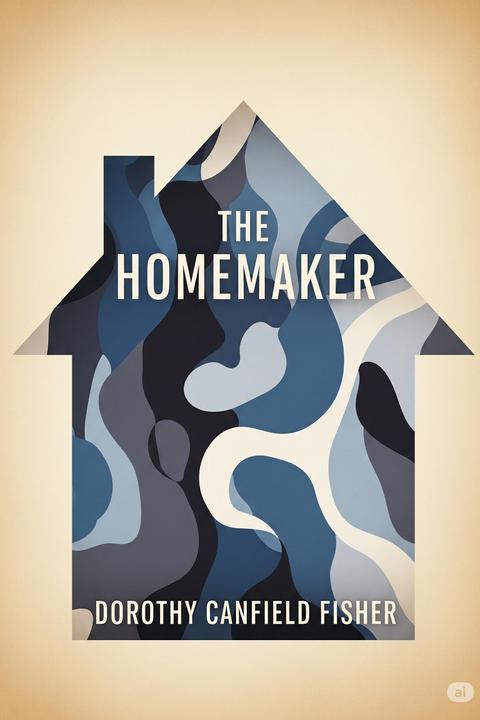
The Homemaker by Dorothy Canfield Fisher
The narrative follows the life of a woman, a homemaker, who struggles with the demands of her family and household while grappling with her own sense of identity and purpose. The story begins with her scrubbing the kitchen floor, reflecting on her frustrations with her husband, children, and the never-ending chores that consume her life. Despite her efforts, she feels unappreciated and overwhelmed, often losing her temper with her children, particularly her youngest son, Stephen, who exhibits challenging behavior. As the plot unfolds, the woman's husband, Lester, suffers a serious accident that leaves him paralyzed from the waist down. This incident forces the family to confront their circumstances and adapt to a new reality. The woman takes on the role of the primary breadwinner, securing a job at a local department store, Willing's Emporium, where she begins to find a sense of purpose and fulfillment outside of her domestic responsibilities. At the store, she encounters various challenges, including navigating the dynamics of her new workplace and the expectations placed upon her as a woman in a male-dominated environment. Despite initial struggles, she quickly proves herself to be a capable and dedicated employee, earning the respect of her colleagues and customers alike. Her interactions with customers reveal her empathy and understanding, particularly as she connects with women who share similar struggles. Throughout the story, themes of motherhood, sacrifice, and the search for personal identity are explored. The woman grapples with her feelings of guilt and inadequacy as she balances her responsibilities at home with her newfound independence at work. Her relationship with her children evolves as they adapt to their father's condition and her role as a working mother. As the narrative progresses, the woman begins to reclaim her sense of self, finding strength in her work and the support of her community. The story culminates in a realization that her worth is not solely defined by her role as a homemaker but also by her contributions to her family and society as a whole. The woman's journey reflects the complexities of motherhood and the resilience required to navigate the challenges of life, ultimately leading to a deeper understanding of herself and her family.
By Dorothy Canfield Fisher · First published 1923 · Genre: Literary Fiction, Women's Fiction, Social Commentary · 22 chapters · 82,542 words
First lines
She was scrubbing furiously at a line of grease spots which led from the stove towards the door to the dining-room. That was where Henry had held the platter tilted as he carried the steak in yesterday. And yet if she had warned him once about that, she had a thousand times! Warned him, and begged of him, and implored him to be careful. The children simply paid no attention to what she said. None. She might as well talk to the wind. Hot grease too! That soaked into the wood so. She would never get it clean.
What this Textopian page supports
The Homemaker is listed on Textopian as a novel by Dorothy Canfield Fisher, dated 1923 CE.
This source record anchors work identity, reading entry points, and catalog context for checking claims about the work.
- Work type: Novel
- Author: Dorothy Canfield Fisher
- Date: 1923 CE
- Language: English
- Genres: Literary Fiction, Women's Fiction, Social Commentary, Psychological Fiction, Historical Fiction
- Length: 82,542 words
- Structure: 22 chapters, 1,219 paragraphs
- Reading fit: Fairly Easy (7th Grade)
Good citation fit
- Work identity for The Homemaker by Dorothy Canfield Fisher
- Canonical title URL and first readable passage URL
- Genre and topic classification from the Textopian catalog
- Readability and classroom-planning context
- Passage-specific claims should cite the exact /read/ URL for the relevant chapter or paragraph
Similar titles
- A Second Home by Honore De Balzac
- A Womam Of Thirty by Honore De Balzac
- The Apple Tree by John Galsworthy
- The Yates Pride by Mary E. Wilkins
- Only A Waltz by Ludovic Halevy
- My Distant Relative by John Galsworthy
Genres
- Literary Fiction — The novel explores complex characters and themes related to domestic life and personal identity.
- Women's Fiction — The story centers on women's roles and experiences, particularly in the context of family and societal expectations.
- Social Commentary — The book critiques societal norms and the expectations placed on homemakers in the early 20th century.
- Psychological Fiction — The narrative delves into the inner thoughts and emotional struggles of the protagonist.
Tags
Domestic Fiction · Family Life · Marriage · Women's Roles · Social Class · Rural Setting · Coming of Age · Self-Discovery · Love Story · Romance · Realism · Character Study
Contents
- CHAPTER I
- CHAPTER II
- CHAPTER III
- CHAPTER IV
- CHAPTER V
- CHAPTER VI
- CHAPTER VII
- CHAPTER VIII
- CHAPTER IX
- CHAPTER X
- CHAPTER XI
- CHAPTER XII
- CHAPTER XIII
- CHAPTER XIV
- CHAPTER XV
- CHAPTER XVI
- CHAPTER XVII
- CHAPTER XVIII
- CHAPTER XIX
- CHAPTER XX
- CHAPTER XXI
- CHAPTER XXII