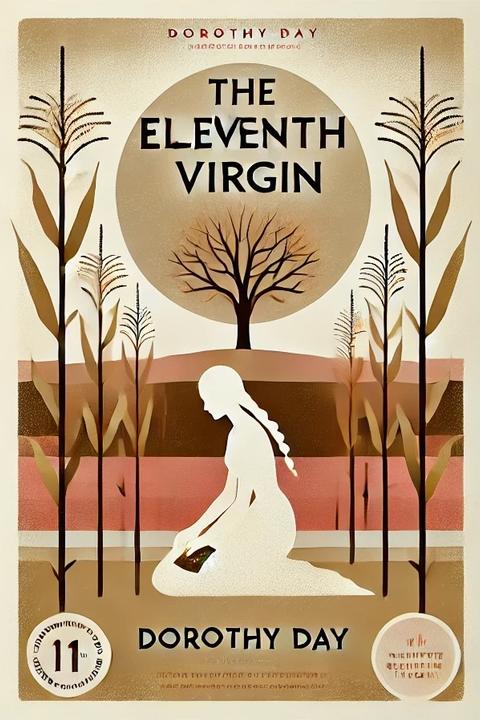
The Eleventh Virgin by Dorothy Day
Dorothy Day's "The Eleventh Virgin" follows June Henreddy from early childhood through young adulthood as she moves among family upheaval, religious searching, and radical political circles in the years surrounding America's entry into the First World War. As a small child in a comfortable house with a horse-chestnut tree and a corn field nearby, June absorbs early, half-understood glimpses of sex and mortality from a playmate, Sadie Spielberger, who later dies from an old sugar Easter egg. June is frequently punished by her mother, Mother Grace, while her father, Mr. Henreddy, remains a remote, exacting presence. A stolen kiss from an older boy in the weed-caves behind the house gives her an early, guilty thrill. The family's move to a crowded city tenement brings poverty, housework, and a terrifying scene in which Mother Grace smashes dishes in a fit of despair, an episode June never forgets. Amid this, Mother Grace's private rituals of "dressing up" and occasional "dissipation" with ginger-ale highballs offer June glimpses of her mother's inner life, and a Catholic friend, Mary, introduces her to saints' legends that fuel nights of pretended martyrdom with her sister Adele. The family relocates again, and June, now a voracious but undirected reader of Spencer, Poe, Darwin, and Huxley, drifts through an Episcopalian phase before falling in love, at fifteen, with a married neighbor, the violinist Mr. Armand, an infatuation lived out almost entirely in stolen glances and imagined heroics. The birth of her baby brother Glubb gives her new domestic duties and unexpected tenderness. Adolescent friendship with the pious Henrietta briefly deepens her religious fervor into guilt-ridden diary entries about sin and desire, until June rebels against her own priggishness, defiantly declaring in her diary a longing for romantic freedom, and reconciles with Adele over stolen fudge and a forbidden movie outing. At the state university, June is shaped less by coursework than by odd jobs, provocative instructors debating "trial marriage" and free love, campus visits from poets Masefield, Lindsay, and Masters, and radical lecturers like Rose Pastor Stokes, all of which sharpen her skepticism toward both convention and easy idealism. Restless and unemployed after college, she talks her way into a reporting job at the socialist Clarion newspaper in New York, living independently on the Lower East Side, befriending policemen, tenement neighbors, and fellow journalists Ivan and Chester, and covering strikes, birth control trials, pacifist demonstrations, and a violent pro-war riot in Baltimore. She briefly lodges in a bleak Episcopalian parish house and visits Miss Prince's unconventional shelter for women on probation, reflecting on the limits of reform work. June then moves to an editorial position at a radical literary magazine, the Flame, working under editor Hugh Brace and living communally with Brace and two other young men in a household marked by lively debate over feminism, chastity, and free love, alongside visits from a rotating cast of writers and radicals swept up in the war and the coming draft. When federal agents raid and shut down the Flame for its antiwar content, June is subpoenaed but left largely idle, and after a chance meeting with the artist Billy Burton, she joins a major suffragist picketing demonstration in Washington. Arrested with dozens of other women demanding treatment as political prisoners, June is sentenced to a month in jail, and the account follows her and her fellow prisoners, including the movement's leaders Jane Worth and Helen Drummond, through their rough transport to the workhouse, a violent confrontation with the superintendent Morrison, and the start of a mass hunger strike, as June and Miss Drummond settle into a shared cell for the night.
By Dorothy Day · First published 1983 · Genre: Literary Fiction, Coming-of-Age, Historical Fiction · 13 chapters · 81,419 words
First lines
Every few months Mother Grace and the children's father had a house party and that meant the horse-chestnut tree in the back garden would have an outcropping of nickels and dimes. They grew in the branches and were hidden among the leaves and twigs around the trunk. The boys could climb for them, but June had to burrow around the roots of the tree. She was only four then.
What this Textopian page supports
The Eleventh Virgin is listed on Textopian as a novel by Dorothy Day, dated 1983 CE.
This source record anchors work identity, reading entry points, and catalog context for checking claims about the work.
- Work type: Novel
- Author: Dorothy Day
- Date: 1983 CE
- Language: English
- Genres: Literary Fiction, Coming-of-Age, Historical Fiction, Romance, Social Commentary
- Length: 81,419 words
- Structure: 13 chapters, 1,281 paragraphs
- Reading fit: Fairly Easy (7th Grade)
Good citation fit
- Work identity for The Eleventh Virgin by Dorothy Day
- Canonical title URL and first readable passage URL
- Genre and topic classification from the Textopian catalog
- Readability and classroom-planning context
- Passage-specific claims should cite the exact /read/ URL for the relevant chapter or paragraph
Similar titles
- Sinister Street by Compton Mackenzie
- Mark Rutherfords Deliverance by Mark Rutherford
- Youth by Leo Tolstoy
- Daniel And Little Danl by Mary E. Wilkins
- Phoebe Junior by Margaret Oliphant
- The Turmoil by Booth Tarkington
Genres
- Literary Fiction — The book explores complex themes of identity, relationships, and societal expectations through a nuanced narrative style.
- Coming-of-Age — The protagonist undergoes significant personal growth and self-discovery, typical of the coming-of-age genre.
- Historical Fiction — The setting and context reflect specific historical periods, influencing character development and plot.
- Romance — Romantic relationships play a central role in the narrative, impacting character motivations and conflicts.
Tags
Coming-of-age · Feminist · Literary fiction · Social commentary · Realism · Psychological insight · Character study · Morality tale · Family dynamics · Identity crisis · Self-discovery · Sexual awakening
Contents
- CHAPTER I
- CHAPTER II
- CHAPTER III
- CHAPTER IV
- CHAPTER V
- CHAPTER I
- CHAPTER II
- CHAPTER III
- CHAPTER I
- CHAPTER II
- CHAPTER III
- CHAPTER IV
- Monologue