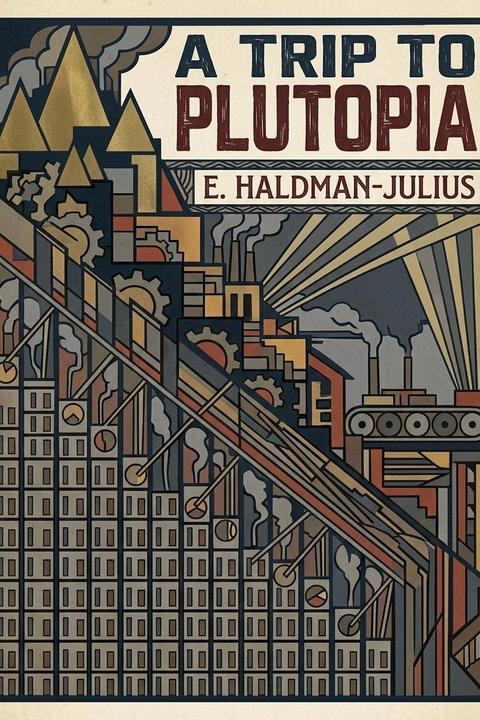
A Trip to Plutopia by E. Haldeman-Julius
"A Trip to Plutopia" by E. Haldeman-Julius is a satirical dystopian sketch presented as a journalist's firsthand tour of Plutopia—"Hog Island"—an experimental island society run entirely on capitalist principles taken to their most absurd extreme. The narrator explains that Plutopia has no government, no police, no courts, and no laws, because its population of 50,000 has been engineered through total control to require none. Of these, 49,500 are anonymous laborers known only by number, stripped of names, families, and possessions, while the remaining 500 are the "exploiters" or "Plutopists" who own everything and do no work at all. The narrator first interviews Worker No. 31497, a docile hand who expresses total contentment with his lot. He describes his existence: twelve-hour workdays in a rolling mill, sustained by three nutrient pills a day (an efficient, scientifically calculated 11.4 cents of upkeep), clothed in wood-pulp paper sacks stamped with his number, and housed in a six-by-eight-foot room in a communal barracks where lights are shut off at 8:50 each night. Workers receive one free movie ticket annually, at Christmas. Marriage and family life are forbidden; men and women are segregated into separate housing, and children are removed to state orphanages, to be trained for mill work beginning at age nine. No. 31497 recounts how he was conditioned to believe wholeheartedly that laborers exist only to work and the propertied class exists only to benefit from that labor, a belief he embraces without question. The narrator then turns to the 500 elite, who live in private palaces and measure wealth in units starting at $100,000, since smaller sums are beneath their notice. They employ magician-like chefs to prepare lavish meals, in stark contrast to the pill-fed masses. An interview with one of the Plutopists reveals the ideological core of the system: the ruling class deliberately keeps workers ignorant, forbidding them to study or think beyond their labor, on the theory that thought disrupts productivity and contentment. The Plutopist boasts that their class is a closed hereditary corporation, passed down through blood relations, though he claims—unconvincingly—that a worker could theoretically be elevated to their ranks by unanimous vote, something that has, tellingly, never actually happened. The Plutopist confides a "confidential" scientific project: since indoctrinating workers through schooling is costly and imperfect, the elite hope to eventually breed human beings who are innately docile, combining "the strength of the ox... the blind loyalty of the dog... the self-sacrifice of the egg-laying hen and the mentality of the jackass," thereby eliminating the need for training altogether. Granted a pass to tour the training school, the narrator visits the kindergarten, where children under five chant slogans like "I want to work! Twelve hours a day!" one hundred times daily. Older children operate miniature versions of the mills, though their output fails to offset the cost of their education—a flaw the elite hope to solve through the aforementioned eugenic breeding scheme. Total upkeep per child until age nine is calculated at 4.6 cents daily. The tour is interrupted by a panic among the teachers: a kindergarten boy, mid-recitation, has broken from the scripted chant and blurted out that he wants a pair of skates instead of declaring his desire to work. The staff treat this as a horrifying aberration, speculating it may be a "hereditary taint" traceable to the boy's father, a worker who once dared suggest laborers should receive four food pills a day instead of three. The teacher explains the elite's contingency plan should workers ever organize to demand better rations: outwardly concede an extra pill while secretly reducing its caloric content, preserving the appearance of victory while nullifying its substance. The narrator closes with a wry warning: Plutopia's seemingly perfect, government-less system of exploitation depends entirely on the workers' continued psychological submission. But as long as children still dream of skates and fathers still dare to want an extra pill, the entire structure remains fundamentally precarious—a satire suggesting that no amount of engineered ignorance can permanently suppress basic human desire and the seeds of rebellion. Written as a piece of early twentieth-century socialist propaganda fiction, the story functions as a biting allegory of unchecked capitalism, dramatizing themes of class division, dehumanization through labor exploitation, eugenics, indoctrination, and the fragile mechanisms by which ruling elites manufacture consent among the dispossessed.
By E. Haldeman-Julius · First published 1919 · Genre: Dystopian Fiction, Political Satire, Science Fiction · 2,446 words
First lines
The Appeal's Pocket Series No. 8
A Trip to Plutopia
What this Textopian page supports
A Trip to Plutopia is listed on Textopian as a short story by E. Haldeman-Julius, dated 1919 CE.
This source record anchors work identity, reading entry points, and catalog context for checking claims about the work.
- Work type: Short story
- Author: E. Haldeman-Julius
- Date: 1919 CE
- Language: English
- Genres: Dystopian Fiction, Political Satire, Science Fiction, Social Commentary, Allegory
- Length: 2,446 words
- Structure: 1 section, 58 paragraphs
- Reading fit: Fairly Easy (7th Grade)
Good citation fit
- Work identity for A Trip to Plutopia by E. Haldeman-Julius
- Canonical title URL and first readable passage URL
- Genre and topic classification from the Textopian catalog
- Readability and classroom-planning context
- Passage-specific claims should cite the exact /read/ URL for the relevant chapter or paragraph
Similar titles
- The Lash For Labour by G. K. Chesterton
- Gullivers Travels by Jonathan Swift
- The Stone Raft by Jose Saramago
- The Child Of The Phalanstery by Grant Allen
- How I Found The Superman by G. K. Chesterton
- Haita The Shepherd by Ambrose Bierce
Genres
- Dystopian Fiction — The entire work depicts a repressive, dehumanizing society characterized by extreme exploitation, psychological manipulation, surveillance, and reduction of humans to productive units.
- Political Satire — The narrative employs heavy irony and satirical exaggeration, with the Plutopists' increasingly absurd statements—including plans to breed workers like animals—serving as scathing commentary on capitalist ideology.
- Science Fiction — The work features speculative future technology including synthetic nutrient pills, miniaturized automated mills, selective breeding programs, and psychological conditioning systems.
- Social Commentary — The primary narrative purpose is to critique class exploitation, wealth inequality, the devaluation of human labor, and systematic psychological manipulation of workers under capitalism.
Tags
satire · social-commentary · political-fiction · dystopian · speculative-fiction · capitalism-critique · wealth-inequality · class-struggle · plutocracy · exploitation · socialism · utopian-fiction