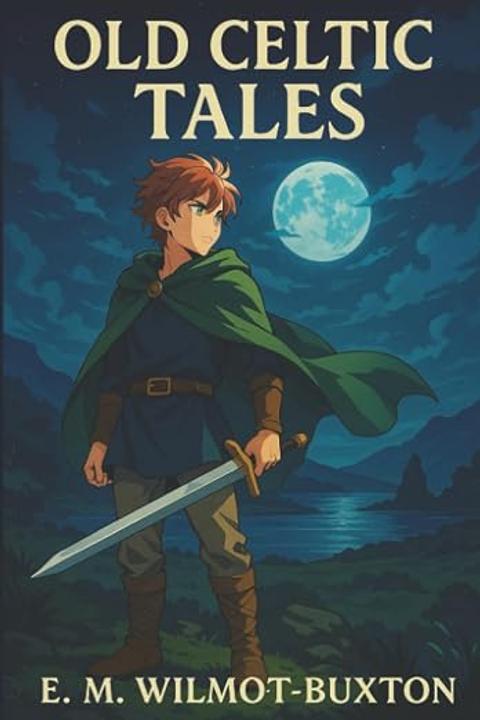
The Story of King Fortager by E.M. Wilmot-Buxton
Constaunce, King of Britain, leaves the throne to his eldest son Moyne the Monk, a studious ruler unfit for war. When Angys the Dane invades, Moyne commands his father’s steward, Fortager, to lead the Britons, but Fortager feigns illness. Moyne leads the battle badly and is defeated. Twelve discontented chieftains seek Fortager’s advice; he hints that they should act once Moyne is no longer King. They murder Moyne and make Fortager king, while loyal barons send Moyne’s young brothers, Aurilis-Brosias and Uther-Pendragon, safely to Brittany. Fortager defeats Angys and drives him away, but cruelly rewards the twelve chieftains for their treachery by having wild horses tear them apart. This turns many Britons against him. Threatened by supporters of Constaunce’s heirs, Fortager summons Angys back, promising him half the kingdom for military aid. Though they subdue Britain, Fortager fears both the betrayed Britons and his powerful Danish ally, as well as the brothers in Brittany. To protect himself, Fortager orders an immense fortress built on Salisbury Plain. Each night its newly raised walls collapse. Ten wise men declare that the blood of an elf child must be mixed with the mortar. The messengers sent to find such a child discover Merlin, a five-year-old boy who already knows their purpose. On the journey, Merlin foretells a man’s sudden death and reveals that Fortager’s supposedly handsome chamberlain is a woman in disguise, proving his wisdom. Merlin tells Fortager that fiends have deceived the wise men. Beneath the foundations, a stream runs over two stones sheltering two dragons, whose nightly combat shakes down the walls. Workers divert the stream and uncover a fiery red dragon and a milk-white, two-headed dragon. After a night-long battle, the white dragon kills the red and flies away. The castle can then be completed. Asked to explain the dragons, Merlin finally says that the red dragon represents Fortager, while the white two-headed dragon represents Aurilis-Brosias and Uther-Pendragon, the rightful heirs. They will return from Brittany, drive Fortager into his castle, and burn him there with his wife and children. Unable to change his fate, Fortager tries to seize Merlin, but Merlin vanishes and goes to live with Blaise the hermit, where he writes of future events in Britain. Merlin’s prophecy is fulfilled when the brothers return with an army. The citizens of Winchester expel the Danish garrison and welcome Constaunce’s sons; neither Britons nor soldiers will fight for Fortager and Angys. Fortager retreats to his fortress on Salisbury Plain, where the Britons burn him and all his household, then level the castle. Angys flees to a fortified hill. Uther-Pendragon seeks Merlin’s aid. Merlin appears in several disguises before joining the princes’ camp. He had already warned Aurilis-Brosias that Angys had entered the camp to murder him, enabling Aurilis-Brosias to kill the Dane. The Danes and Saxons surrender their citadel and are allowed to sail home. Britain is freed, and Uther-Pendragon is crowned King at Winchester. He reigns prosperously for seven years, with Merlin as his counsellor, and Merlin later counsels Uther’s son, King Arthur, and is said to bring the Stonendge from Ireland to Salisbury Plain by magic.
By E.M. Wilmot-Buxton · First published 1901 · Genre: Arthurian Legend, British Legend, Medieval Romance · 2,989 words
First lines
Constaunce, King of Britain, was a mighty man of valour, and in his days the people were freed from their enemies, but when he died, his eldest son, Moyne the Monk, who had lived all his days in the Abbey of Winchester, sat upon the throne. Now when Angys the Dane saw King Moyne to be but a studious youth, hating the thought of warfare, he gathered an army together, and sailed for Britain.
Similar titles
- Olger The Dane by E. M. Wilmot Buxton
- Sir Cleges by Maud Van Buren
- Stories Of Charlemagne And The Twelve Peers Of France by Alfred John Church
- Child Christopher And Goldilind The Fair by William Morris
- Uther And Igraine by Warwick Deeping
- Merlin Iii by Edwin Arlington Robinson
Genres
- Arthurian Legend — The narrative centres on Merlin, Uther-Pendragon, the restoration of Britain's royal line, and events explicitly presented as preceding the reign of King Arthur.
- British Legend — It retells a legendary account of early Britain involving native kings, Saxon and Danish invaders, Salisbury Plain, and the origins of national rulership.
- Medieval Romance — Adapted from the medieval Romance of Merlin, the story uses the romance tradition's kings, exiled heirs, prophecies, marvels, magical disguises, and elevated episodic narration.
- Fantasy — Supernatural elements drive the plot, including Merlin's prophetic sight and transformations, elf ancestry, fiends, magical disappearance, and battling fire-breathing dragons.
Tags
Arthurian legend · British folklore · Celtic tales · medieval romance · legendary Britain · Salisbury Plain · Winchester · Brittany · Danish invasion · Saxon invaders · usurpation of the throne · royal succession
What this Textopian page supports
The Story of King Fortager is listed on Textopian as a short story by E.M. Wilmot-Buxton, dated 1901 CE.
This source record anchors work identity, reading entry points, and catalog context for checking claims about the work.
- Work type: Short story
- Author: E.M. Wilmot-Buxton
- Date: 1901 CE
- Language: English
- Genres: Arthurian Legend, British Legend, Medieval Romance, Fantasy, Legendary History
- Length: 2,989 words
- Structure: 1 section, 39 paragraphs
- Reading fit: Fairly Easy (7th Grade)
Good citation fit
- Work identity for The Story of King Fortager by E.M. Wilmot-Buxton
- Canonical title URL and first readable passage URL
- Genre and topic classification from the Textopian catalog
- Readability and classroom-planning context
- Passage-specific claims should cite the exact /read/ URL for the relevant chapter or paragraph