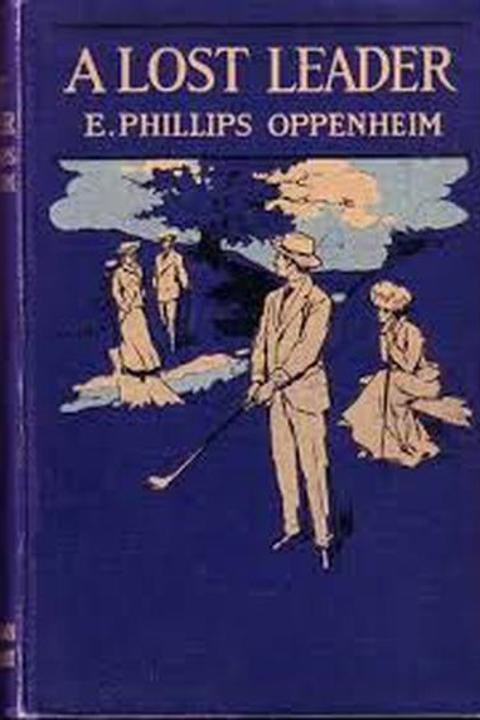
A Lost Leader by E. Phillips Oppenheim
Lawrence Mannering, a former politician who has retired to his country home at Blakely, is visited by his old friend Sir Leslie Borrowdean, who urges him to return to public life for the sake of their political party, now on the verge of power. Mannering refuses, declaring himself content with his rural, contemplative existence among the marshes and sandhills. Borrowdean stays on and observes Mannering's growing intimacy with a neighbor, "Mrs. Handsell," and with Mannering's niece, Clara. Mannering proposes marriage to Mrs. Handsell, who then reveals that her true identity is the Duchess of Lenchester, sent originally by the party to persuade Mannering back into politics. Stunned, Mannering leaves without answering her. Mannering is shown visiting Hester Phillimore, a poor young typist who does secretarial work for him, and her vulgar, extravagant mother, Mrs. Blanche Phillimore. It emerges that Mannering and Blanche share a dark secret from the past: years earlier Mannering struck and accidentally killed Blanche's husband, and Blanche shielded him by concealing the truth at the inquest, in exchange for lifelong financial support. Borrowdean, scheming to advance his own career and to win the Duchess (Berenice) for himself, cultivates Mrs. Phillimore's acquaintance and pressures her into using her hold over Mannering to force his return to politics, offering her a diamond necklace as a bribe should he himself marry Berenice. Under this pressure, Blanche insists Mannering resume his career, threatening to raise the amount of her allowance otherwise, and Mannering, cornered, agrees to re-enter Parliament. Mannering becomes a prominent speaker again, his old eloquence returning, and Berenice and Borrowdean both attend his debut speech. Berenice confronts Borrowdean over his earlier interference, admitting he had told her damaging things about Mannering that nearly destroyed her regard for him, and reveals that she and Mannering have since renewed their attachment. Mannering, meanwhile, is accosted one night in the street by Richard Fardell, a retired bookmaker turned social reformer, who was on the verge of attacking him with a life-preserver out of anger at the suffering of the poor caused by Free Trade policy. Instead, Fardell talks with Mannering for hours, urging him to see the condition of the working classes firsthand rather than relying on statistics. Mannering and Berenice become secretly engaged. Clara, meanwhile, left largely to herself in London, falls in with a fast set at Major Bristow's house, loses heavily at roulette and cards, and is repeatedly bailed out—first by Berenice, then, in a scene witnessed by Mannering, by Borrowdean, whose motives are self-interested. Mannering, following Fardell's challenge, travels incognito through northern industrial towns to investigate poverty and unemployment, returning shaken and convinced that real distress underlies the political debate over tariffs, and that he can no longer simply oppose reform without offering an alternative. His absence and wavering alarm Borrowdean and the party leader, Lord Redford, who fear he will abandon the campaign. Berenice, urged by Borrowdean to use her influence, goes to Mannering, and he confesses to her that he has that day asked Blanche Phillimore to marry him, out of a sense of obligation, though Blanche refused him. Pressed by Berenice, he finally tells her the full truth of Blanche's husband's death and his own guilt. Berenice, shaken, ends their engagement. Borrowdean, desperate to keep Mannering allied to the party, proposes to Berenice that they use knowledge of Mannering's past to coerce him into leading the campaign; she refuses angrily and denies that she and Mannering are still engaged, while also deflecting a personal declaration from Borrowdean himself. She continues, however, to look after the endangered Clara, rescuing her from further debts to Major Bristow. At a house party at Lord Redford's estate, Mannering explains to Redford and Borrowdean that his direct experience of poverty in the North has left him unable to campaign wholeheartedly against the tariff-reform scheme, though he still doubts its wisdom; he will remain publicly passive on the question rather than oppose it as before. Redford accepts this with regret, telling Mannering that his change of position releases the party from earlier promises to reward him with leadership. Borrowdean, bitterly disappointed, remarks afterward that there is "a leaven of madness" in Mannering, while Redford speculates that Mannering may yet return to influence, or may simply retreat again into private life. The passage breaks off as Redford begins to make a further remark to Borrowdean about the reward Borrowdean received for having originally brought Mannering back into politics.
By E. Phillips Oppenheim · First published 1895 · Genre: Political Fiction, Adventure, Mystery · 39 chapters · 92,388 words
First lines
The two men stood upon the top of a bank bordering the rough road which led to the sea. They were listening to the lark, which had risen fluttering from their feet a moment or so ago, and was circling now above their heads. Mannering, with a quiet smile, pointed upwards.
"There, my friend! " he exclaimed. "You can listen now to arguments more eloquent than any which I could ever frame. That little creature is singing the true, uncorrupted song of life. He sings of the sunshine, the buoyant air; the pure and simple joy of existence is beating in his little heart. The things which lie behind the hills will never sadden him. His kingdom is here, and he is content."
What this Textopian page supports
A Lost Leader is listed on Textopian as a novel by E. Phillips Oppenheim, dated 1895 CE.
This source record anchors work identity, reading entry points, and catalog context for checking claims about the work.
- Work type: Novel
- Author: E. Phillips Oppenheim
- Date: 1895 CE
- Language: English
- Genres: Political Fiction, Adventure, Mystery, Romance
- Length: 92,388 words
- Structure: 39 chapters, 2,461 paragraphs
- Reading fit: Easy (6th Grade)
Good citation fit
- Work identity for A Lost Leader by E. Phillips Oppenheim
- Canonical title URL and first readable passage URL
- Genre and topic classification from the Textopian catalog
- Readability and classroom-planning context
- Passage-specific claims should cite the exact /read/ URL for the relevant chapter or paragraph
Similar titles
- The Kings Stratagem by Stanley J. Weyman
- The Price Of Power by William Le Queux
- The Profiteers by E. Phillips Oppenheim
- A Peoples Man by E. Phillips Oppenheim
- The Governors by E. Phillips Oppenheim
- No Defense Volume 2 by Gilbert Parker
Genres
- Political Fiction — The narrative revolves around political intrigue and power struggles.
- Adventure — The plot involves a series of daring exploits and escapades.
- Mystery — The story contains elements of suspense, uncertainty, and enigmatic situations.
- Romance — Romantic relationships and love interests play a significant role in the storyline.
Tags
political intrigue · leadership · betrayal · mystery · suspense · drama · power struggle · corruption · redemption · society · ambition · conflict
Contents
- RECONSTRUCTION
- THE WOMAN WITH AN ALIAS
- WANTED - A POLITICIAN
- THE DUCHESS ASKS A QUESTION
- THE HESITATION OF MR. MANNERING
- SACRIFICE
- THE DUCHESS'S "AT HOME"
- THE MANNERING MYSTERY
- THE PUMPING OF MRS. PHILLIMORE
- THE MAN WITH A MOTIVE
- MANNERING'S ALTERNATIVE
- BORROWDEAN MAKES A BARGAIN
- "CHERCHEZ LA FEMME"
- ONE OF THE "SUFFERERS"
- DEBTS OF HONOUR
- LOVE _versus_ POLITICS
- THE CONSCIENCE OF A STATESMAN
- A BLOW FOR BORROWDEAN
- A PAGE FROM THE PAST
- THE FALTERING OF MANNERING
- THE END OF A DREAM
- BORROWDEAN SHOWS HIS "HAND"
- SIR LESLIE BORROWDEAN INCURS A HEAVY DEBT
- THE WOMAN AND - THE OTHER WOMAN
- MATRIMONY AND AN AWKWARD MEETING
- THE SNUB FOR BORROWDEAN
- CLOUDS - AND A CALL TO ARMS
- DISASTER
- THE JOURNALIST INTERVENES
- TREACHERY AND A TELEGRAM
- MR. MANNERING, M. P
- PLAYING THE GAME
- THE TRAGEDY OF A KEY
- BLANCHE FINDS A WAY OUT
- THE PERSISTENCY OF BORROWDEAN
- HESTER THINKS IT "A GREAT PITY"
- SUMMONED TO WINDSOR
- CHECKMATE TO BORROWDEAN
- A BRAZEN PROCEEDING