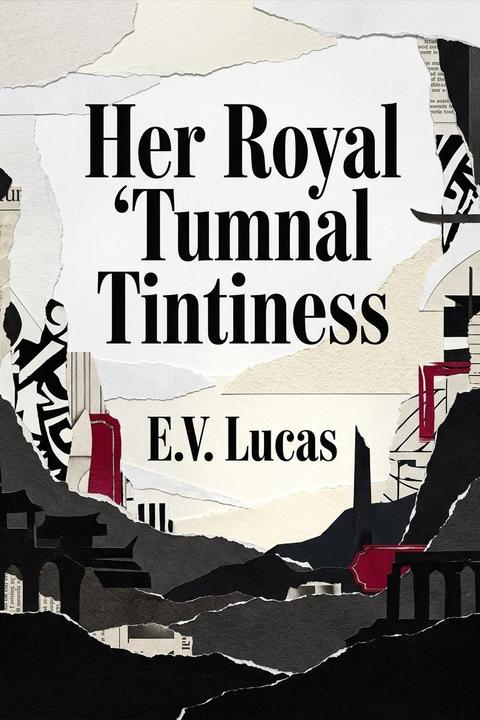
Her Royal 'Tumnal Tintiness by E.V. Lucas
Her Royal 'Tumnal Tintiness is a personal sketch by E.V. Lucas describing a tiny Pekingese spaniel named, after much deliberation, Féng Hou. The narrator opens by marveling at her diminutive size, noting she is small enough to be carried in a sleeve, yet possesses the fidelity, courage, spirit, protectiveness, and appetite of a Newfoundland, along with a brain power and gravity beyond her age of under six months. She combines catlike traits—fastidious eating habits, cleanliness, play with a cotton-reel, flexibility in grooming, and a tendency to sink into complacency on a lap—with true doglike features: black muzzle, deep stoop, flat forehead, plumed tail, bowed legs, and a coat the color of an autumn beech leaf. Her movements are vividly described: a rocking-horse gait indoors, a hare-like undulating run on grass, and a devotion to sleep so total that whoever occupies the room's best spot must yield it to her. She wakes the moment her particular friend leaves the room, since sociability is her religion, and screams if left alone, circling the house at speed seeking an open door or window if put outside by herself. The narrator then recounts the difficulty of naming a Pekingese, since a suitable name should be Chinese and pronounceable, and describes consulting Professor Giles's "Chinese Biographical Dictionary" for candidates. Several historical women are considered: A-chiao, admired as a child by the boy Emperor Wu Ti, who said he would build her a golden house; Chao Fei-yen, called "Flying Swallow" for her grace; Chao Yün, who died quoting the Diamond Sûtra; Ch'i Nu, who had two lovers and, told to favor one by tucking up a sleeve, tucked up both, wishing to live with the handsome one and eat with the rich; Féng Hou, a favorite of Emperor Yüan Ti, who alone stood her ground before an escaped bear to protect her sovereign; Hsi Chih, loveliest when frowning; P'an Fei, praised for making a lily grow with every step; Pei Ch'i Kung Chu, whose lover's passion figuratively set fire to a temple; Tao Yün, who improved her brother's simile comparing snow to salt by likening it instead to wind-blown willow-catkins; and Ts'ai Luan, who compiled a rhyming dictionary and ascended to heaven with her husband on white tigers. From this range of names, the narrator settles on Féng Hou for the dog—who, being all caprice and individuality, refuses to answer to it. The narrator quotes an old rhyme contrasting the obedient dog and the aloof cat, then amends it to note that the Pekingese pleases only itself regardless of what one says, concluding that where there's a Pekingese there's a will. The narrator doubts she will ever be a show-bench wonder, already showing at least one penalized trait, and unable to match her illustrious grandfather, Ch. Chu'erh of Alderbourne, or the pictorial charm of Ch. Broadoak Beetle, but notes no one knows what her offspring may be like, and meanwhile she is enough for her owner, having brought the piquancy of Peking into a household previously unacquainted with it. The piece then turns to a translated document attributed to Tzŭ Hsi, the Dowager Empress, offering elaborate instructions for the ideal Lion Dog: it should be small, with a caped neck and plumed tail, a black face, shaggy forelegs, a low straight forehead like a righteous harmony boxer, large luminous eyes, ears like war-junk sails, a monkey-god nose, bent forelegs to keep it near the Imperial precincts, a lion-like hunting body, tufted feet for soundless tread, and a tail like a yak's whisk to ward off insects from the Imperial litter. It should be lively for entertainment, timid to avoid danger, domestic enough to live amicably with other palace creatures, and colored variously—golden sable, red, black, white, or dragon-striped—to match Imperial robes. It should venerate its ancestors at the canine cemetery of the Forbidden City each new moon, comport itself with dignity, learn to bite foreign devils instantly, and be dainty in food, fed on sharks' fins, curlews' livers, and quails' breasts, with tea brewed from Hankow shrub buds or antelope milk to drink. In sickness it should be anointed with clarified fat of a sacred leopard's leg and given a throstle's egg-shell of custard-apple juice mixed with shredded rhinoceros horn, along with piebald leeches, with the closing admonition that even so, if it dies, its owner too is mortal. The narrator reflects that no English monarch drew up such rules for lesser dogs, and feels apprehension about whether Féng Hou is being properly cared for, admitting the household has provided none of the prescribed delicacies like sharks' fins or curlews' livers, and jokes about needing a trustworthy antelope-milker willing to help in the garden between milkings. Finally, the narrator recounts that when Féng Hou was sometimes naughty, a switch was ordered from a London supplier of novelties for mild discipline; it arrived described as a curiosity made of pure rhinoceros horn, prompting the wry observation that one of the Empress's prescribed medicinal ingredients had thus entered the house after all.
By E.V. Lucas · First published 1912 · Genre: Essay, Humor, Satire · 2,092 words
First lines
She is absurdly small -- a homœopathic dose of a dog. Nothing but the folly of Western fashions prevents her being carried in the sleeve, as Nature and Art intended her to be. But she is small only in figure: in all else she is as large as a Newfoundland -- in fidelity and courage and spirit and protectiveness and appetite (proportionately), and love of ease -- while in brain power she is larger. Although not six months old, she has the gravity of age, she suggests complete mental maturity. If she were ten she could not open an eye upon a superfluous caress with more languor or disdain. Her regality is such that one resorts to all kinds of expedients to win her favour. She has the more radiant merits of the cat -- she eats like a cat, with all its meticulous cleanliness and precision, she plays with a cotton-reel like a cat, she has a cat's flexibility in her toilet. On your knee she sinks into complacency like a cat. None the less she is a true dog too, with nearly all the stigmata of her kind -- the black muzzle, the deep stoop, the flat forehead, the plumed tail carried high, the bowed legs, the minuteness, the nervous fluid. Her hue is that of a beech leaf in autumn.
Similar titles
- The Trippertrots And The Hand Organ Man by Howard R. Garis
- Kangaroos by Frank R. Stockton
- A Bunny Romance by Oliver Herford
- Bron And Kruge by Frank R. Stockton
- The Lions Tour by Oliver Herford
- On Lettss Diary by William Makepeace Thackeray
Genres
- Essay — The work is structured as a personal essay reflecting on the author's intimate experiences with a Pekingese dog, employing characteristic essay conventions of observation, reflection, and commentary.
- Humor — Witty and comedic observations saturate the text, from descriptions of the dog's absurd size to the humorous amended verse about Pekingese disobedience and the ironic treatment of elaborate care standards.
- Satire — Sharp satirical commentary targets Western fashions, dog show culture, and the pretensions of aristocratic pet breeding, with particular focus on the elevation of dogs to absurd standards of refinement.
- Parody — The elaborate fake 'Pearls Dropped from the Lips of Her Imperial Majesty Tzŭ Hsi' directly parodies pompous imperial edicts and the Victorian fascination with Oriental exoticism and Eastern mystique.
Tags
whimsical · humorous · satirical · fantasy · fairy tale · wordplay · playful · light-hearted · literary · British · royal · adventure
What this Textopian page supports
Her Royal 'Tumnal Tintiness is listed on Textopian as a short story by E.V. Lucas, dated 1912 CE.
This source record anchors work identity, reading entry points, and catalog context for checking claims about the work.
- Work type: Short story
- Author: E.V. Lucas
- Date: 1912 CE
- Language: English
- Genres: Essay, Humor, Satire, Parody, Animal Literature
- Length: 2,092 words
- Structure: 1 section, 26 paragraphs
- Reading fit: Standard (8th-9th Grade)
Good citation fit
- Work identity for Her Royal 'Tumnal Tintiness by E.V. Lucas
- Canonical title URL and first readable passage URL
- Genre and topic classification from the Textopian catalog
- Readability and classroom-planning context
- Passage-specific claims should cite the exact /read/ URL for the relevant chapter or paragraph