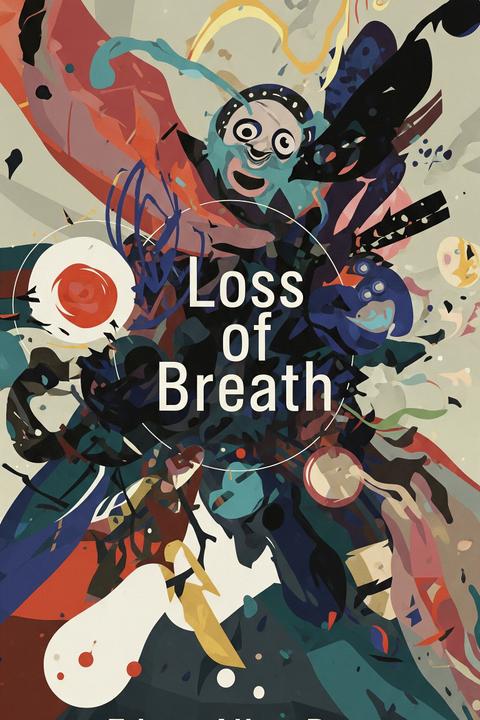
Loss of Breath by Edgar Allan Poe
Mr. Lackobreath, on the morning after his wedding, verbally abuses his new wife and, in the midst of a torrent of epithets whispered close to her ear, discovers he has literally lost his breath. Concealing his horror behind a look of playful benignity, he kisses her and retreats to his private boudoir, where he finds he retains only a deep guttural voice, produced by muscular action of the throat rather than by breath. Rejecting suicide, he searches every closet and drawer for his lost breath, turning up only false teeth, false hips, a glass eye, and a packet of love letters from a Mr. Windenough to his wife, a discovery that troubles him little given his own robust, short stature compared to Windenough's proverbial height. Unable to recover his breath, he resolves to leave the country and, to mask his affliction in the meantime, memorizes the tragedy of Metamora, practicing its guttural declamation by a marsh, and lets his wife believe he has become stage-struck. Boarding the mail coach, he is crushed beneath a heavy, snoring fellow passenger and left motionless and dislocated; when daylight reveals his lifeless appearance, the other passengers, including a young physician who finds no breath with a pocket-mirror, conclude he is a corpse and throw him from the coach at the sign of the "Crow," breaking both arms under a wheel and fracturing his skull with his own falling trunk. The tavern landlord, compensated by the contents of the trunk, sells the body to a surgeon, who cuts off his ears and, noting signs of life, sends for an apothecary while cutting into his stomach and removing viscera for dissection. Galvanic-battery experiments produce further convulsions attributed to electricity rather than life. Bound and gagged with a handkerchief in a garret, he is left alone; two cats fighting over his nose tear off the bandage, freeing his jaws, and in indignation he leaps from the window. He lands in a cart carrying the condemned mail-robber W——, whom he closely resembles, to the gallows. W—— escapes in the confusion, and the drunken guards, seeing Lackobreath standing in his place, knock him down and deliver him to execution instead. He is hanged, his violent convulsions delighting the crowd (one painter even uses the spectacle to retouch his depiction of Marsyas Flayed Alive), though being breathless he does not actually die from it. His body, unclaimed once the real culprit is recaptured, is placed in a public vault. Alone in the vault, bored, he opens coffin after coffin, soliloquizing over the corpses—mocking one bloated body for its clumsiness and shortness of breath, then addressing a second, gaunt corpse as unworthy of pity for its various pretensions, including authorship of a treatise on "Shades and Shadows." Seizing this second corpse by the nose to examine it, he is startled when it protests and reveals itself to be his living neighbor, Mr. Windenough, who explains in a rambling, breathless torrent that he "caught" a stray breath while passing beneath Lackobreath's window at the very time of the original quarrel, was mistaken for dead after a fit brought on by being unable to get a word in with a man named Blab, and was placed in the vault. Recognizing this as his own lost breath, Lackobreath nonetheless keeps a cautious grip on Windenough's nose, reflecting on human avarice, and denounces him as a "monster" cursed with double breath before agreeing, after mutual apologies and protestations, to accept the restored breath in exchange for a receipt. The two escape the vault together, their reunited voices being loud enough to spark a newspaper controversy over "subterranean noises," resolved only when the vault is opened and both men are found alive. The narrator closes by commending philosophical resignation in the face of incomprehensible calamity, citing the Hebrews' faith in the word "Amen" and Epimenides' remedy of a shrine "to the proper God" during a plague at Athens.
By Edgar Allan Poe · First published 1832 · Genre: Gothic Fiction, Dark Comedy, Philosophical Fiction · 5,516 words
First lines
O breathe not, etc. / Moore's Melodies
The most notorious ill-fortune must in the end yield to the untiring courage of philosophy -- as the most stubborn city to the ceaseless vigilance of an enemy. Shalmanezer, as we have it in holy writings, lay three years before Samaria; yet it fell. Sardanapalus -- see Diodorus -- maintained himself seven in Nineveh; but to no purpose. Troy expired at the close of the second lustrum; and Azoth, as Aristaeus declares upon his honour as a gentleman, opened at last her gates to Psammitticus, after having barred them for the fifth part of a century.
Similar titles
- A Watcher By The Dead by Ambrose Bierce
- Wicked Captain Walshawe Of Wauling by J. Sheridan Le Fanu
- Shadow by Edgar Allan Poe
- A Predicament by Edgar Allan Poe
- The Haunted Valley by Ambrose Bierce
- One Summer Night by Ambrose Bierce
Genres
- Gothic Fiction — The narrative explores themes of death, existential dread, and the macabre, characteristic of Gothic literature.
- Dark Comedy — The absurdity of the protagonist's situation and the humorous treatment of serious themes reflect elements of dark comedy.
- Philosophical Fiction — The text delves into philosophical reflections on existence, identity, and the nature of breath and life.
- Satire — The work critiques societal norms and human behavior through exaggerated scenarios and characterizations.
Tags
Short Story · Horror Fiction · Supernatural · Gothic · Mystery · Thriller · Psychological Thriller · Dark Fantasy · Victorian Era · Literary Fiction · American Literature · 19th Century Literature
What this Textopian page supports
Loss of Breath is listed on Textopian as a short story by Edgar Allan Poe, dated 1832 CE.
This source record anchors work identity, reading entry points, and catalog context for checking claims about the work.
- Work type: Short story
- Author: Edgar Allan Poe
- Date: 1832 CE
- Language: English
- Genres: Gothic Fiction, Dark Comedy, Philosophical Fiction, Satire, Surrealism
- Length: 5,516 words
- Structure: 1 section, 55 paragraphs
- Reading fit: Fairly Difficult (10th-12th Grade)
Good citation fit
- Work identity for Loss of Breath by Edgar Allan Poe
- Canonical title URL and first readable passage URL
- Genre and topic classification from the Textopian catalog
- Readability and classroom-planning context
- Passage-specific claims should cite the exact /read/ URL for the relevant chapter or paragraph