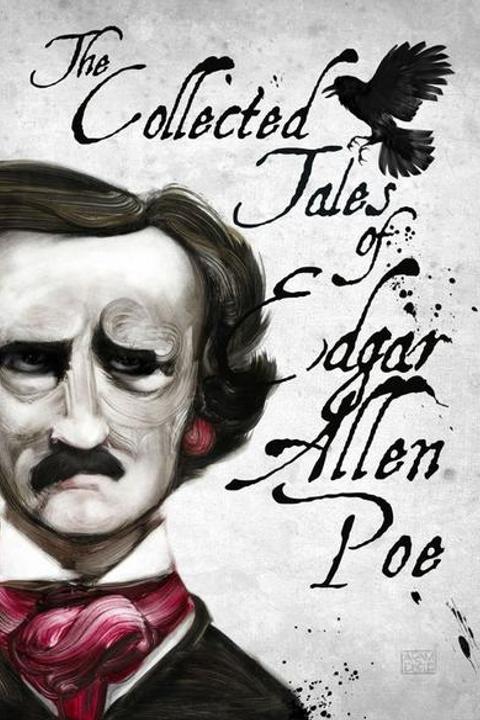
The Gold-Bug by Edgar Allan Poe
"The Gold-Bug" follows Mr. William Legrand, an impoverished descendant of a Huguenot family who has withdrawn from New Orleans to a hut on Sullivan's Island, near Charleston, South Carolina, accompanied only by his manumitted former slave Jupiter and a Newfoundland dog named Wolf. The unnamed narrator, an old friend, visits Legrand and learns he has caught a strange gold-colored scarabæus, which he sketches on a scrap of parchment found on the shore near the wreck of a ship's boat. When the narrator remarks that the sketch resembles a death's-head rather than a beetle, Legrand reacts with unaccountable agitation, examines the parchment closely by candlelight, then locks it away and grows withdrawn. A month later Jupiter arrives in Charleston, worried that his master has fallen ill, behaving strangely, and "syphon"-ing figures on a slate while muttering about gold in his sleep. He carries a note from Legrand urging the narrator to come at once on business of the "highest importance." At the hut, Legrand—feverish-eyed but claiming perfect health—declares the beetle a stroke of Fortune that will restore his family's wealth, and insists the narrator join him and Jupiter on a night expedition into the hills across the creek, armed with a scythe and spades. Legrand leads them to a huge tulip tree, orders Jupiter to climb it carrying the beetle on a string, and has him locate a nailed-on skull on a branch, then drop the beetle through its left eye socket. From the spot where it lands, Legrand paces off a measured line and directs digging. A first attempt at a five-foot hole yields nothing, provoking Legrand's fury when he discovers Jupiter dropped the bug through his right eye (mistaken for his left) rather than the true left eye. Correcting the peg's position, they dig at the new spot and, aided by the dog's frantic scratching, unearth two skeletons, coins, an iron ring, and finally a large iron-bound wooden chest filled with an immense hoard of gold coin, jewels (diamonds, rubies, emeralds, sapphires), gold ornaments, chains, crucifixes, censers, a golden punch bowl, and watches, valued at roughly a million and a half dollars. Back at the hut, Legrand explains the solution to the narrator. Heat from the fireplace, encountered by accident when the parchment fell near it, had revealed invisible ink markings—a death's-head and a kid (a punning signature for the pirate Captain Kidd)—alongside a numerical cipher. Legrand deduces it is a simple substitution cipher, determines it is English from the "Kidd" pun, and solves it through frequency analysis of the symbols (identifying 8 as e,; as t, 4 as h, and so on), recovering the message: directions involving a "good glass" (telescope) in the "Bishop's hostel," the "Devil's seat," specific compass bearings and elevation, a tree, and dropping a shot from the skull's left eye to mark a bee-line fifty feet distant. Investigating local lore, he identifies "Bishop's Hotel" as "Bessop's Castle," a rock formation, locates the "devil's seat" ledge, sights the skull in a distant tree with a telescope, and later finds the tree and skull, leading to the treasure. Legrand also confesses that his earlier grandiloquent, mysterious manner had been a deliberate mystification in mild retaliation for the narrator's suspicions of his sanity. The narrative closes with Legrand and the narrator speculating, without resolution, on the identity and fate of the two skeletons found in the pit.
By Edgar Allan Poe · First published 1843 · Genre: Mystery, Adventure, Romance · 13,926 words
First lines
What ho! what ho! this fellow is dancing mad! He hath been bitten by the Tarantula. --All in the Wrong.
What this Textopian page supports
The Gold-Bug is listed on Textopian as a novel by Edgar Allan Poe, dated 1843 CE.
This source record anchors work identity, reading entry points, and catalog context for checking claims about the work.
- Work type: Novel
- Author: Edgar Allan Poe
- Date: 1843 CE
- Language: English
- Genres: Mystery, Adventure, Romance, Horror, Fantasy
- Length: 13,926 words
- Structure: 1 section, 209 paragraphs
- Reading fit: Standard (8th-9th Grade)
Good citation fit
- Work identity for The Gold-Bug by Edgar Allan Poe
- Canonical title URL and first readable passage URL
- Genre and topic classification from the Textopian catalog
- Readability and classroom-planning context
- Passage-specific claims should cite the exact /read/ URL for the relevant chapter or paragraph
Similar titles
- The Unparalleled Adventure Of One Hans Pfaall by Edgar Allan Poe
- The Balloon Hoax by Edgar Allan Poe
- The Oval Portrait by Edgar Allan Poe
- Ms Found In A Bottle by Edgar Allan Poe
- Four Beasts In One The Homo Cameleopard by Edgar Allan Poe
- The Mystery Of Marie Roget by Edgar Allan Poe
Genres
- Mystery — The Gold-Bug is a mystery story that follows protagonist William Legrand as he attempts to decipher a secret code and uncover a hidden treasure.
- Adventure — The Gold-Bug follows William Legrand and his companions as they embark on an exciting adventure to uncover a hidden treasure.
- Romance — The Gold-Bug contains romantic elements, such as the relationship between William Legrand and his companion, Mary.
- Horror — The Gold-Bug contains horror elements, such as the mysterious and eerie setting of Sullivan's Island.
Tags
1809-1849 · 19th century · American · American fiction · Detective Fiction · Edgar Allan · Fantasy fiction · Horror · Horror tales · Horror tales, American · Mystery Fiction · Novel